Pennington T H, Pringle C R, McCrae M A
J Virol. 1977 Oct;24(1):397-400. doi: 10.1128/JVI.24.1.397-400.1977.
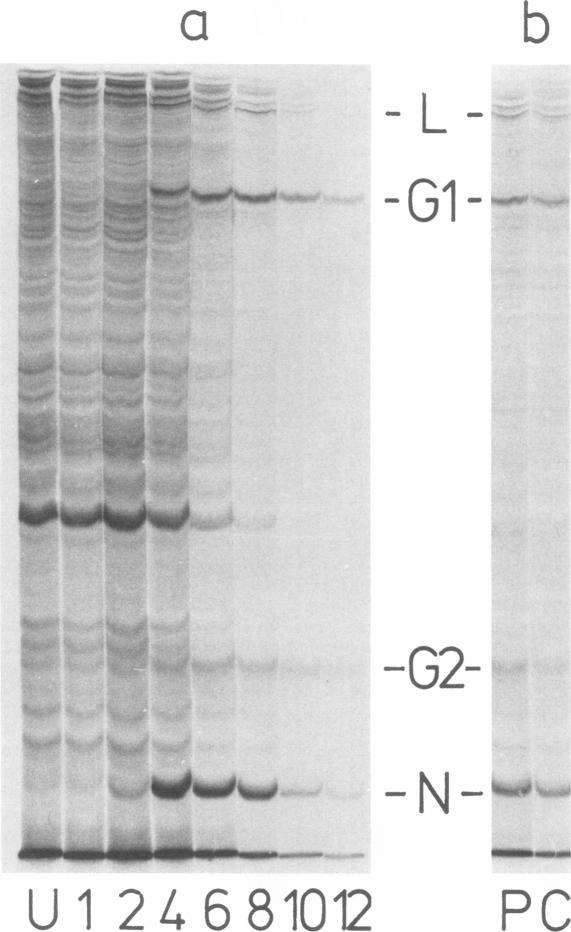
Bunyamwera virus-induced polypeptide synthesis in BSC-1 cell has been studied using polyacrylamide gel electrophoresis and autoradiography. Four virus-induced polypeptides were identified. Their molecular weights were 200 X 10(6) (L), 128 X 10(6) (G1), 31 X 10(6) (G2), and 23 X 10(6) (N). Pulse-chase experiments, short labeling experiments, and experiments using amino acid analogs failed to show evidence of polypeptides processing by proteolytic cleavage. Analysis of the kinetics of synthesis of these polypeptides showed that a clear division into early and late categories could be made, the onset of synthesis of polypeptide N and L rapidly reached a peak and then declined. Polypeptides G1 and G2 were made for several hours; their rate of synthesis then declined. All four polypeptides then continued to be made in relatively small amounts for many hours.
利用聚丙烯酰胺凝胶电泳和放射自显影技术,对布尼亚姆韦拉病毒在BSC - 1细胞中诱导的多肽合成进行了研究。鉴定出四种病毒诱导的多肽。它们的分子量分别为200×10⁶(L)、128×10⁶(G1)、31×10⁶(G2)和23×10⁶(N)。脉冲追踪实验、短时间标记实验以及使用氨基酸类似物的实验均未显示出多肽经蛋白水解切割加工的证据。对这些多肽合成动力学的分析表明,可以明确分为早期和晚期两类,多肽N和L的合成起始迅速达到峰值,然后下降。多肽G1和G2合成数小时;其合成速率随后下降。之后,所有四种多肽在数小时内持续以相对少量合成。