Berg D J, Lynch N A, Lynch R G, Lauricella D M
Department of Internal Medicine, University of Iowa College of Medicine, Iowa City 52242, USA.
Am J Pathol. 1998 May;152(5):1377-86.
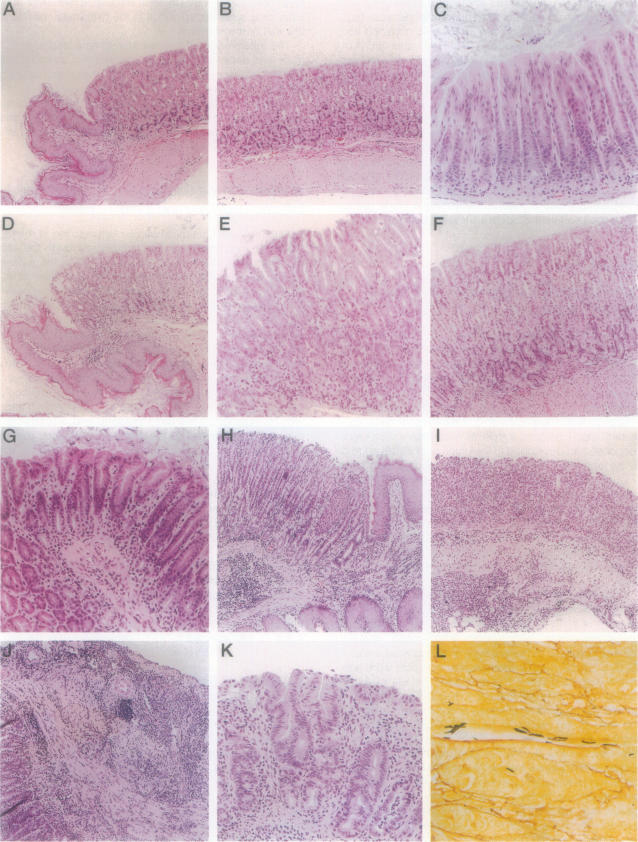
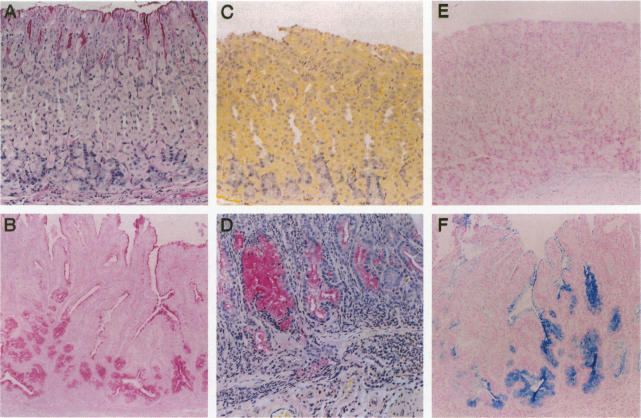
Interleukin (IL)-10 is a potent anti-inflammatory and immune-regulatory cytokine. Mice deficient in IL-10 production (IL-10(-/-)) develop a spontaneous inflammatory bowel disease, indicating that IL-10 is an important regulator of the mucosal immune response in vivo. To study the role of IL-10 in the host response to gastric Helicobacter infection, stomachs of IL-10(-/-) and wild-type mice were colonized with Helicobacter felis, as a model of human H. pylori infection. Within 4 weeks of H. felis infection, wild-type mice develop a mild, focal chronic gastritis. In contrast, H. felis-infected IL-10(-/-) mice develop a severe hyperplastic gastritis, characterized by a dense, predominantly mononuclear cell inflammation of the mucosa and submucosa and epithelial cell proliferation and dedifferentiation. Within 4 weeks of H. felis infection, there are striking alterations in the character of the gastric epithelium from IL-10(-/-) mice, including a profound loss of parietal and chief cells, focal de novo production of acidic mucins, and marked epithelial proliferation with disordered epithelial architecture. These findings indicate that, in the absence of IL-10, the inflammatory and immunological responses of the murine host to gastric colonization with Helicobacter is a rapidly evolving pathological process with features that mimic those associated with H. pylori infection in humans. H. felis-infected IL-10(-/-) mice may provide a model with which to investigate the cellular and molecular changes that stem from gastric infection with H. pylori.
白细胞介素(IL)-10是一种强效的抗炎和免疫调节细胞因子。缺乏IL-10产生的小鼠(IL-10(-/-))会发生自发性炎症性肠病,这表明IL-10是体内黏膜免疫反应的重要调节因子。为了研究IL-10在宿主对胃幽门螺杆菌感染反应中的作用,将猫幽门螺杆菌定殖于IL-10(-/-)小鼠和野生型小鼠的胃中,作为人类幽门螺杆菌感染的模型。在感染猫幽门螺杆菌的4周内,野生型小鼠会发生轻度的局灶性慢性胃炎。相比之下,感染猫幽门螺杆菌的IL-10(-/-)小鼠会发生严重的增生性胃炎,其特征为黏膜和黏膜下层出现密集的、以单核细胞为主的炎症以及上皮细胞增殖和去分化。在感染猫幽门螺杆菌的4周内,IL-10(-/-)小鼠的胃上皮特征发生了显著改变,包括壁细胞和主细胞大量丧失、局灶性新产生酸性黏蛋白以及上皮明显增殖且上皮结构紊乱。这些发现表明,在缺乏IL-10的情况下,小鼠宿主对胃幽门螺杆菌定殖的炎症和免疫反应是一个快速演变的病理过程,其特征类似于人类幽门螺杆菌感染相关的特征。感染猫幽门螺杆菌的IL-10(-/-)小鼠可能提供了一个模型,用于研究由幽门螺杆菌胃感染引发的细胞和分子变化。