Harding L E, Harris M L, Stephen C R, Elliott J E
Pacific Wildlife Research Centre, Canadian Wildlife Service, Environment Canada, Delta, British Columbia, Canada V4K 3N2.
Environ Health Perspect. 1999 Feb;107(2):141-7. doi: 10.1289/ehp.99107141.
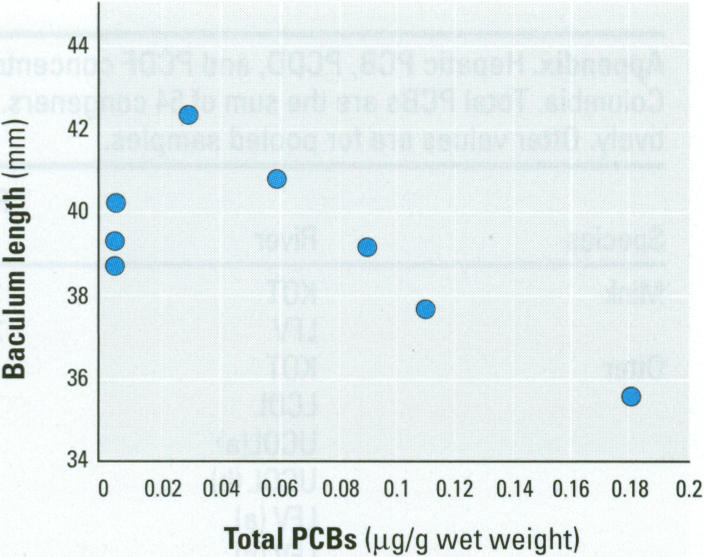
We assessed chlorinated hydrocarbon contamination of mink and river otters on the Columbia and Fraser River systems of northwestern North America, in relation to morphological measures of condition. We obtained carcasses of mink and river otters from commercial trappers during the winters 1994-1995 and 1995-1996. Necropsies included evaluation of the following biological parameters: sex, body mass and length, age, thymus, heart, liver, lung, spleen, pancreas, kidney, gonad, omentum, adrenal gland and baculum masses, baculum length, and stomach contents. Livers were analyzed, individually or in pools, for residues of organochlorine (OC) pesticides, polychlorinated biphenyls (PCBs), dibenzo-p-dioxins, and dibenzofurans. Contaminant levels were relatively low compared to those documented in other North American populations, although they ranged higher than those detected during an earlier survey (1990-1992) of these regional populations. Body condition varied slightly among collection regions, but showed no relationship with contaminant burden. Mink from the upper Fraser River had less fat stores and also had some of the lowest OC contamination levels observed. Similarly, a few individuals with enlarged livers and kidneys had low contaminant levels. Although a few individual animals with gross abnormalities of reproductive systems did not show high levels of contamination, there was a significant negative correlation between total PCB concentrations (as Aroclor 1260) and baculum length in juvenile mink (r = 0.707; p = 0.033; n = 8). The association of juvenile baculum length with eventual reproductive success is unknown, but further characterization of reproductive organ morphology and relationship to contaminants should be undertaken in a larger subset of these populations.
我们评估了北美西北部哥伦比亚河和弗雷泽河系统中貂和水獭的氯代烃污染情况,并将其与身体状况的形态学指标进行关联分析。我们于1994 - 1995年冬季和1995 - 1996年冬季从商业捕猎者处获取了貂和水獭的尸体。尸检包括对以下生物学参数的评估:性别、体重和体长、年龄、胸腺、心脏、肝脏、肺、脾脏、胰腺、肾脏、性腺、网膜、肾上腺和阴茎骨质量、阴茎骨长度以及胃内容物。对肝脏进行单独或混合分析,检测有机氯(OC)农药、多氯联苯(PCBs)、二苯并 - p - 二恶英和二苯并呋喃的残留量。与北美其他种群记录的污染水平相比,这些污染物水平相对较低,尽管它们高于对这些区域种群早期调查(1990 - 1992年)中检测到的水平。身体状况在不同采集区域略有差异,但与污染物负荷无关。弗雷泽河上游的貂脂肪储备较少,且有机氯污染水平也是观察到的最低水平之一。同样,一些肝脏和肾脏肿大的个体污染物水平较低。尽管少数生殖系统有明显异常的个体并未表现出高污染水平,但幼年貂体内总多氯联苯浓度(以Aroclor 1260计)与阴茎骨长度之间存在显著负相关(r = 0.707;p = 0.033;n = 8)。幼年貂阴茎骨长度与最终繁殖成功率之间的关联尚不清楚,但应对这些种群中更大的子集进行生殖器官形态及其与污染物关系的进一步特征分析。