Maddox P, Chin E, Mallavarapu A, Yeh E, Salmon E D, Bloom K
Department of Biology, University of North Carolina, Chapel Hill, North Carolina 27599-3280, USA.
J Cell Biol. 1999 Mar 8;144(5):977-87. doi: 10.1083/jcb.144.5.977.
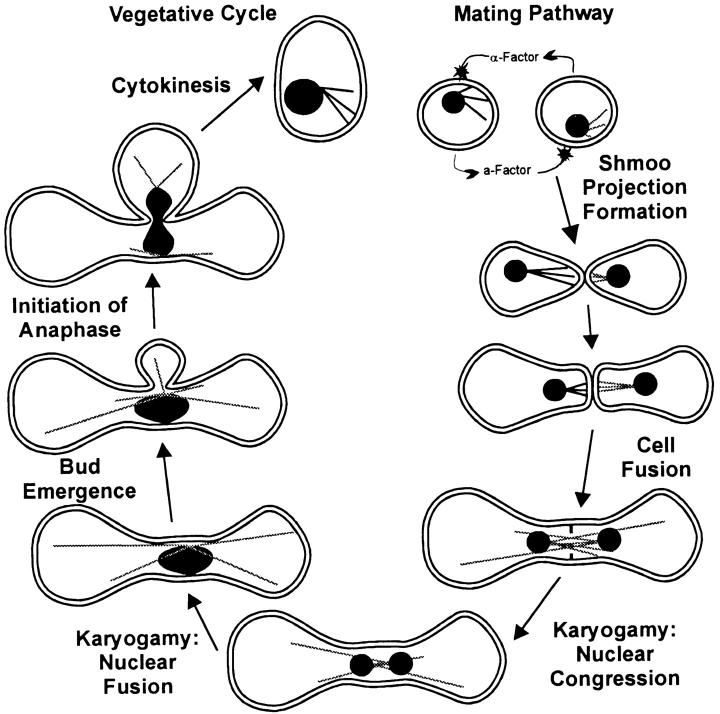
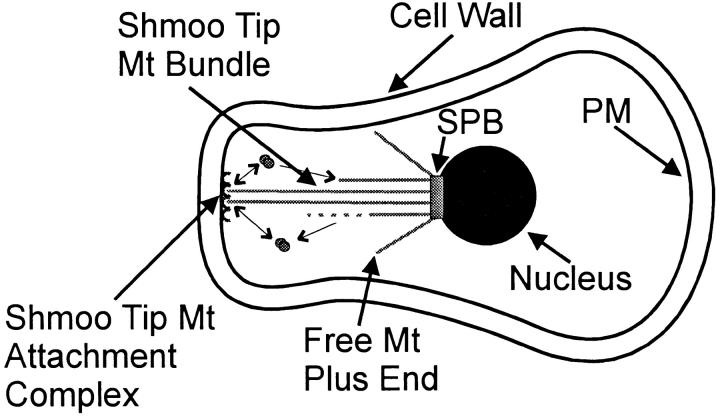
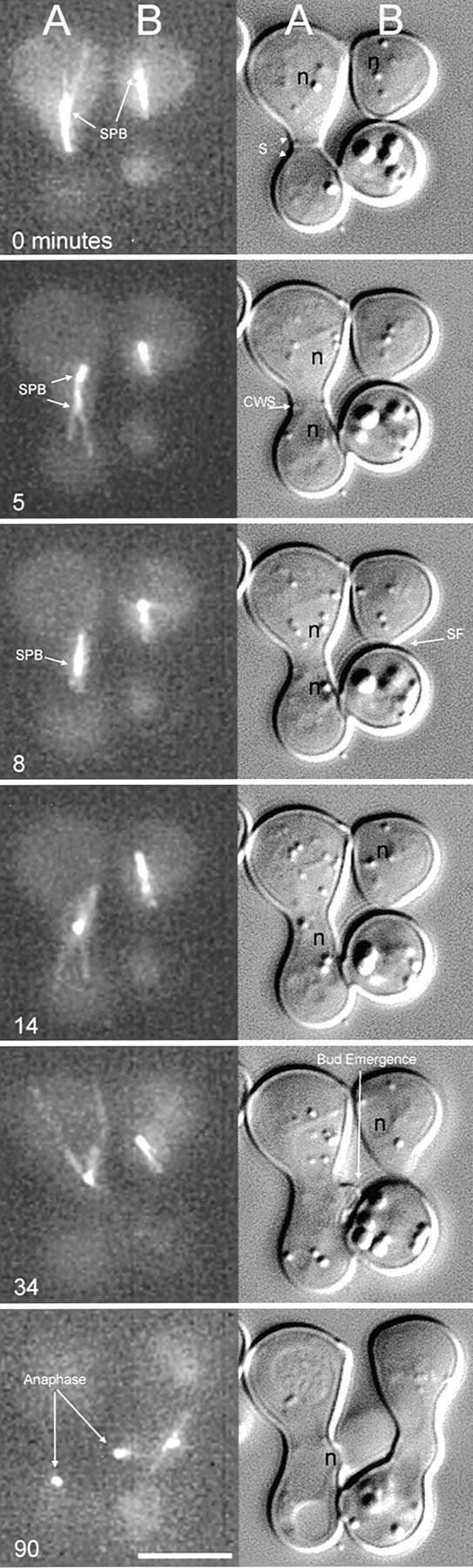
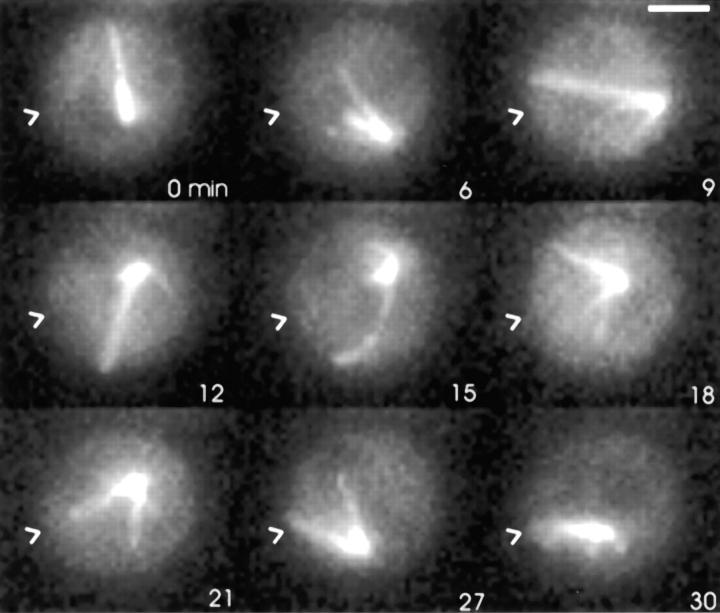
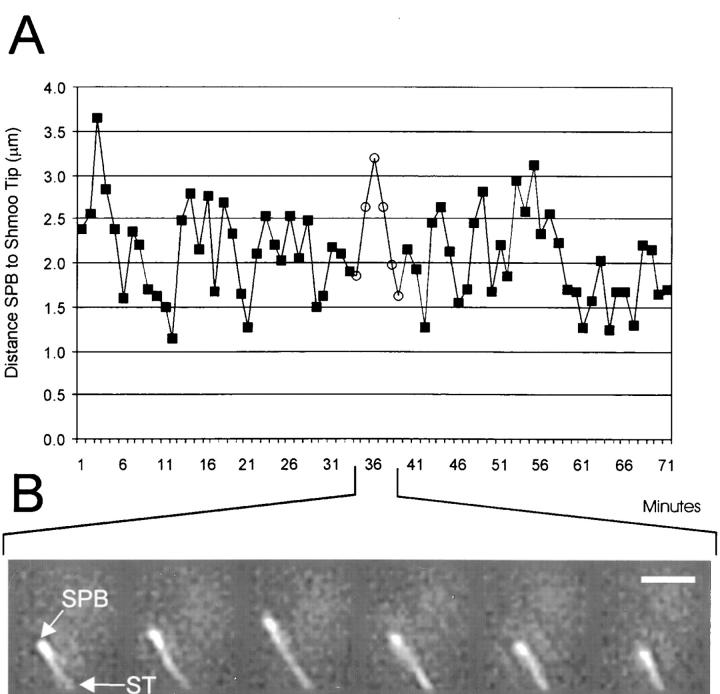
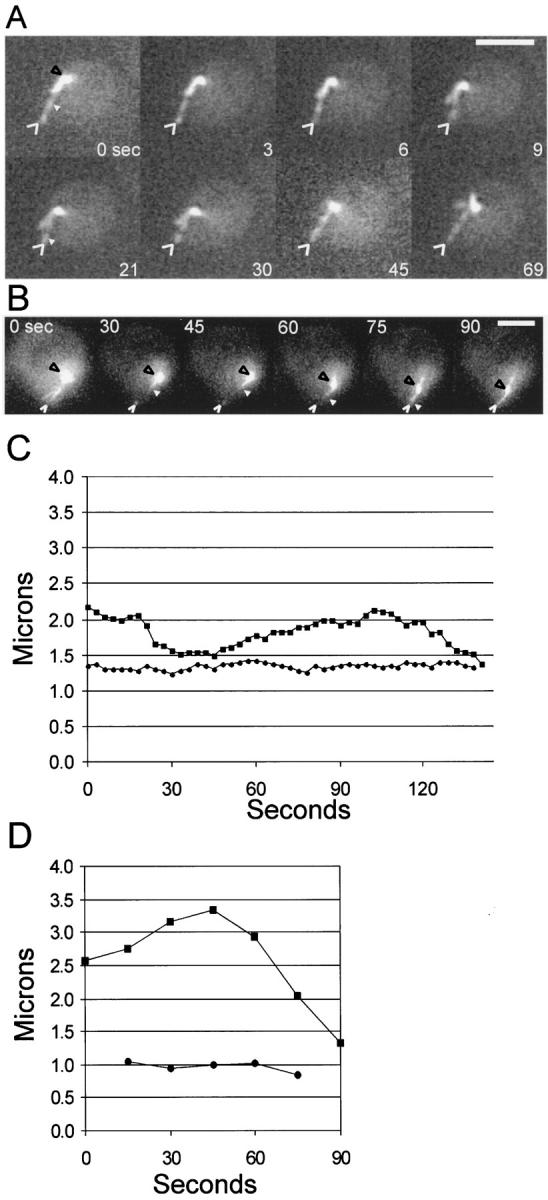
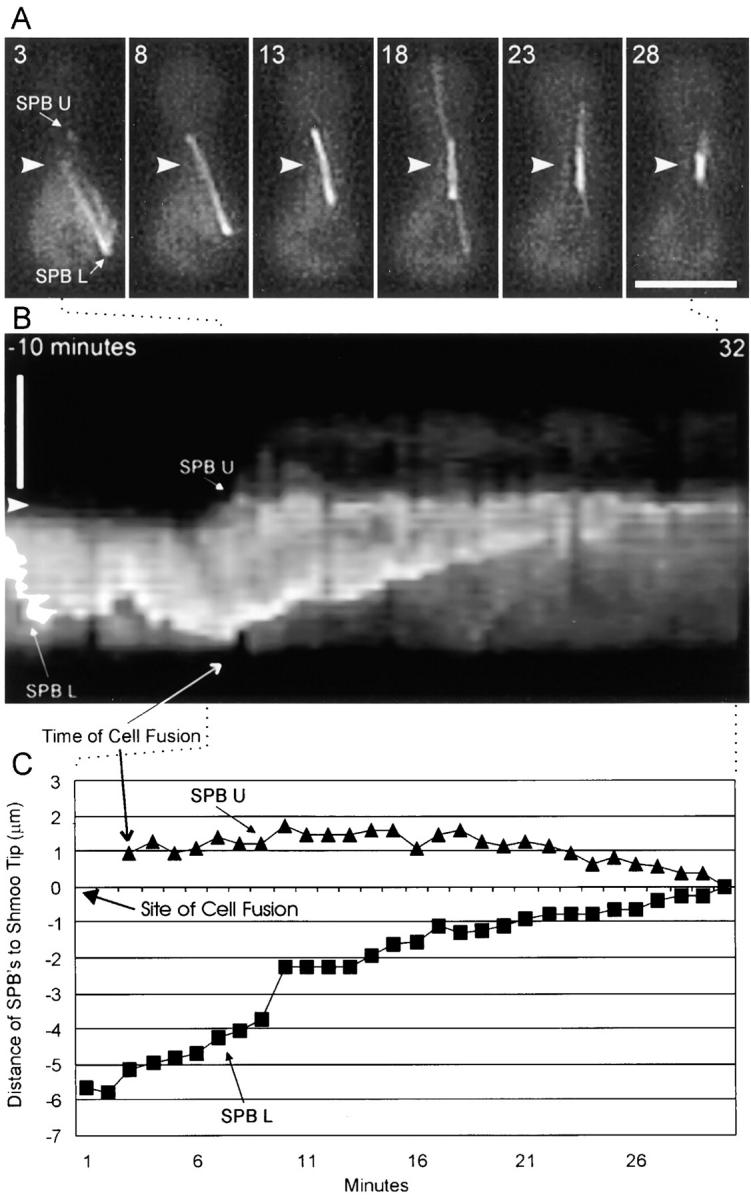
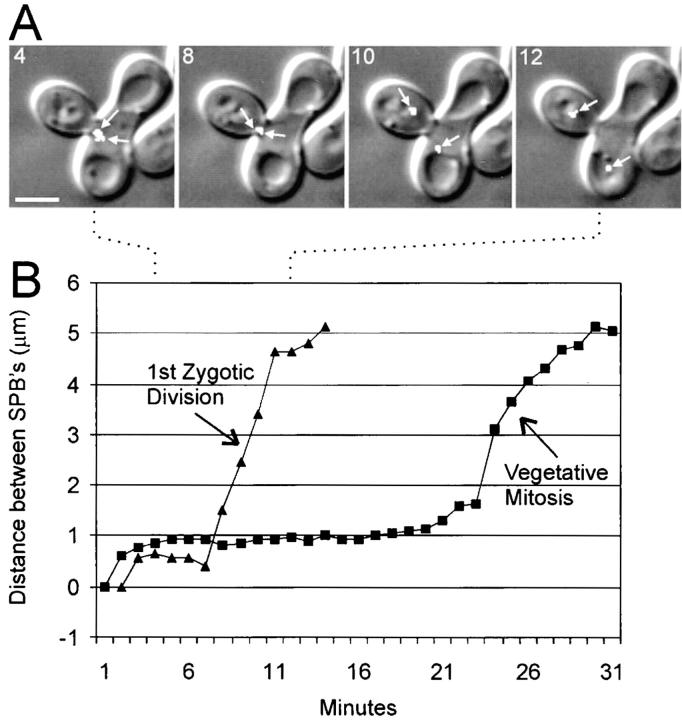
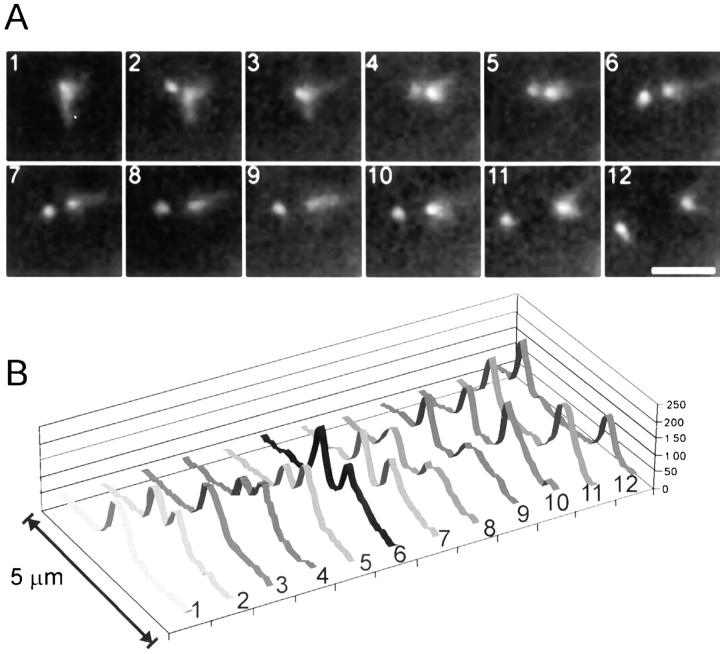
We have used time-lapse digital imaging microscopy to examine cytoplasmic astral microtubules (Mts) and spindle dynamics during the mating pathway in budding yeast Saccharomyces cerevisiae. Mating begins when two cells of opposite mating type come into proximity. The cells arrest in the G1 phase of the cell cycle and grow a projection towards one another forming a shmoo projection. Imaging of microtubule dynamics with green fluorescent protein (GFP) fusions to dynein or tubulin revealed that the nucleus and spindle pole body (SPB) became oriented and tethered to the shmoo tip by a Mt-dependent search and capture mechanism. Dynamically unstable astral Mts were captured at the shmoo tip forming a bundle of three or four astral Mts. This bundle changed length as the tethered nucleus and SPB oscillated toward and away from the shmoo tip at growth and shortening velocities typical of free plus end astral Mts (approximately 0.5 micrometer/min). Fluorescent fiduciary marks in Mt bundles showed that Mt growth and shortening occurred primarily at the shmoo tip, not the SPB. This indicates that Mt plus end assembly/disassembly was coupled to pushing and pulling of the nucleus. Upon cell fusion, a fluorescent bar of Mts was formed between the two shmoo tip bundles, which slowly shortened (0.23 +/- 0.07 micrometer/min) as the two nuclei and their SPBs came together and fused (karyogamy). Bud emergence occurred adjacent to the fused SPB approximately 30 min after SPB fusion. During the first mitosis, the SPBs separated as the spindle elongated at a constant velocity (0.75 micrometer/min) into the zygotic bud. There was no indication of a temporal delay at the 2-micrometer stage of spindle morphogenesis or a lag in Mt nucleation by replicated SPBs as occurs in vegetative mitosis implying a lack of normal checkpoints. Thus, the shmoo tip appears to be a new model system for studying Mt plus end dynamic attachments and much like higher eukaryotes, the first mitosis after haploid cell fusion in budding yeast may forgo cell cycle checkpoints present in vegetative mitosis.
我们利用延时数字成像显微镜来检测出芽酵母酿酒酵母交配途径中细胞质星状微管(Mts)和纺锤体的动态变化。当两种不同交配型的细胞靠近时,交配开始。细胞停滞在细胞周期的G1期,并向彼此生长出一个突起,形成一个“shmoo”突起。用与动力蛋白或微管蛋白融合的绿色荧光蛋白(GFP)对微管动态进行成像显示,细胞核和纺锤体极体(SPB)通过一种依赖微管的搜索和捕获机制定向并系附于“shmoo”尖端。动态不稳定的星状微管在“shmoo”尖端被捕获,形成一束三到四根星状微管。随着系附的细胞核和SPB以自由正端星状微管典型的生长和缩短速度(约0.5微米/分钟)朝向和远离“shmoo”尖端振荡,这束微管的长度发生变化。微管束中的荧光基准标记显示,微管的生长和缩短主要发生在“shmoo”尖端,而非SPB。这表明微管正端的组装/拆卸与细胞核的推拉作用相关联。细胞融合时,在两个“shmoo”尖端束之间形成了一条微管荧光带,随着两个细胞核及其SPB聚集并融合(核融合),这条荧光带缓慢缩短(0.23±0.07微米/分钟)。在SPB融合后约30分钟,芽在融合的SPB附近出现。在第一次有丝分裂期间,随着纺锤体以恒定速度(0.75微米/分钟)伸长进入合子芽,SPB分离。在纺锤体形态发生的2微米阶段没有时间延迟的迹象,也没有像在营养性有丝分裂中那样复制的SPB在微管成核方面的滞后,这意味着缺乏正常的检查点。因此,“shmoo”尖端似乎是研究微管正端动态附着的一个新模型系统,并且与高等真核生物很相似,出芽酵母单倍体细胞融合后的第一次有丝分裂可能会放弃营养性有丝分裂中存在的细胞周期检查点。