Wright S D, Burton C, Hernandez M, Hassing H, Montenegro J, Mundt S, Patel S, Card D J, Hermanowski-Vosatka A, Bergstrom J D, Sparrow C P, Detmers P A, Chao Y S
Department of Lipid Biochemsitry, Merck Research Laboratories, Rahway, New Jersey 07065, USA.
J Exp Med. 2000 Apr 17;191(8):1437-42. doi: 10.1084/jem.191.8.1437.
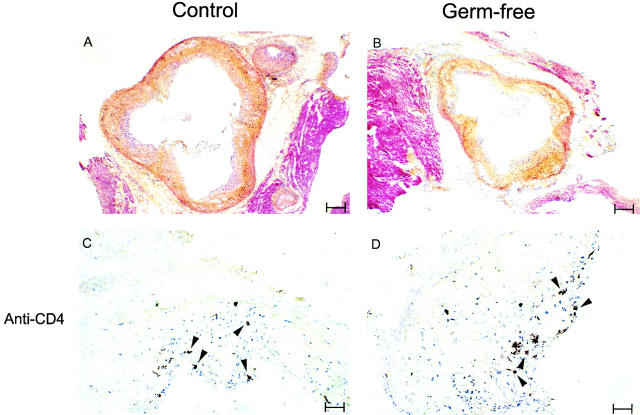
Recent work has revealed correlations between bacterial or viral infections and atherosclerotic disease. One particular bacterium, Chlamydia pneumoniae, has been observed at high frequency in human atherosclerotic lesions, prompting the hypothesis that infectious agents may be necessary for the initiation or progression of atherosclerosis. To determine if responses to gram-negative bacteria are necessary for atherogenesis, we first bred atherosclerosis-prone apolipoprotein (apo) E(-/)- (deficient) mice with animals incapable of responding to bacterial lipopolysaccharide. Atherogenesis was unaffected in doubly deficient animals. We further tested the role of infectious agents by creating a colony of germ-free apo E(-/)- mice. These animals are free of all microbial agents (bacterial, viral, and fungal). Atherosclerosis in germ-free animals was not measurably different from that in animals raised with ambient levels of microbial challenge. These studies show that infection is not necessary for murine atherosclerosis and that, unlike peptic ulcer, Koch's postulates cannot be fulfilled for any infectious agent in atherosclerosis.
近期的研究揭示了细菌或病毒感染与动脉粥样硬化疾病之间的关联。一种特殊的细菌,肺炎衣原体,在人类动脉粥样硬化病变中被高频观察到,这促使人们提出假说,即感染因子可能是动脉粥样硬化起始或进展所必需的。为了确定对革兰氏阴性菌的反应是否是动脉粥样硬化发生所必需的,我们首先将易患动脉粥样硬化的载脂蛋白(apo)E基因敲除(缺陷)小鼠与无法对细菌脂多糖作出反应的动物进行杂交。在双缺陷动物中,动脉粥样硬化的发生未受影响。我们通过培育无菌的apo E基因敲除小鼠群体进一步测试了感染因子的作用。这些动物没有任何微生物因子(细菌、病毒和真菌)。无菌动物的动脉粥样硬化与在有环境水平微生物挑战的情况下饲养的动物相比,没有明显差异。这些研究表明,感染对于小鼠动脉粥样硬化并非必需,并且与消化性溃疡不同,对于动脉粥样硬化中的任何感染因子,科赫法则都无法得到满足。