Bryant Julie, Wang Heiman, Cabezas Cesar, Ramirez Gladys, Watts Douglas, Russell Kevin, Barrett Alan
University of Texas Medical Branch, Galveston, Texas 77555-0609, USA.
Emerg Infect Dis. 2003 Aug;9(8):926-33. doi: 10.3201/eid0908.030075.
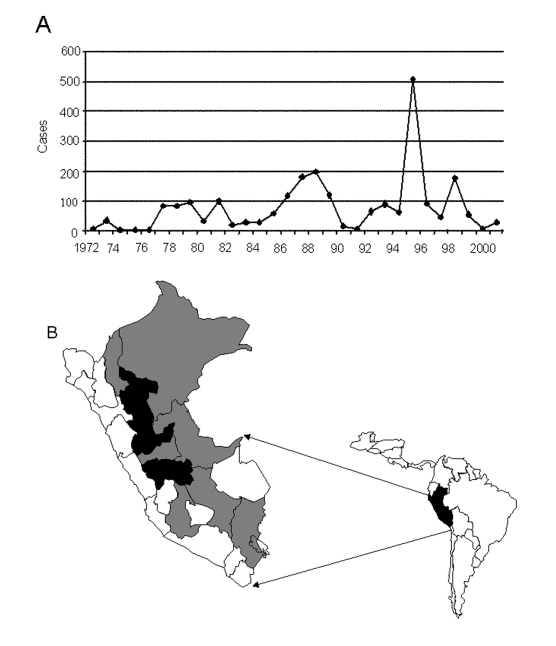
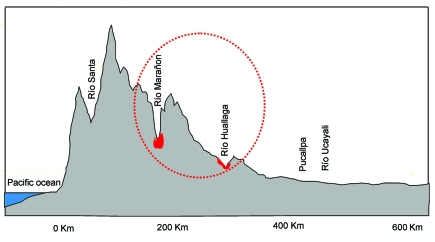
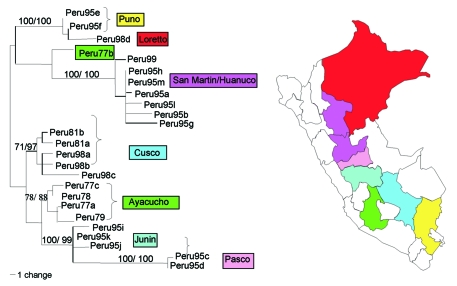
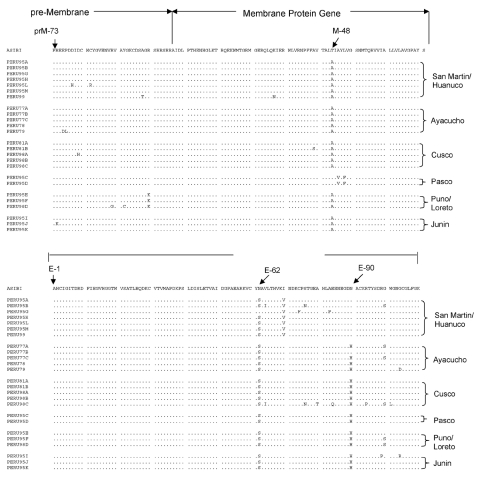
The prevailing paradigm of yellow fever virus (YFV) ecology in South America is that of wandering epizootics. The virus is believed to move from place to place in epizootic waves involving monkeys and mosquitoes, rather than persistently circulating within particular locales. After a large outbreak of YFV illness in Peru in 1995, we used phylogenetic analyses of virus isolates to reexamine the hypothesis of virus movement. We sequenced a 670-nucleotide fragment of the prM/E gene region from 25 Peruvian YFV samples collected from 1977 to 1999, and delineated six clades representing the states (Departments) of Puno, Pasco, Junin, Ayacucho, San Martin/Huanuco, and Cusco. The concurrent appearance of at least four variants during the 1995 epidemic and the genetic stability of separate virus lineages over time indicate that Peruvian YFV is locally maintained and circulates continuously in discrete foci of enzootic transmission.
南美洲黄热病病毒(YFV)生态学的主流范式是流浪性动物流行病。人们认为该病毒在涉及猴子和蚊子的动物流行病浪潮中从一个地方传播到另一个地方,而不是在特定地区持续循环。1995年秘鲁爆发大规模黄热病疫情后,我们利用病毒分离株的系统发育分析重新审视了病毒传播的假说。我们对1977年至1999年收集的25份秘鲁黄热病病毒样本的prM/E基因区域的670个核苷酸片段进行了测序,并划分出六个分支,分别代表普诺、帕斯科、胡宁、阿亚库乔、圣马丁/瓦努科和库斯科等州(省)。1995年疫情期间至少四种变体的同时出现以及不同病毒谱系随时间的遗传稳定性表明,秘鲁黄热病病毒在当地得以维持,并在不同的动物源性传播疫源地持续循环。