Grupo de Biogeografía, Diversidad y Conservación, Departamento de Biología Animal, Facultad de Ciencias, Universidad de Málaga, Málaga, Spain.
Instituto IBYDA, Centro de Experimentación Grice-Hutchinson, Málaga, Spain.
PLoS Negl Trop Dis. 2021 Jun 7;15(6):e0009496. doi: 10.1371/journal.pntd.0009496. eCollection 2021 Jun.
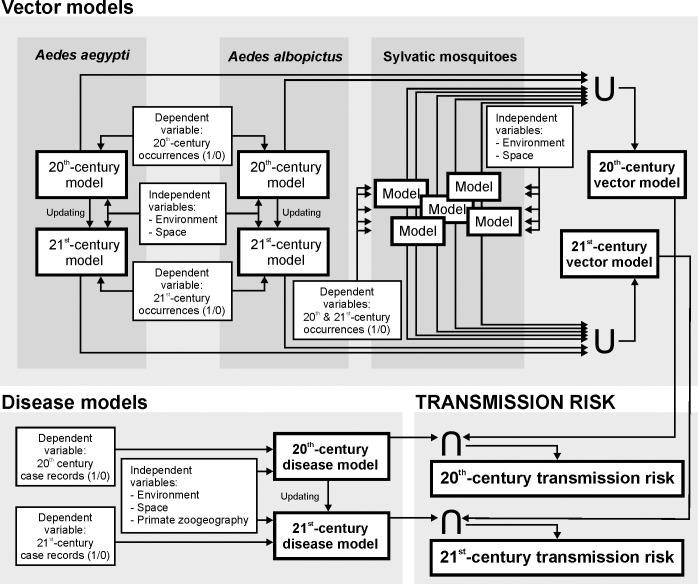
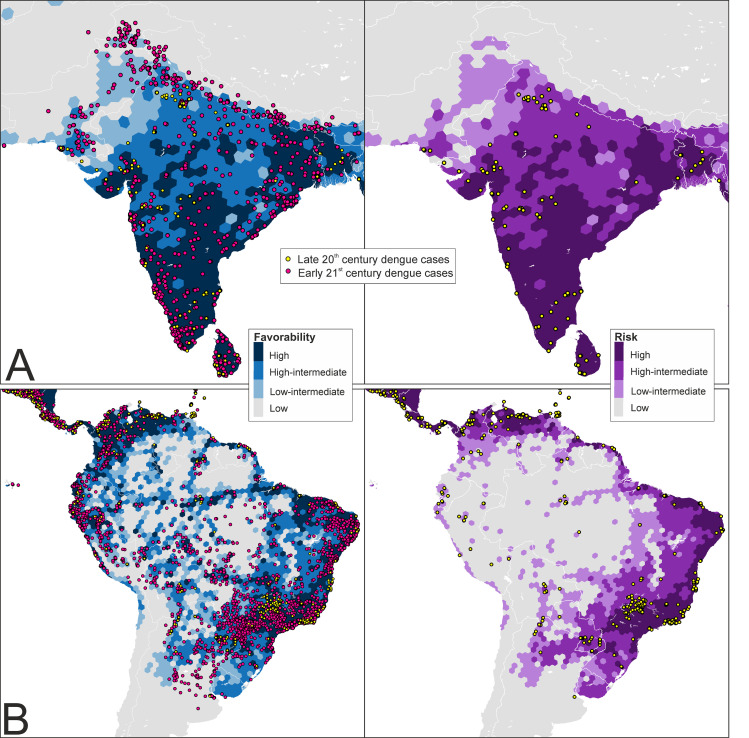
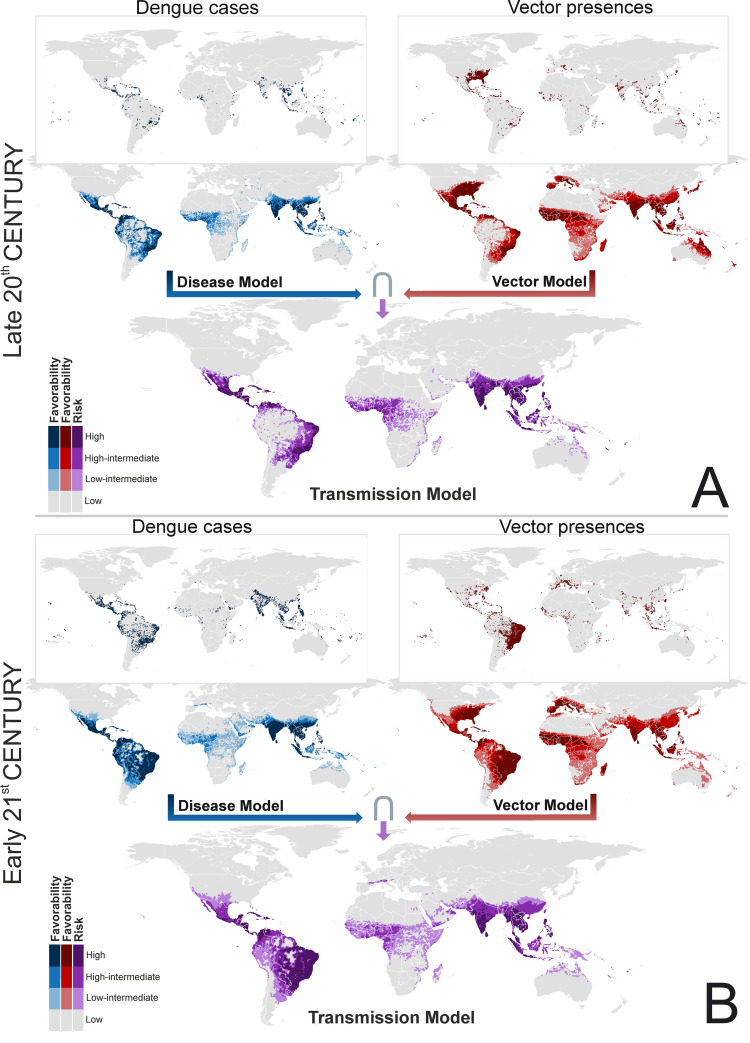
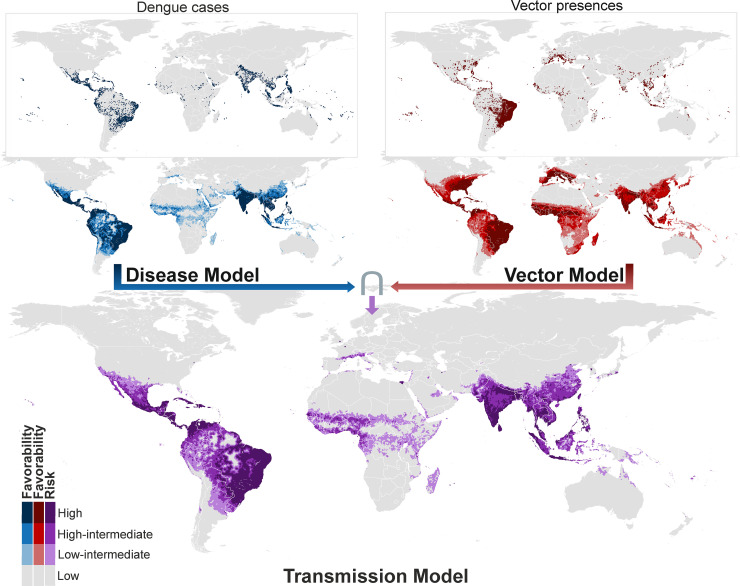
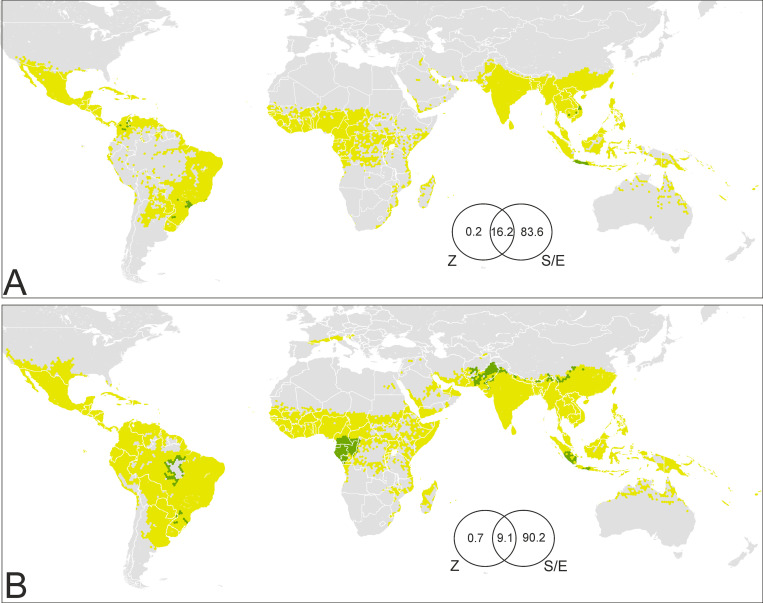
Dengue is a viral disease transmitted by mosquitoes. The rapid spread of dengue could lead to a global pandemic, and so the geographical extent of this spread needs to be assessed and predicted. There are also reasons to suggest that transmission of dengue from non-human primates in tropical forest cycles is being underestimated. We investigate the fine-scale geographic changes in transmission risk since the late 20th century, and take into account for the first time the potential role that primate biogeography and sylvatic vectors play in increasing the disease transmission risk. We apply a biogeographic framework to the most recent global dataset of dengue cases. Temporally stratified models describing favorable areas for vector presence and for disease transmission are combined. Our models were validated for predictive capacity, and point to a significant broadening of vector presence in tropical and non-tropical areas globally. We show that dengue transmission is likely to spread to affected areas in China, Papua New Guinea, Australia, USA, Colombia, Venezuela, Madagascar, as well as to cities in Europe and Japan. These models also suggest that dengue transmission is likely to spread to regions where there are presently no or very few reports of occurrence. According to our results, sylvatic dengue cycles account for a small percentage of the global extent of the human case record, but could be increasing in relevance in Asia, Africa, and South America. The spatial distribution of factors favoring transmission risk in different regions of the world allows for distinct management strategies to be prepared.
登革热是一种由蚊子传播的病毒性疾病。登革热的迅速传播可能导致全球大流行,因此需要评估和预测这种传播的地理范围。也有理由表明,在热带森林循环中,从非人类灵长类动物传播登革热的情况被低估了。我们调查了自 20 世纪末以来传播风险的细微地理变化,并首次考虑了灵长类动物生物地理学和森林媒介在增加疾病传播风险方面的潜在作用。我们将生物地理框架应用于最新的全球登革热病例数据集。描述有利的媒介存在和疾病传播的时间分层模型相结合。我们的模型经过验证具有预测能力,表明在全球范围内,热带和非热带地区的媒介存在范围显著扩大。我们表明,登革热传播可能会蔓延到中国、巴布亚新几内亚、澳大利亚、美国、哥伦比亚、委内瑞拉、马达加斯加以及欧洲和日本的城市中。这些模型还表明,登革热传播可能会蔓延到目前没有或很少有发生报告的地区。根据我们的研究结果,森林型登革热循环仅占全球人类病例记录的一小部分,但在亚洲、非洲和南美洲,其相关性可能会增加。不同地区有利于传播风险的因素的空间分布允许制定不同的管理策略。