Laude H, Gelfi J, Lavenant L, Charley B
Laboratoire de Virologie et Immunologie Moléculaires, Institut National de la Recherche Agronomique, Jouy-en-Josas, France.
J Virol. 1992 Feb;66(2):743-9. doi: 10.1128/JVI.66.2.743-749.1992.
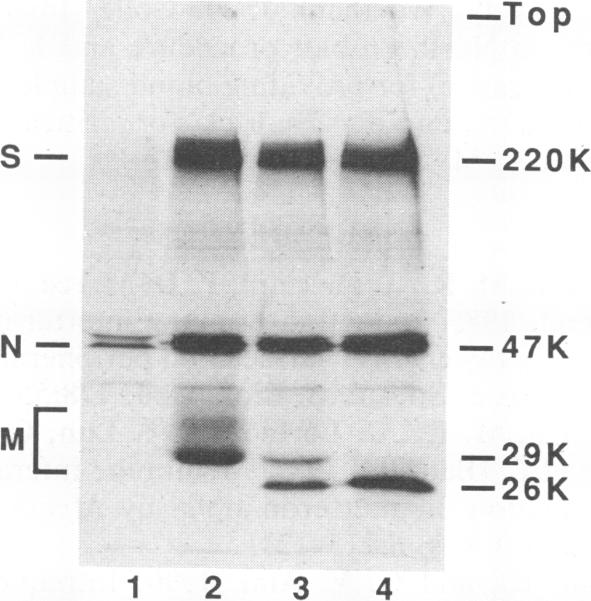
Transmissible gastroenteritis virus, an enteropathogenic coronavirus of swine, is a potent inducer of alpha interferon (IFN-alpha) both in vitro and in vivo. Previous studies have shown that virus-infected fixed cells or viral suspensions were able to induce an early and strong IFN-alpha synthesis by naive lymphocytes. Two monoclonal antibodies directed against the viral membrane glycoprotein M (29,000; formerly E1) were found to markedly inhibit virus-induced IFN production, thus assigning to M protein a potential effector role in this phenomenon (B. Charley and H. Laude, J. Virol. 62:8-11, 1988). The present report describes the selection and characterization of a collection of 125 mutant viruses which escaped complement-mediated neutralization by two IFN induction-blocking anti-M protein monoclonal antibodies. Two of these mutants, designated H92 and dm49-4, were found to exhibit a markedly reduced interferogenic activity. IFN synthesis by lymphocytes incubated with purified suspensions of these mutants was 30- to 300-fold lower than that of the parental virus. The transcription of IFN-alpha genes following induction by each mutant was decreased proportionally, as evidenced by Northern (RNA) blot analysis. The sequence of the M gene of 20 complement-mediated neutralization-resistant mutants, including the 2 defective mutants, was determined by direct sequencing of genome RNA. Thirteen distinct amino acid changes were predicted, all located at positions 6 to 22 from the N terminus of the mature M protein and within the putative ectodomain of the molecule. Two substitutions, Thr-17 to Ile and Ser-19 to Pro, were assumed to generate the defective phenotypes of mutants dm49-4 and H92, respectively. The alteration of an Asn-Ser-Thr sequence in dm49-4 virus led to the synthesis of an M protein devoid of a glycan side chain, which suggests a possible involvement of this structure in IFN induction. Overall, these data supported the view that an interferogenic determinant resides in the N-terminal, exposed part of the molecule and provided further evidence for the direct role of M protein in the induction of IFN-alpha by transmissible gastroenteritis virus. The acronym VIP (viral interferogenic protein) is proposed as a designation for this particular class of proteins.
猪传染性胃肠炎病毒是猪的一种肠道致病性冠状病毒,在体外和体内均是α干扰素(IFN-α)的有效诱导剂。先前的研究表明,病毒感染的固定细胞或病毒悬液能够诱导未致敏淋巴细胞早期且强烈地合成IFN-α。发现两种针对病毒膜糖蛋白M(29,000;原E1)的单克隆抗体可显著抑制病毒诱导的IFN产生,从而赋予M蛋白在此现象中潜在的效应作用(B. Charley和H. Laude,《病毒学杂志》62:8 - 11,1988)。本报告描述了125种突变病毒的筛选和特性,这些病毒逃脱了两种IFN诱导阻断抗M蛋白单克隆抗体介导的补体中和作用。其中两种突变体,命名为H92和dm49 - 4,被发现其干扰原活性显著降低。用这些突变体的纯化悬液孵育的淋巴细胞合成的IFN比亲本病毒低30至300倍。Northern(RNA)印迹分析表明,每种突变体诱导后IFN-α基因的转录成比例下降。通过对基因组RNA直接测序确定了20种抗补体介导中和作用的突变体(包括2种缺陷突变体)的M基因序列。预测有13个不同的氨基酸变化,均位于成熟M蛋白N端第6至22位,且在该分子假定的胞外结构域内。两种替换,即Thr - 17替换为Ile和Ser - 19替换为Pro,分别被认为产生了突变体dm49 - 4和H92的缺陷表型。dm49 - 4病毒中Asn - Ser - Thr序列的改变导致合成了一种无糖基侧链的M蛋白,这表明该结构可能参与IFN诱导。总体而言,这些数据支持这样一种观点,即干扰原决定簇位于该分子N端暴露部分,并为M蛋白在猪传染性胃肠炎病毒诱导IFN-α中的直接作用提供了进一步证据。建议用首字母缩写VIP(病毒干扰原蛋白)来命名这类特殊的蛋白质。