Singapore Institute for Clinical Sciences, Brenner Centre for Molecular Medicine, Agency for Science, Technology and Research (A*STAR), Singapore.
Laboratory of Molecular Imaging, Singapore Bioimaging Consortium, A*STAR, Singapore.
Am J Physiol Endocrinol Metab. 2021 Jan 1;320(1):E139-E150. doi: 10.1152/ajpendo.00480.2020. Epub 2020 Nov 25.
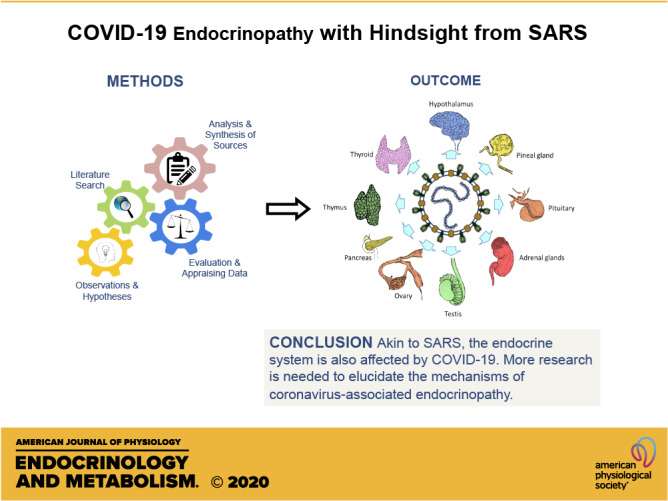
The current COVID-19 pandemic is probably the worst the world has ever faced since the start of the new millennium. Although the respiratory system is the most prominent target of SARS-CoV-2 (the contagion of COVID-19), extrapulmonary involvement are emerging as important contributors of its morbidity and lethality. This article summarizes the impact of SARS-CoV and SARS-CoV-2 on the endocrine system to facilitate our understanding of the nature of coronavirus-associated endocrinopathy. Although new data are rapidly accumulating on this novel infection, many of the endocrine manifestations of COVID-19 remain incompletely elucidated. We, hereby, summarize various endocrine dysfunctions including coronavirus-induced new onset diabetes mellitus, hypocortisolism, thyroid hormone, and reproductive system aberrations so that clinicians armed with such insights can potentially benefit patients with COVID-19 at the bedside.
当前的 COVID-19 大流行可能是自新千年开始以来,世界面临的最严重的一次。尽管呼吸系统是 SARS-CoV-2(COVID-19 的病原体)最明显的靶器官,但肺外器官的受累已成为其发病率和死亡率的重要因素。本文总结了 SARS-CoV 和 SARS-CoV-2 对内分泌系统的影响,以帮助我们了解与冠状病毒相关的内分泌疾病的本质。尽管关于这种新型感染的新数据正在迅速积累,但 COVID-19 的许多内分泌表现仍未完全阐明。我们在此总结了各种内分泌功能障碍,包括冠状病毒引起的新发糖尿病、皮质醇功能减退症、甲状腺激素和生殖系统异常,以便临床医生能够根据这些认识在床边为 COVID-19 患者提供潜在的益处。