Pan Deyun, Sun Ning, Cheung Kei-Hoi, Guan Zhong, Ma Ligeng, Holford Matthew, Deng Xingwang, Zhao Hongyu
Division of Biostatistics, Yale University, New Haven, CT 06520, USA.
BMC Bioinformatics. 2003 Nov 7;4:56. doi: 10.1186/1471-2105-4-56.
To date, many genomic and pathway-related tools and databases have been developed to analyze microarray data. In published web-based applications to date, however, complex pathways have been displayed with static image files that may not be up-to-date or are time-consuming to rebuild. In addition, gene expression analyses focus on individual probes and genes with little or no consideration of pathways. These approaches reveal little information about pathways that are key to a full understanding of the building blocks of biological systems. Therefore, there is a need to provide useful tools that can generate pathways without manually building images and allow gene expression data to be integrated and analyzed at pathway levels for such experimental organisms as Arabidopsis.
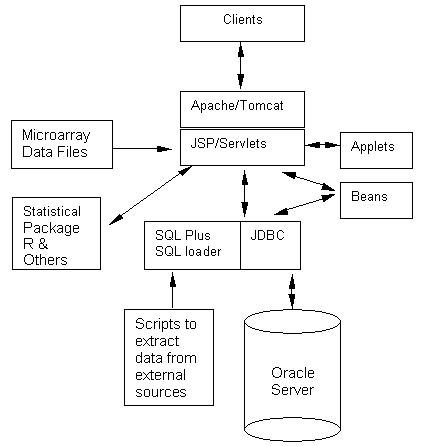
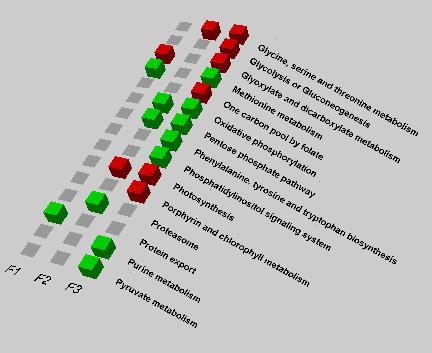
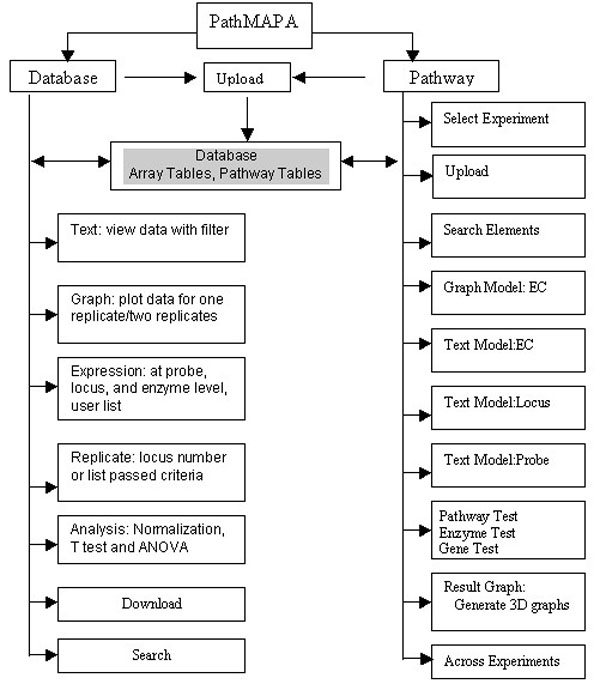
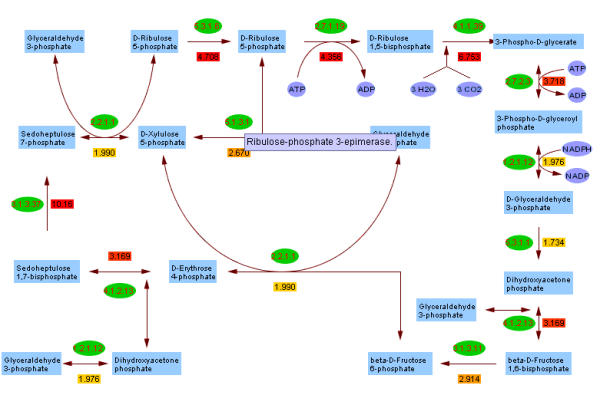
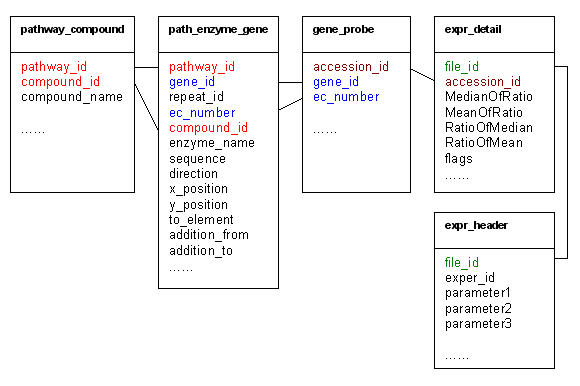
We have developed PathMAPA, a web-based application written in Java that can be easily accessed over the Internet. An Oracle database is used to store, query, and manipulate the large amounts of data that are involved. PathMAPA allows its users to (i) upload and populate microarray data into a database; (ii) integrate gene expression with enzymes of the pathways; (iii) generate pathway diagrams without building image files manually; (iv) visualize gene expressions for each pathway at enzyme, locus, and probe levels; and (v) perform statistical tests at pathway, enzyme and gene levels. PathMAPA can be used to examine Arabidopsis thaliana gene expression patterns associated with metabolic pathways.
PathMAPA provides two unique features for the gene expression analysis of Arabidopsis thaliana: (i) automatic generation of pathways associated with gene expression and (ii) statistical tests at pathway level. The first feature allows for the periodical updating of genomic data for pathways, while the second feature can provide insight into how treatments affect relevant pathways for the selected experiment(s).
迄今为止,已经开发了许多基因组和通路相关的工具及数据库来分析微阵列数据。然而,在目前已发布的基于网络的应用程序中,复杂的通路是通过静态图像文件展示的,这些文件可能不是最新的,或者重建起来很耗时。此外,基因表达分析侧重于单个探针和基因,很少或根本不考虑通路。这些方法几乎没有揭示出对于全面理解生物系统组成部分至关重要的通路信息。因此,需要提供有用的工具,能够在无需手动构建图像的情况下生成通路,并允许在通路水平上对拟南芥等实验生物的基因表达数据进行整合和分析。
我们开发了PathMAPA,这是一个用Java编写的基于网络的应用程序,可通过互联网轻松访问。使用Oracle数据库来存储、查询和处理所涉及的大量数据。PathMAPA允许用户:(i)将微阵列数据上传并填充到数据库中;(ii)将基因表达与通路中的酶进行整合;(iii)在无需手动构建图像文件的情况下生成通路图;(iv)在酶、基因座和探针水平上可视化每个通路的基因表达;以及(v)在通路、酶和基因水平上进行统计测试。PathMAPA可用于研究拟南芥与代谢通路相关的基因表达模式。
PathMAPA为拟南芥的基因表达分析提供了两个独特的功能:(i)自动生成与基因表达相关的通路;(ii)在通路水平上进行统计测试。第一个功能允许定期更新通路的基因组数据,而第二个功能可以深入了解处理如何影响所选实验的相关通路。