Puhan Milo A, Behnke Michaela, Frey Martin, Grueter Thomas, Brandli Otto, Lichtenschopf Alfred, Guyatt Gordon H, Schunemann Holger J
Horten Centre, University Hospital of Zurich, Postfach Nord CH-8091 Zurich, Switzerland.
Health Qual Life Outcomes. 2004 Jan 8;2:1. doi: 10.1186/1477-7525-2-1.
Assessment of health-related quality of life (HRQL) is important in patients with chronic obstructive pulmonary disease (COPD). Despite the high prevalence of COPD in Germany, Switzerland and Austria there is no validated disease-specific instrument available. The objective of this study was to translate the Chronic Respiratory Questionnaire (CRQ), one of the most widely used respiratory HRQL questionnaires, into German, develop an interviewer- and self-administered version including both standardised and individualised dyspnoea questions, and validate these versions in two randomised studies.
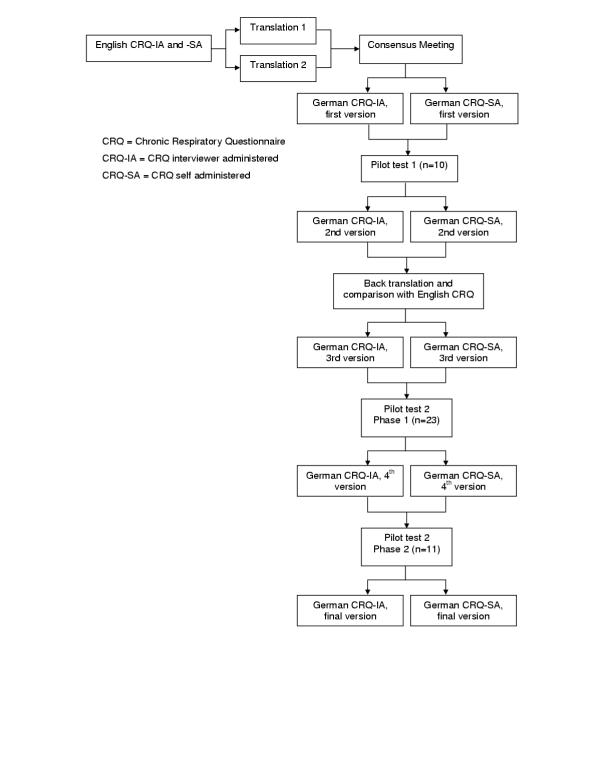
We recruited three groups of patients with COPD in Switzerland, Germany and Austria. The 44 patients of the first group completed the CRQ during pilot testing to adapt the CRQ to German-speaking patients. We then recruited 80 patients participating in pulmonary rehabilitation programs to assess internal consistency reliability and cross-sectional validity of the CRQ. The third group consisted of 38 patients with stable COPD without an intervention to assess test-retest reliability. To compare the interviewer- and self-administered versions, we randomised patients in groups 2 and 3 to the interviewer- or self-administered CRQ. Patients completed both the standardised and individualised dyspnoea questions.
For both administration formats and all domains, we found good internal consistency reliability (Crohnbach's alpha between 0.73 and 0.89). Cross-sectional validity tended to be better for the standardised compared to the individualised dyspnoea questions and cross-sectional validity was slightly better for the self-administered format. Test-retest reliability was good for both the interviewer-administered CRQ (intraclass correlation coefficients for different domains between 0.81 and 0.95) and the self-administered format (intraclass correlation coefficients between 0.78 and 0.86). Lower within-person variability was responsible for the higher test-retest reliability of the interviewer-administered format while between person variability was similar for both formats.
Investigators in German-speaking countries can choose between valid and reliable self-and interviewer-administered CRQ formats.
评估慢性阻塞性肺疾病(COPD)患者的健康相关生活质量(HRQL)很重要。尽管COPD在德国、瑞士和奥地利的患病率很高,但尚无经过验证的针对该疾病的工具。本研究的目的是将最广泛使用的呼吸HRQL问卷之一——慢性呼吸问卷(CRQ)翻译成德语,开发包括标准化和个体化呼吸困难问题的访谈式和自填式版本,并在两项随机研究中对这些版本进行验证。
我们在瑞士、德国和奥地利招募了三组COPD患者。第一组的44名患者在预试验期间完成了CRQ,以使CRQ适用于讲德语的患者。然后,我们招募了80名参加肺康复计划的患者,以评估CRQ的内部一致性可靠性和横断面效度。第三组由38名稳定期COPD患者组成,不进行干预,以评估重测信度。为了比较访谈式和自填式版本,我们将第2组和第3组的患者随机分为访谈式或自填式CRQ。患者完成了标准化和个体化的呼吸困难问题。
对于两种施测形式和所有领域,我们都发现了良好的内部一致性可靠性(Cronbach's α在0.73至0.89之间)。与个体化呼吸困难问题相比,标准化呼吸困难问题的横断面效度往往更好,自填式形式的横断面效度略好。访谈式CRQ(不同领域的组内相关系数在0.81至0.95之间)和自填式形式(组内相关系数在0.78至0.86之间)的重测信度都很好。个体内变异性较低导致访谈式形式的重测信度较高,而两种形式的个体间变异性相似。
在讲德语的国家,研究人员可以在有效且可靠的自填式和访谈式CRQ形式之间进行选择。