Damato Salvatore, Bonatti Chiara, Frigo Vinicio, Pappagallo Silvana, Raccanelli Rita, Rampoldi Claudio, Rodi Francesco
Department of Clinical Medicine and Prevention, University of Milano-Bicocca, Via Cadore 48, 20052 Monza, MI, Italy.
Health Qual Life Outcomes. 2005 Feb 7;3:9. doi: 10.1186/1477-7525-3-9.
The development and validation study of the Clinical Chronic Obstructive Disease (COPD) Questionnaire (CCQ) has recently been published in this journal. The CCQ is the first questionnaire that incorporates both clinician and patient guideline goals in the clinical control evaluation of patients with COPD in general clinical practice. The aim of this study is the validation of the CCQ questionnaire in Italian, in specific pulmonary disease clinical practice.
Validity was tested on a population of healthy subjects and patients with COPD, using the Italian validated version of the Short Form Health Survey (SF-36) and guideline recommended routine measurement in COPD patients (FEV1, FVC, BMI and functional dyspnoea). Test-retest reliability was tested by re-administering the CCQ after 2 weeks. Responsiveness was tested by re-administering the CCQ after three weeks of hospital pulmonary rehabilitation. Distance walked and Borg breathlessness rating were measured at the end of the six-minute walking test (6 MWT), before and after rehabilitation.
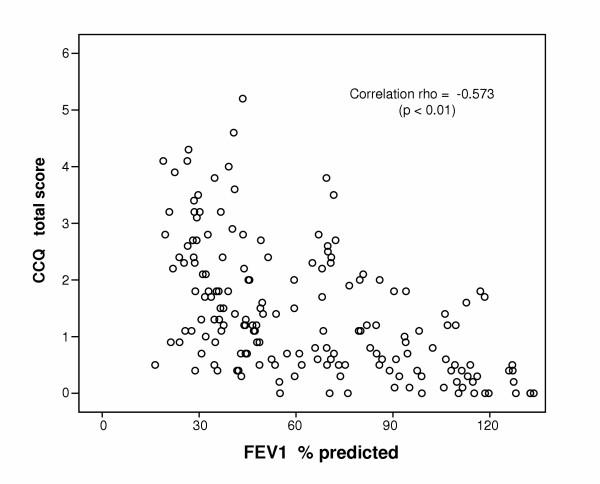
Cross-sectional data were collected from 175 subjects (55 healthy; 40 mild-moderate, 50 severe and 25 very severe COPD). Cronbach's alpha was high (0.89). The CCQ scores in patients were significantly worse than in healthy subjects. The CCQ total score in patients with COPD was significantly worse in those with BMI < or = 21. Significant correlations were found between the CCQ total score and domains of the SF-36 (rho = -0.43 to rho = -0.72). The correlation between the CCQ and FEV1 % predicted was rho = -0.57. The correlation between the CCQ and MRC was rho = 0.63. Test-retest reliability was determined in 112 subjects over a period of two weeks (Intra Class Coefficient = 0.99). Forty-six patients with COPD showed significant improvement in CCQ scores, distance-walked and Borg breathlessness rating after 3 weeks of pulmonary rehabilitation, indicating CCQ responsiveness.
The CCQ is self-administered and has been specially developed to measure clinical control in patients with COPD. Data support its validity, reliability and responsiveness in Italian and in specific pulmonary disease clinical practice.
《临床慢性阻塞性肺疾病(COPD)问卷》(CCQ)的开发与验证研究最近已发表在本期刊上。CCQ是首个在一般临床实践中对COPD患者进行临床控制评估时纳入临床医生和患者指南目标的问卷。本研究的目的是在意大利特定肺部疾病临床实践中验证CCQ问卷。
使用意大利语验证版的简短健康调查问卷(SF - 36)以及COPD患者指南推荐的常规测量指标(FEV1、FVC、BMI和功能性呼吸困难),对健康受试者和COPD患者群体进行有效性测试。通过在2周后重新发放CCQ来测试重测信度。通过在医院进行3周肺部康复后重新发放CCQ来测试反应度。在六分钟步行试验(6MWT)结束时、康复前后测量步行距离和Borg呼吸困难评分。
收集了175名受试者的横断面数据(55名健康者;40名轻度至中度、50名重度和25名极重度COPD患者)。Cronbach's alpha系数较高(0.89)。患者的CCQ评分显著低于健康受试者。BMI≤21的COPD患者的CCQ总分显著更低。在CCQ总分与SF - 36各领域之间发现了显著相关性(rho = -0.43至rho = -0.72)。CCQ与预测的FEV1%之间的相关性为rho = -0.57。CCQ与MRC之间的相关性为rho = 0.63。在112名受试者中进行了为期2周的重测信度测定(组内相关系数 = 0.99)。46名COPD患者在3周肺部康复后,CCQ评分、步行距离和Borg呼吸困难评分有显著改善,表明CCQ具有反应度。
CCQ为自填式问卷,是专门为测量COPD患者的临床控制而开发的。数据支持其在意大利语及特定肺部疾病临床实践中的有效性、可靠性和反应度。