Baranowski Eric, Ruiz-Jarabo Carmen M, Pariente Nonia, Verdaguer Nuria, Domingo Esteban
Centro de Biología Molecular Severo Ochoa (CSIC-UAM), Centro de Investigación en Sanidad Animal (CISA-INIA), Madrid, Spain.
Adv Virus Res. 2003;62:19-111. doi: 10.1016/s0065-3527(03)62002-6.
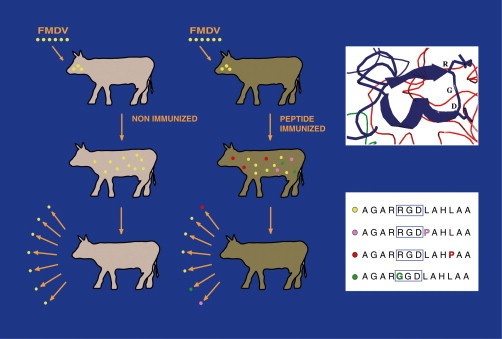
The picture beginning to form from genome analyses of viruses, unicellular organisms, and multicellular organisms is that viruses have shared functional modules with cells. A process of coevolution has probably involved exchanges of genetic information between cells and viruses for long evolutionary periods. From this point of view present-day viruses show flexibility in receptor usage and a capacity to alter through mutation their receptor recognition specificity. It is possible that for the complex DNA viruses, due to a likely limited tolerance to generalized high mutation rates, modifications in receptor specificity will be less frequent than for RNA viruses, albeit with similar biological consequences once they occur. It is found that different receptors, or allelic forms of one receptor, may be used with different efficiency and receptor affinities are probably modified by mutation and selection. Receptor abundance and its affinity for a virus may modulate not only the efficiency of infection, but also the capacity of the virus to diffuse toward other sites of the organism. The chapter concludes that receptors may be shared by different, unrelated viruses and that one virus may use several receptors and may expand its receptor specificity in ways that, at present, are largely unpredictable.
从对病毒、单细胞生物和多细胞生物的基因组分析中逐渐形成的情况是,病毒与细胞具有共享的功能模块。在漫长的进化时期里,细胞和病毒之间可能通过基因信息交换参与了一个共同进化过程。从这一角度来看,当今的病毒在受体使用方面表现出灵活性,并且有能力通过突变改变其受体识别特异性。对于复杂的DNA病毒而言,由于对普遍较高突变率的耐受性可能有限,受体特异性的改变可能比RNA病毒少见,尽管一旦发生,其生物学后果相似。研究发现,不同的受体或同一受体的等位基因形式可能以不同的效率被使用,并且受体亲和力可能会因突变和选择而改变。受体丰度及其对病毒的亲和力不仅可能调节感染效率,还可能调节病毒向生物体其他部位扩散的能力。本章得出结论,不同的、不相关的病毒可能共享受体,并且一种病毒可能使用多种受体,而且可能以目前很大程度上无法预测的方式扩展其受体特异性。