Borreani Claudia, Miccinesi Guido, Brunelli Cinzia, Lina Micaela
Psychology Unit, National Cancer Institute, Milan, Via Venezian 1, 20133 Milan, Italy.
Health Qual Life Outcomes. 2004 Jan 23;2:7. doi: 10.1186/1477-7525-2-7.
In the second half of the nineties, a scientific debate about the usefulness of qualitative research in medicine began in the main medical journals as well as the amount of "qualitative" papers published on peer reviewed journals has noticeably increased during these last years. Nevertheless the label of qualitative methodology has been assigned to an heterogeneous collection of studies. Some of them show a complete awareness of the specificity of this kind of research, while others are still largely influenced by the quantitative paradigm prevailing in the medical field. The concern with the rigour and credibility of qualitative methods has lead to the development of a number of checklist for assessing qualitative research. The purposes of this review were to describe the quality of the development of qualitative research in the medical field, focusing on oncology and palliative care, and to discuss the applicability of a descriptive checklist.
A review was conducted on Medline and PsycINFO databases. On the basis of their abstract, papers found have been classified considering: publication year, kind of journal, paper type, data gathering method, sample size and declared methodological approach. A sub sample of the previous papers was than selected and their methodological characteristics were evaluated based on a descriptive checklist.
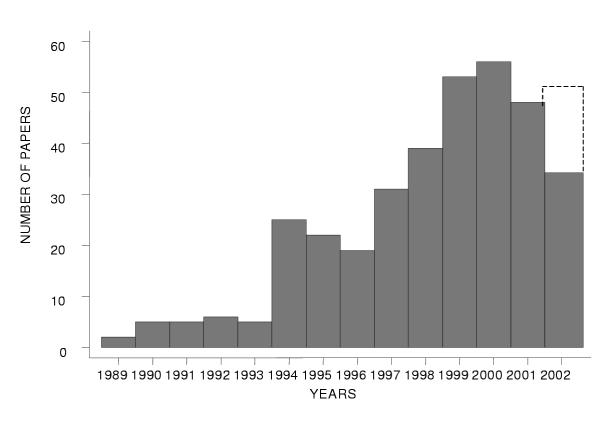
351 abstracts and 26 full papers were analysed. An increase over time in the number of qualitative studies is evident. While most of the papers before 1999 were published on nursing journals (43%), afterwards also medical journals were largely represented. Psychological journals increased from 7% to 12%. The 22% of studies used a sample size lower than 15 and the 15% did not specify the sample size in the abstract. The methodological approach was also often not specified and the percentage increased in the second time period (from 73% to 80%). Grounded theory was the most employed methodological approach while phenomenology shows a decrease. Interview remains the most used data gathering method in both periods, even if it shows a 10% reductions, while focus group and multiple methods application both increase to 12%. The use of the descriptive checklist on the full text of the 26 papers shows that all the items present a larger percentage of satisfaction after 1 January 1999 than it was for the paper published before 1999. There seems to be two different types of quality criteria: specific and unspecific. The first ones mainly refer to qualitative paradigm (such as the relationship with the subject of research or evidence about how subjects perceived the research) and they are often not satisfied. In contrast unspecific criteria (such as the connection to an existing body of knowledge or systematic data gathering) which are mainly shared with the quantitative paradigm are more frequently satisfied.
In oncology and palliative care the publication of qualitative studies increased during the nineties, reaching its peak in around 2000. The use of descriptive checklists even if it was not easy to apply, allows researchers to get a deeper insight into methodological facets that a global judgement may leave out.
在九十年代后半期,关于定性研究在医学领域的实用性的科学辩论在主要医学期刊上展开,并且在过去几年中,发表在同行评审期刊上的“定性”论文数量显著增加。然而,定性方法这一标签已被应用于一系列不同类型的研究。其中一些研究充分认识到了这类研究的特殊性,而另一些研究在很大程度上仍受医学领域盛行的定量范式的影响。对定性方法的严谨性和可信度的关注促使了一些用于评估定性研究的清单的制定。本综述的目的是描述医学领域定性研究的发展质量,重点关注肿瘤学和姑息治疗,并讨论描述性清单的适用性。
对Medline和PsycINFO数据库进行了综述。根据摘要,对检索到的论文进行分类时考虑了:发表年份、期刊类型、论文类型、数据收集方法、样本量和声明的方法学途径。然后从前述论文中选取一个子样本,并根据描述性清单评估其方法学特征。
分析了351篇摘要和26篇全文。定性研究的数量随时间呈明显增加趋势。1999年之前的大多数论文发表在护理期刊上(43%),之后医学期刊的占比也很大。心理学期刊从7%增加到12%。22%的研究样本量小于15,15%的研究在摘要中未明确样本量。方法学途径也常常未明确说明,且在第二个时间段该比例有所增加(从73%增至80%)。扎根理论是最常用的方法学途径,而现象学的应用有所减少。访谈在两个时期都是最常用的数据收集方法,尽管其使用比例下降了10%,而焦点小组和多种方法的应用比例均增至12%。对26篇论文全文使用描述性清单的结果显示,1999年1月1日之后发表的论文在所有项目上的满意度百分比均高于1999年之前发表的论文。似乎存在两种不同类型的质量标准:特定标准和非特定标准。前者主要涉及定性范式(如与研究主题的关系或关于受试者如何看待该研究的证据),且往往未得到满足。相比之下,主要与定量范式共有的非特定标准(如与现有知识体系的联系或系统的数据收集)更常得到满足。
在肿瘤学和姑息治疗领域,定性研究在九十年代发表数量增加,在2000年左右达到峰值。使用描述性清单虽然应用起来并不容易,但能使研究人员更深入地了解整体判断可能忽略的方法学方面。
