Lau Joseph T F, Lau Mason, Kim Jean H, Tsui Hi-Yi, Tsang Thomas, Wong Tze Wai
Centre for Biostatistics and Epidemiology, Faculty of Medicine, Chinese University of Hong Kong, School of Public Health, Prince of Wales Hospital, Hong Kong Special Administrative Region, People's Republic of China.
Emerg Infect Dis. 2004 Feb;10(2):235-43. doi: 10.3201/eid1002.030626.
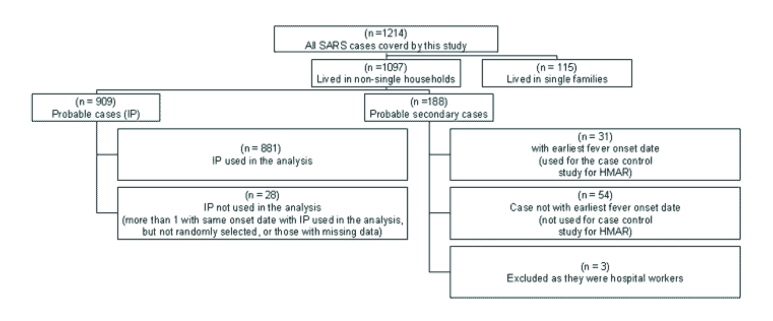
Although severe acute respiratory syndrome (SARS) is highly infectious in clinical settings, SARS has not been well examined in household settings. The household and household member attack rates were calculated for 1,214 SARS case-patients and their household members, stratified by two phases of the epidemic. A case-control analysis identified risk factors for secondary infection. Secondary infection occurred in 14.9% (22.1% versus 11% in earlier and later phases) of all households and 8% (11.7% versus 5.9% in the earlier and later phases) of all household members. Healthcare workers' households were less likely to be affected. Risk factors from the multivariate analysis included at-home duration before hospitalization, hospital visitation to the SARS patient (and mask use during the visit), and frequency of close contact. SARS transmission at the household level was not negligible in Hong Kong. Transmission rates may be greatly reduced with precautionary measures taken by household members of SARS patients.
尽管严重急性呼吸综合征(SARS)在临床环境中具有高度传染性,但在家居环境中对SARS的研究尚不充分。我们针对1214例SARS病例患者及其家庭成员,按疫情的两个阶段进行分层,计算了家庭及家庭成员的感染率。一项病例对照分析确定了二次感染的危险因素。在所有家庭中,14.9%发生了二次感染(早期和后期分别为22.1%和11%);在所有家庭成员中,8%发生了二次感染(早期和后期分别为11.7%和5.9%)。医护人员家庭受影响的可能性较小。多变量分析得出的危险因素包括住院前在家停留时间、前往医院探视SARS患者(以及探视期间是否佩戴口罩)和密切接触频率。在香港,SARS在家庭层面的传播不可忽视。SARS患者的家庭成员采取预防措施可大幅降低传播率。