Gong Yunyun, Hounsa Assomption, Egal Sharif, Turner Paul C, Sutcliffe Anne E, Hall Andrew J, Cardwell Kitty, Wild Christopher P
Molecular Epidemiology Unit, Centre for Epidemiology and Biostatistics, Leeds Institute of Genetics Health and Therapeutics, Faculty of Medicine and Health, University of Leeds, Leeds, United Kingdom.
Environ Health Perspect. 2004 Sep;112(13):1334-8. doi: 10.1289/ehp.6954.
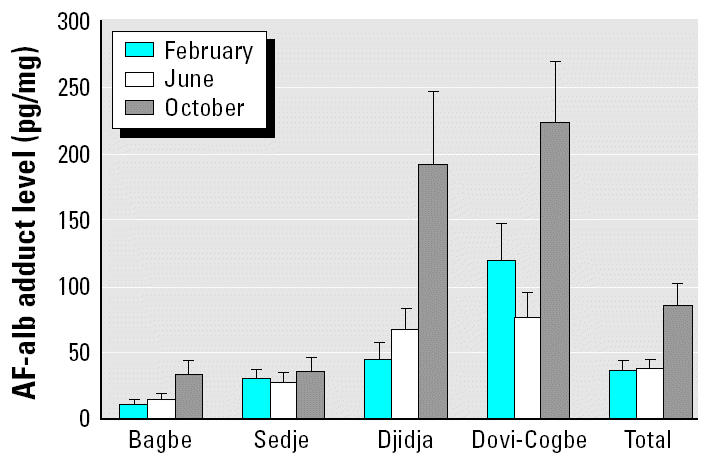
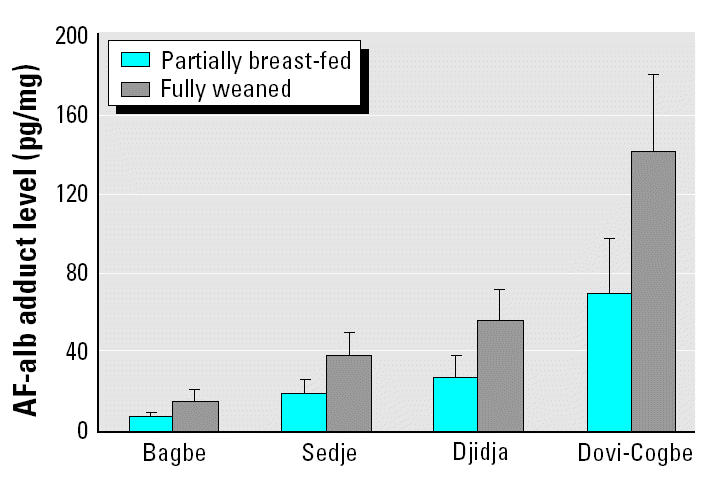
Aflatoxins are dietary contaminants that are hepatocarcinogenic and immunotoxic and cause growth retardation in animals, but there is little evidence concerning the latter two parameters in exposed human populations. Aflatoxin exposure of West African children is known to be high, so we conducted a longitudinal study over an 8-month period in Benin to assess the effects of exposure on growth. Two hundred children 16-37 months of age were recruited from four villages, two with high and two with low aflatoxin exposure (50 children per village). Serum aflatoxin-albumin (AF-alb) adducts, anthropometric parameters, information on food consumption, and various demographic data were measured at recruitment (February) and at two subsequent time points (June and October). Plasma levels of vitamin A and zinc were also measured. AF-alb adducts increased markedly between February and October in three of the four villages, with the largest increases in the villages with higher exposures. Children who were fully weaned at recruitment had higher AF-alb than did those still partially breast-fed (p < 0.0001); the major weaning food was a maize-based porridge. There was no association between AF-alb and micronutrient levels, suggesting that aflatoxin exposure was not accompanied by a general nutritional deficiency. There was, however, a strong negative correlation (p < 0.0001) between AF-alb and height increase over the 8-month follow-up after adjustment for age, sex, height at recruitment, socioeconomic status, village, and weaning status; the highest quartile of AF-alb was associated with a mean 1.7 cm reduction in growth over 8 months compared with the lowest quartile. This study emphasizes the association between aflatoxin and stunting, although the underlying mechanisms remain unclear. Aflatoxin exposure during the weaning period may be critical in terms of adverse health effects in West African children, and intervention measures to reduce exposure merit investigation.
黄曲霉毒素是膳食污染物,具有肝致癌性和免疫毒性,可导致动物生长发育迟缓,但关于接触黄曲霉毒素的人群出现后两种情况的证据很少。已知西非儿童黄曲霉毒素暴露水平较高,因此我们在贝宁进行了为期8个月的纵向研究,以评估黄曲霉毒素暴露对生长的影响。从四个村庄招募了200名16 - 37个月大的儿童,其中两个村庄黄曲霉毒素暴露水平高,两个村庄暴露水平低(每个村庄50名儿童)。在招募时(2月)以及随后的两个时间点(6月和10月)测量血清黄曲霉毒素 - 白蛋白(AF - alb)加合物、人体测量参数、食物消费信息以及各种人口统计学数据。还测量了血浆中维生素A和锌的水平。在四个村庄中的三个,2月至10月期间AF - alb加合物显著增加,暴露水平较高的村庄增加幅度最大。招募时完全断奶的儿童AF - alb水平高于仍部分母乳喂养的儿童(p < 0.0001);主要断奶食品是玉米粥。AF - alb与微量营养素水平之间没有关联,这表明黄曲霉毒素暴露并未伴随普遍的营养缺乏。然而,在对年龄、性别、招募时的身高、社会经济地位、村庄和断奶状态进行调整后,AF - alb与8个月随访期间的身高增长之间存在强烈的负相关(p < 0.0001);与最低四分位数相比,AF - alb最高四分位数与8个月内平均生长减少1.7厘米相关。本研究强调了黄曲霉毒素与发育迟缓之间的关联,尽管潜在机制尚不清楚。断奶期的黄曲霉毒素暴露可能对西非儿童的健康产生不利影响,减少暴露的干预措施值得研究。