Blasi E, Pitzurra L, Puliti M, Lanfrancone L, Bistoni F
Department of Experimental Medicine and Biochemical Sciences, University of Perugia, Italy.
Infect Immun. 1992 Mar;60(3):832-7. doi: 10.1128/iai.60.3.832-837.1992.
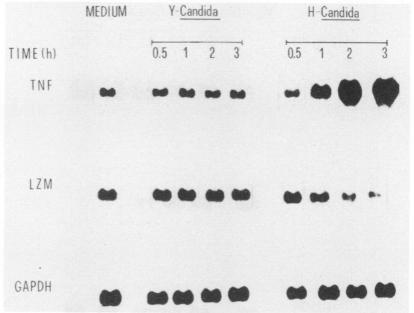
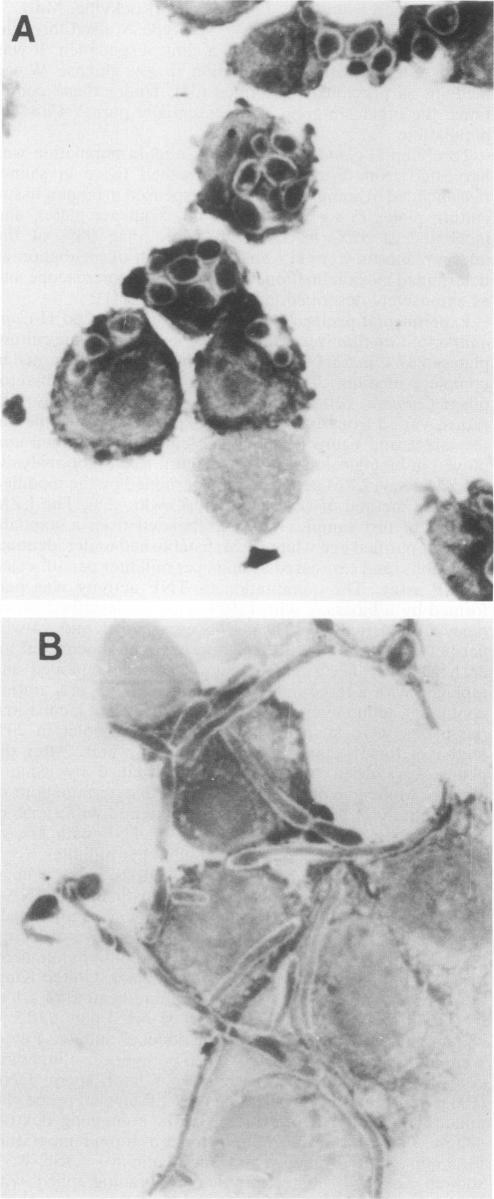
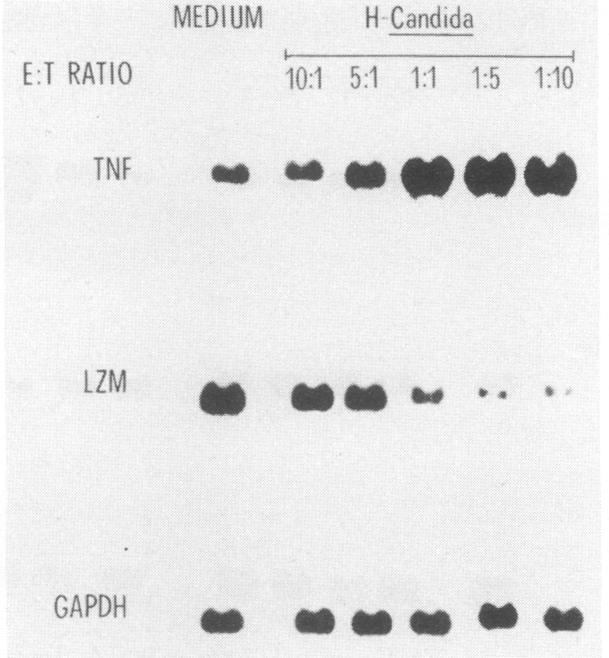
The dimorphic transition of Candida albicans from the yeast (Y-Candida) to the hyphal (H-Candida) form is a complex event; the relevance of this transition in fungal pathogenicity is still poorly understood. By using a cloned macrophage cell line (ANA-1), we questioned whether the interaction between macrophages and Y-Candida or H-Candida could affect specific cell functions, i.e., tumor necrosis factor and lysozyme production. We found that ANA-1 macrophages selectively responded to H-Candida with increased tumor necrosis factor and downregulated lysozyme, as assessed by measurement of relative mRNA levels and secreted biological activities. The H-Candida-mediated effects were (i) dependent upon the ratio between ANA-1 macrophages and H-Candida, (ii) detectable after 1 h of coincubation, and (iii) accomplished without fungal ingestion. Conversely, Y-Candida, which was found inside the ANA-1 macrophages, did not affect tumor necrosis factor and lysozyme production, nor did it prevent the macrophage response to other stimuli. Overall, these results indicate that a macrophage can distinguish between Y-Candida and H-Candida and that only the latter is able to modulate specific functions. H-Candida is recognized and probably processed as an extracellular target. The possible implication of macrophages as autocrine and paracrine regulatory cells during Candida infections is discussed.
白色念珠菌从酵母形态(Y-念珠菌)向菌丝形态(H-念珠菌)的二态转变是一个复杂的过程;这种转变在真菌致病性中的相关性仍知之甚少。通过使用克隆的巨噬细胞系(ANA-1),我们探究巨噬细胞与Y-念珠菌或H-念珠菌之间的相互作用是否会影响特定的细胞功能,即肿瘤坏死因子和溶菌酶的产生。我们发现,通过测量相对mRNA水平和分泌的生物活性评估,ANA-1巨噬细胞对H-念珠菌有选择性反应,肿瘤坏死因子增加,溶菌酶下调。H-念珠菌介导的效应:(i)取决于ANA-1巨噬细胞与H-念珠菌的比例;(ii)共孵育1小时后可检测到;(iii)在没有真菌摄取的情况下完成。相反,在ANA-1巨噬细胞内发现的Y-念珠菌既不影响肿瘤坏死因子和溶菌酶的产生,也不阻止巨噬细胞对其他刺激的反应。总体而言,这些结果表明巨噬细胞能够区分Y-念珠菌和H-念珠菌,并且只有后者能够调节特定功能。H-念珠菌被识别并可能作为细胞外靶点被处理。本文讨论了巨噬细胞在念珠菌感染期间作为自分泌和旁分泌调节细胞的可能意义。