Merkenschlager M, Fisher A G
Department of Immunology, Institute de Chimie Biologique, Strasbourg, France.
Proc Natl Acad Sci U S A. 1992 May 15;89(10):4255-9. doi: 10.1073/pnas.89.10.4255.
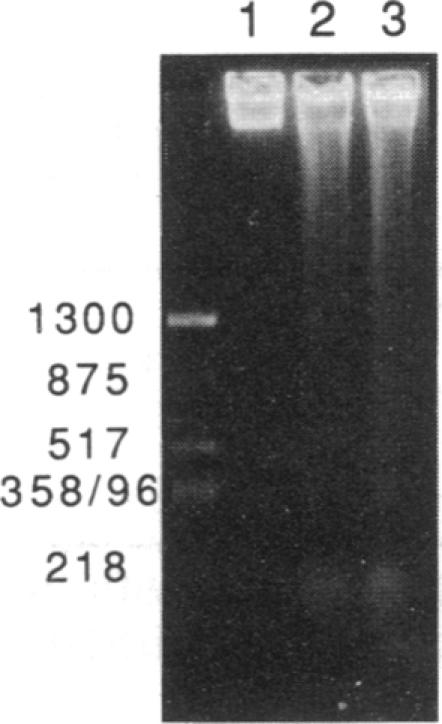
A recently described organ culture system for human thymocytes is shown to support the generation of a diverse T-cell receptor repertoire in vitro: thymocytes of the alpha beta lineage, including representatives of the V beta families 5.2/5.3, 6.7, and 8, accounted for the majority of T-cell receptor-positive cells throughout a 3-week culture period. Thymocytes bearing gamma delta receptors were also identified, particularly among the CD4 CD8 double-negative subset. The T-cell receptor repertoire expressed in organ culture responded to experimental manipulation with staphylococcal enterotoxins. Staphylococcal enterotoxin D (a powerful activator of human peripheral T cells expressing V beta 5.2/5.3 receptors) caused a marked reduction of V beta 5.2/5.3 expression, as determined with the V beta-specific antibody 42/1C1. Evidence is presented that this loss of V beta 5.2/5.3 expression resulted from the selective deletion of activated thymocytes by apoptosis, in concert with T-cell receptor modulation. These effects of staphylococcal enterotoxin D were specific (since staphylococcal enterotoxin E did not influence V beta 5.2/5.3 expression) and V beta-selective (since expression of V beta 6.7 remained unaffected by staphylococcal enterotoxin D). On the basis of these observations, we suggest that thymic organ culture provides a powerful approach to study the generation of the human T-cell repertoire.
最近描述的一种用于人类胸腺细胞的器官培养系统,已被证明能在体外支持多样化的T细胞受体库的生成:在整个3周的培养期内,αβ谱系的胸腺细胞,包括Vβ家族5.2/5.3、6.7和8的代表,占T细胞受体阳性细胞的大多数。还鉴定出了带有γδ受体的胸腺细胞,尤其是在CD4 CD8双阴性亚群中。器官培养中表达的T细胞受体库对葡萄球菌肠毒素的实验操作有反应。葡萄球菌肠毒素D(一种表达Vβ5.2/5.3受体的人类外周T细胞的强力激活剂)导致Vβ5.2/5.3表达明显降低,这是用Vβ特异性抗体42/1C1测定的。有证据表明,Vβ5.2/5.3表达的这种丧失是由凋亡导致的活化胸腺细胞的选择性缺失以及T细胞受体调节共同引起的。葡萄球菌肠毒素D的这些作用是特异性的(因为葡萄球菌肠毒素E不影响Vβ5.2/5.3表达)且是Vβ选择性的(因为Vβ6.7的表达不受葡萄球菌肠毒素D的影响)。基于这些观察结果,我们认为胸腺器官培养为研究人类T细胞受体库的生成提供了一种有力的方法。