Kourtzi Zoe, Betts Lisa R, Sarkheil Pegah, Welchman Andrew E
Max-Planck Institute for Biological Cybernetics, Tübingen, Germany.
PLoS Biol. 2005 Jul;3(7):e204. doi: 10.1371/journal.pbio.0030204. Epub 2005 Jun 7.
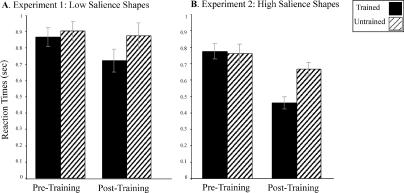
Expertise in recognizing objects in cluttered scenes is a critical skill for our interactions in complex environments and is thought to develop with learning. However, the neural implementation of object learning across stages of visual analysis in the human brain remains largely unknown. Using combined psychophysics and functional magnetic resonance imaging (fMRI), we show a link between shape-specific learning in cluttered scenes and distributed neuronal plasticity in the human visual cortex. We report stronger fMRI responses for trained than untrained shapes across early and higher visual areas when observers learned to detect low-salience shapes in noisy backgrounds. However, training with high-salience pop-out targets resulted in lower fMRI responses for trained than untrained shapes in higher occipitotemporal areas. These findings suggest that learning of camouflaged shapes is mediated by increasing neural sensitivity across visual areas to bolster target segmentation and feature integration. In contrast, learning of prominent pop-out shapes is mediated by associations at higher occipitotemporal areas that support sparser coding of the critical features for target recognition. We propose that the human brain learns novel objects in complex scenes by reorganizing shape processing across visual areas, while taking advantage of natural image correlations that determine the distinctiveness of target shapes.
在杂乱场景中识别物体的专业技能是我们在复杂环境中进行交互的一项关键技能,并且被认为是随着学习而发展的。然而,人类大脑在视觉分析各阶段进行物体学习的神经机制在很大程度上仍不为人所知。通过结合心理物理学和功能磁共振成像(fMRI),我们揭示了杂乱场景中特定形状学习与人类视觉皮层中分布式神经元可塑性之间的联系。当观察者学会在嘈杂背景中检测低显著性形状时,我们发现与未训练形状相比,在早期和高级视觉区域中,训练过的形状会引发更强的fMRI反应。然而,使用高显著性的弹出式目标进行训练时,在较高的枕颞区域中,与未训练形状相比,训练过的形状引发的fMRI反应更低。这些发现表明,伪装形状的学习是通过增强视觉区域的神经敏感性来促进目标分割和特征整合来介导的。相比之下,突出的弹出式形状的学习是由较高枕颞区域的关联介导的,这些关联支持对目标识别关键特征的更稀疏编码。我们提出,人类大脑通过在视觉区域重新组织形状处理来学习复杂场景中的新物体,同时利用自然图像相关性来确定目标形状的独特性。