Bricker Betsy J, Ewalt Darla R
Bacterial Diseases of Livestock Research Unit, National Animal Disease Center, Agricultural Research Service, United States Department of Agriculture, 2300 Dayton Rd, Ames, IA 50010, USA.
BMC Microbiol. 2005 Jun 23;5:37. doi: 10.1186/1471-2180-5-37.
A fundamental question that arises during epidemiological investigations of bacterial disease outbreaks is whether the outbreak strain is genetically related to a proposed index strain. Highly discriminating genetic markers for characterizing bacterial strains can help in clarifying the genetic relationships among strains. Under the auspices of the European Society of Clinical Microbiology and Infectious Diseases, the European Study Group for Epidemiological Markers (ESGEM) established guidelines for evaluating the performance of typing systems based of a number of criteria. Recently, HOOF-Print genotype analysis, a new method for typing Brucella abortus strains based on hypervariability at eight tandem repeat loci, was described. This paper evaluates the HOOF-Print assay by four of the criteria set out by the ESGEM: typeability, reproducibility, power of discrimination, and concordance with other typing methods.
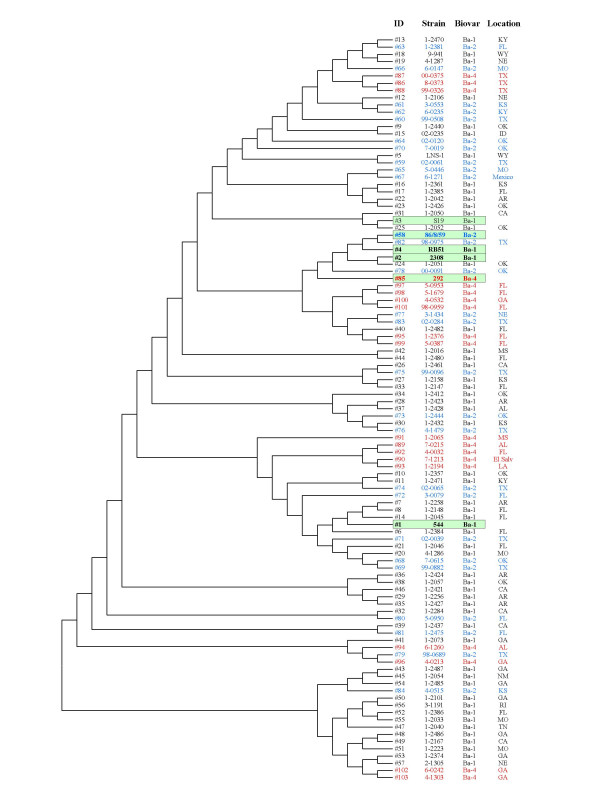
The HOOF-Print Assay was evaluated with a test population composed of 97 unrelated field isolates and 6 common laboratory strains of B. abortus. Both typeability and reproducibility of the assay were excellent. Allele diversity and frequency varied widely among the eight loci, ranging from 1 to 13 alleles. The power of discrimination, measured by the Hunter-Gaston discrimination index (HGDI), varied by locus ranging from 0 to 0.89, where a maximal value of 1.0 indicates discrimination of all strains. The HGDI values calculated for subgroups sorted by biovar were similar to the values determined for the whole population. None of the individual loci achieved the recommended HGDI threshold of 0.95, but the HGDI of the composite profiles was 0.99 (93 unique genotypes from 97 field strains evaluated), well above the recommended threshold. By comparison, the HGDI value for biovar typing was 0.61 in a test population biased with disproportionate numbers of the less common biovars. Cluster analysis based on HOOF-Print genotypes assembled the strains into hierarchical groups with no apparent association with the time or location of strain isolation. Likewise, these hierarchical groups were not homogeneous with regard to biotype. In one extreme case, two field isolates with identical fingerprints were identified as different biovars by conventional methods.
The main purpose of this study was to assess the ability of HOOF-Print genotyping to discriminate unrelated field strains of B. abortus, and whether the assay met established requirements for bacterial strain typing methods. The discriminatory power of the assay was remarkable, considering the genetic homogeneity found among species within the genus. The assay met or exceeded all of the recommended levels for the performance criteria of typeability, reproducibility, and power of discrimination, however some inconsistencies with conventional biovar typing were observed. Nevertheless, the results indicate that with cautious interpretation, multilocus genotyping of polymorphic tandem repeats by HOOF-Print analysis could be a valuable complement to routine epidemiological investigations into localized B. abortus outbreaks.
在细菌疾病暴发的流行病学调查中出现的一个基本问题是,暴发菌株与提议的指示菌株是否存在遗传关系。用于鉴定细菌菌株的高分辨率遗传标记有助于阐明菌株之间的遗传关系。在欧洲临床微生物学和传染病学会的支持下,欧洲流行病学标记物研究小组(ESGEM)基于多项标准制定了评估分型系统性能的指南。最近,描述了一种基于八个串联重复位点的高变异性对流产布鲁氏菌菌株进行分型的新方法——HOOF-Print基因型分析。本文根据ESGEM规定的四项标准评估了HOOF-Print检测方法:分型能力、可重复性、鉴别力以及与其他分型方法的一致性。
使用由97株不相关的现场分离株和6株流产布鲁氏菌常见实验室菌株组成的测试群体对HOOF-Print检测方法进行了评估。该检测方法的分型能力和可重复性均极佳。八个位点的等位基因多样性和频率差异很大,等位基因数量从1个到13个不等。通过Hunter-Gaston鉴别指数(HGDI)衡量的鉴别力因位点而异,范围从0到0.89,其中最大值1.0表示能区分所有菌株。按生物变种分类的亚组计算出的HGDI值与针对整个群体确定的值相似。没有单个位点达到推荐的HGDI阈值0.95,但复合图谱的HGDI为0.99(在评估的97株现场菌株中有93种独特基因型),远高于推荐阈值。相比之下,在一个偏向于少见生物变种数量不成比例的测试群体中,生物变种分型的HGDI值为0.61。基于HOOF-Print基因型的聚类分析将菌株聚为层次分明的组,与菌株分离的时间或地点没有明显关联。同样,这些层次分明的组在生物型方面也不是同质的。在一个极端案例中,两个指纹相同的现场分离株通过传统方法被鉴定为不同的生物变种。
本研究的主要目的是评估HOOF-Print基因分型区分流产布鲁氏菌不相关现场菌株的能力,以及该检测方法是否符合既定的细菌菌株分型方法要求。考虑到该属内物种间发现的遗传同质性,该检测方法的鉴别力非常显著。该检测方法在分型能力、可重复性和鉴别力等性能标准方面达到或超过了所有推荐水平,然而观察到与传统生物变种分型存在一些不一致。尽管如此,结果表明,经过谨慎解读,通过HOOF-Print分析对多态性串联重复序列进行多位点基因分型可能是对局部流产布鲁氏菌暴发进行常规流行病学调查的有价值补充。
