Xiao Pei, Yang Hongxia, Di Dongdong, Piao Dongri, Zhang Qiuxiang, Hao Ruie, Yao Suxia, Zhao Rong, Zhang Fanfei, Tian Guozhong, Zhao Hongyan, Fan Weixing, Cui Buyun, Jiang Hai
State Key Laboratory for Infectious Disease Prevention and Control, Collaborative Innovation Center for Diagnosis and Treatment of Infectious Diseases, National Institute for Communicable Disease Control and Prevention, Chinese Center for Disease Control and Prevention, Beijing, China.
Disease Inspection Laboratory, Shanxi Center for Disease Control and Prevention, Taiyuan, China.
PLoS One. 2015 Jan 23;10(1):e0115932. doi: 10.1371/journal.pone.0115932. eCollection 2015.
Brucellosis presents a significant economic burden for China because it causes reproductive failure in host species and chronic health problems in humans. These problems can involve multiple organs. Brucellosis is highly endemic in Shanxi Province China. Molecular typing would be very useful to epidemiological surveillance. The purpose of this study was to assess the diversity of Brucella melitensis strains for epidemiological surveillance. Historical monitoring data suggest that Brucella melitensis biovar 3 is the predominant strain associated with the epidemic of brucellosis in Shanxi Province.
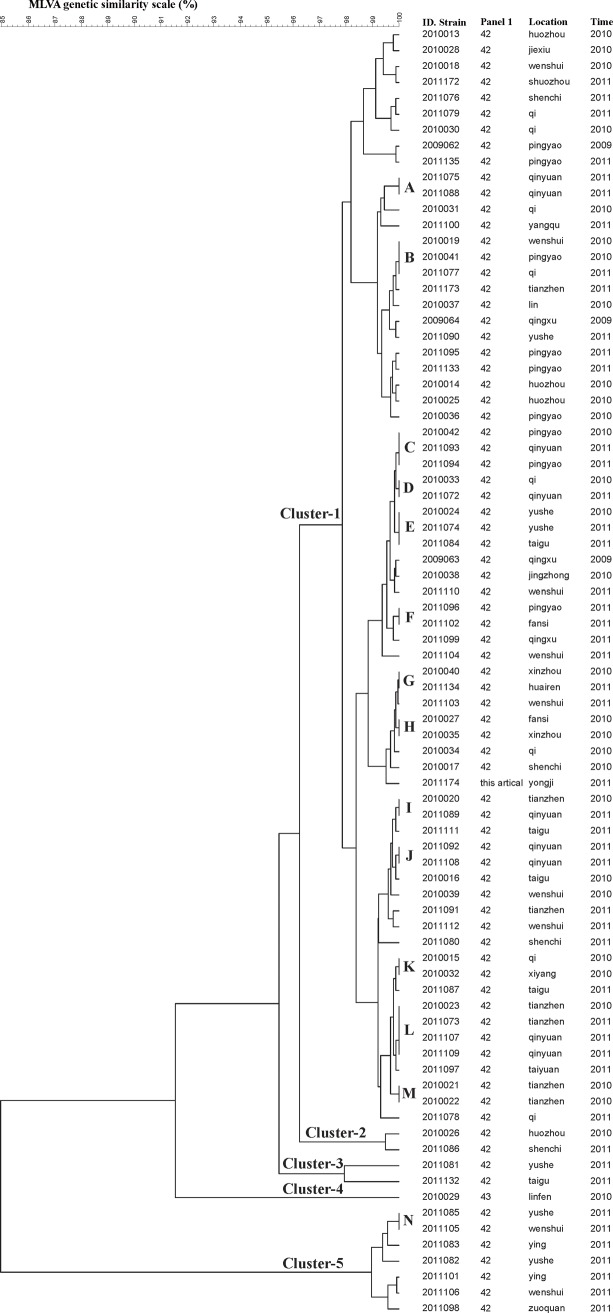
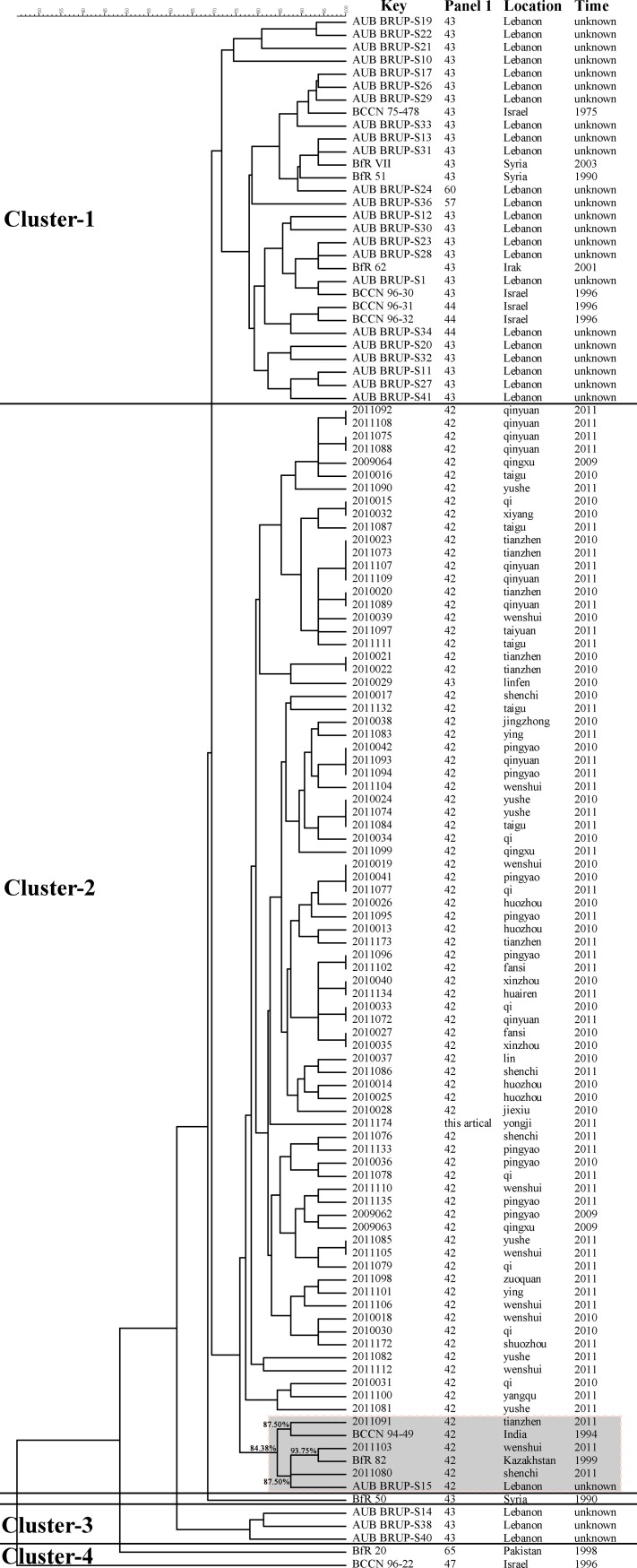
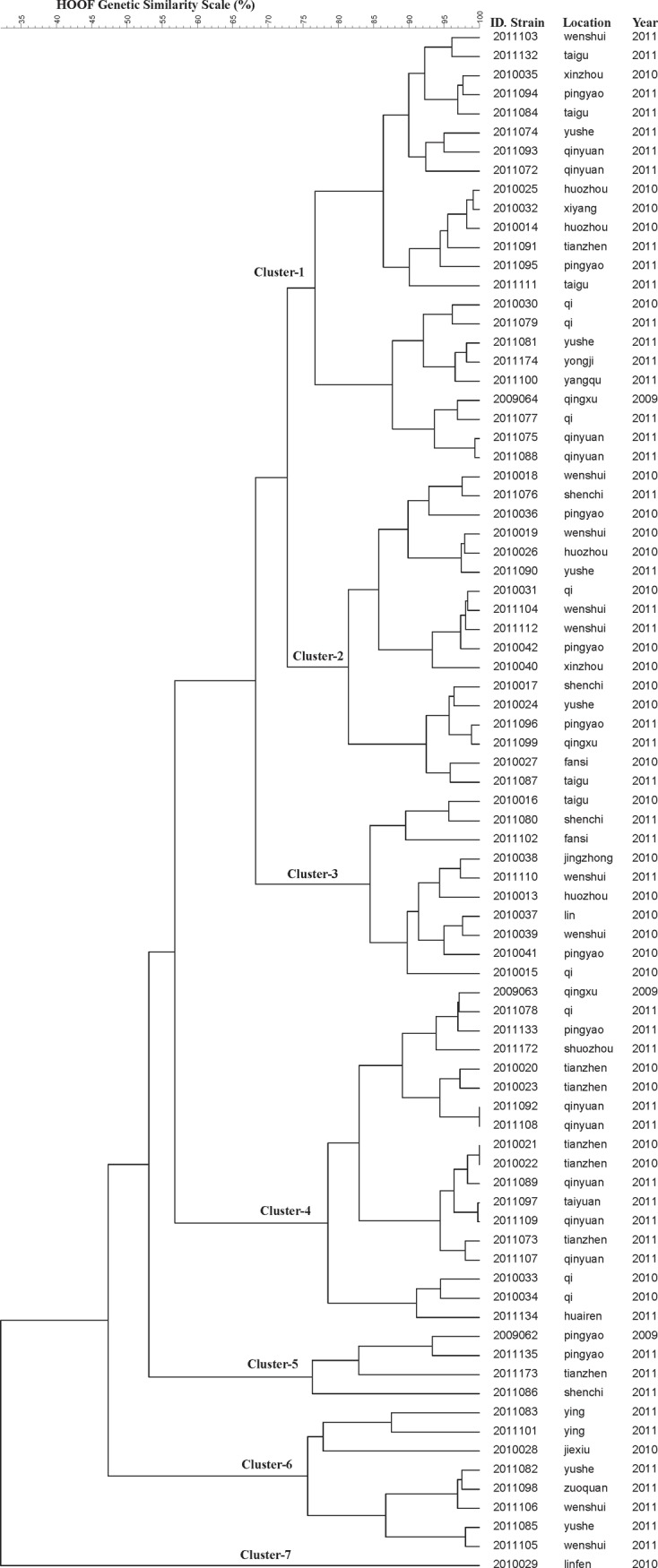
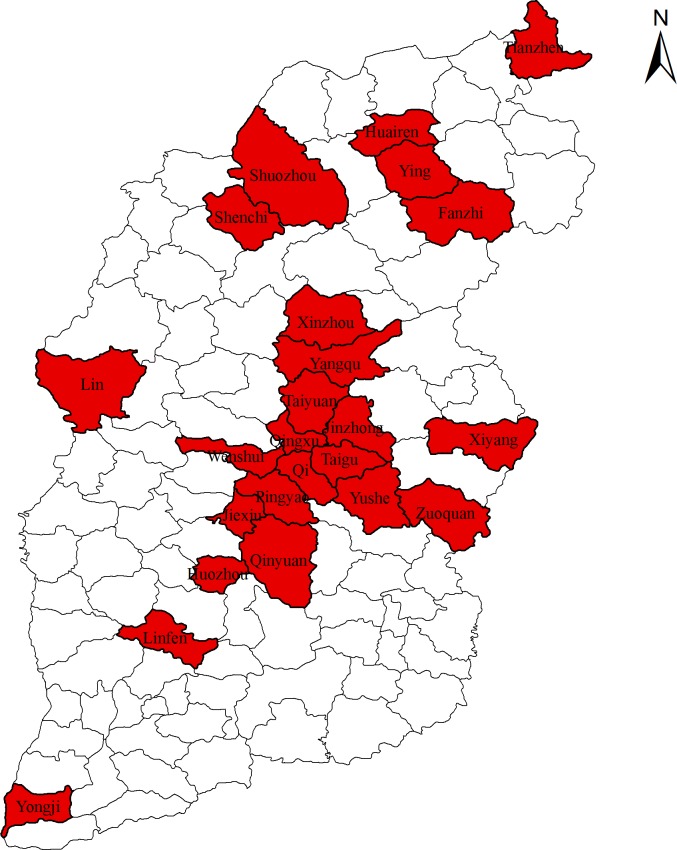
METHODS/PRINCIPAL FINDINGS: Multiple-locus variable-number repeat analysis (MLVA-16) and hypervariable octameric oligonucleotide fingerprinting (HOOF-print) were used to type a human-hosted Brucella melitensis population (81 strains). Sixty-two MLVA genotypes (discriminatory index: 0.99) were detected, and they had a genetic similarity coefficient ranging from 84.9% to 100%. Eighty strains of the population belonged to the eastern Mediterranean group with panel 1 genotypes 42 (79 strains) and 43 (1 strain). A new panel 1 genotype was found in this study. It was named 114 MLVAorsay genotype and it showed similarity to the two isolates from Guangdong in a previous study. Brucella melitensis is distributed throughout Shanxi Province, and like samples from Inner Mongolia, the eastern Mediterranean genotype 42 was the main epidemic strain (97%). The HOOF-printing showed a higher diversity than MLVA-16 with a genetic similarity coefficient ranging from 56.8% to 100%.
According to the MLVA-16 and HOOF-printing results, both methods could be used for the epidemiological surveillance of brucellosis. A new genotype was found in both Shanxi and Guangdong Provinces. In areas with brucellosis, the MLVA-16 scheme is very important for tracing cases back to their origins during outbreak investigations. It may facilitate the expansion and eradication of the disease.
布鲁氏菌病给中国带来了巨大的经济负担,因为它会导致宿主物种的繁殖失败以及人类的慢性健康问题。这些问题可能涉及多个器官。布鲁氏菌病在中国山西省高度流行。分子分型对于流行病学监测非常有用。本研究的目的是评估羊种布鲁氏菌菌株的多样性以进行流行病学监测。历史监测数据表明,羊种布鲁氏菌生物变种3是与山西省布鲁氏菌病流行相关的主要菌株。
方法/主要发现:采用多位点可变数目串联重复分析(MLVA-16)和高变八聚体寡核苷酸指纹图谱(HOOF-print)对81株人源羊种布鲁氏菌群体进行分型。检测到62种MLVA基因型(鉴别指数:0.99),其遗传相似系数在84.9%至100%之间。该群体中的80株属于东地中海组,其面板1基因型为42(79株)和43(1株)。本研究发现了一种新的面板1基因型。它被命名为114 MLVA奥赛基因型,并且在先前的研究中显示与来自广东的两个分离株相似。羊种布鲁氏菌分布于山西省各地,与内蒙古的样本一样,东地中海基因型42是主要的流行菌株(97%)。HOOF-print分析显示出比MLVA-16更高的多样性,其遗传相似系数在56.8%至100%之间。
根据MLVA-16和HOOF-print分析结果,这两种方法均可用于布鲁氏菌病的流行病学监测。在山西和广东两省均发现了一种新基因型。在布鲁氏菌病流行地区,MLVA-16方案对于在疫情调查期间追踪病例源头非常重要。它可能有助于疾病的扩大控制和根除。