Feng Y X, Yuan H, Rein A, Levin J G
Laboratory of Molecular Virology and Carcinogenesis, NCI-Frederick Cancer Research and Development Center, Maryland 21702.
J Virol. 1992 Aug;66(8):5127-32. doi: 10.1128/JVI.66.8.5127-5132.1992.
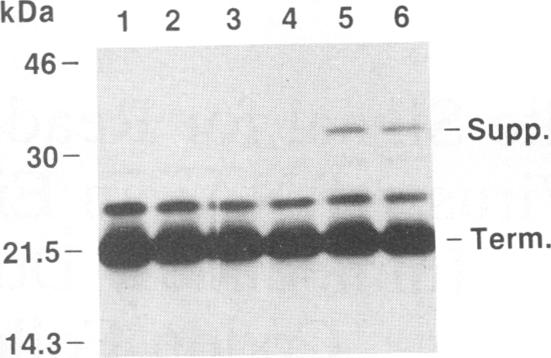
The pol gene of murine leukemia virus and other mammalian type C retroviruses is expressed by read-through suppression of an in-frame UAG codon which separates the gag and pol coding regions. In this study, we have analyzed the sequence requirements for read-through suppression by placing different portions of wild-type and mutant viral sequences from the gag-pol junction between reporter genes and testing transcripts of these constructs for suppression in reticulocyte lysates. We find that the read-through signal is contained within the first 57 nucleotides on the 3' side of the UAG codon. Our results indicate that the identities of six conserved bases in the eight-nucleotide, purine-rich sequence immediately downstream of the UAG codon are critical for suppression, as is the existence of a pseudoknot structure spanning the next 49 nucleotides. Thus, read-through suppression depends on a complex, bipartite signal in the mRNA.
鼠白血病病毒和其他哺乳动物C型逆转录病毒的pol基因是通过对一个位于gag和pol编码区之间的符合读框的UAG密码子进行通读抑制来表达的。在本研究中,我们通过将来自gag-pol连接区的野生型和突变病毒序列的不同部分置于报告基因之间,分析了通读抑制的序列要求,并在网织红细胞裂解物中测试这些构建体的转录本的抑制情况。我们发现通读信号包含在UAG密码子3'侧的前57个核苷酸内。我们的结果表明,UAG密码子下游紧邻的富含嘌呤的八核苷酸序列中六个保守碱基的身份对于抑制至关重要,跨越接下来49个核苷酸的假结结构的存在也是如此。因此,通读抑制取决于mRNA中一个复杂的、二分信号。