Swiss Federal Institute of Technology - ETH Zurich, ETH Center, CH-8092 Zurich, Switzerland.
Plant Methods. 2006 Jan 9;2:1. doi: 10.1186/1746-4811-2-1.
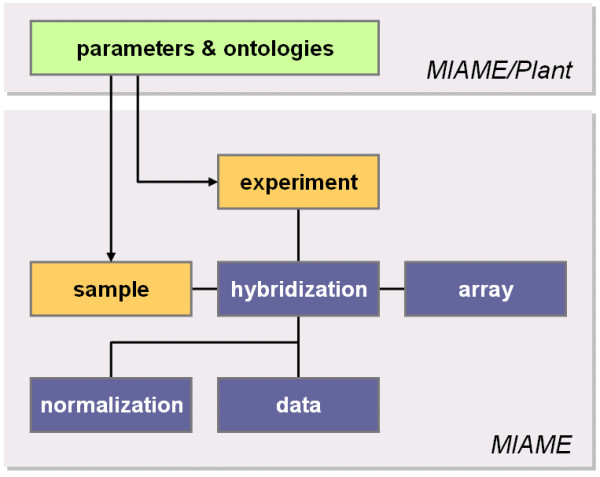
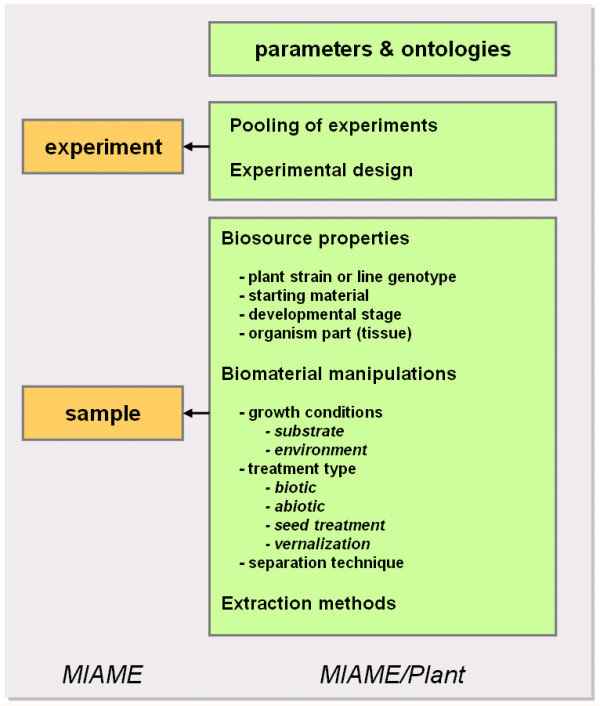
Appropriate biological interpretation of microarray data calls for relevant experimental annotation. The widely accepted MIAME guidelines provide a generic, organism-independant standard for minimal information about microarray experiments. In its overall structure, MIAME is very general and specifications cover mostly technical aspects, while relevant organism-specific information useful to understand the underlying experiments is largely missing. If plant biologists want to use results from published microarray experiments, they need detailed information about biological aspects, such as growth conditions, harvesting time or harvested organ(s). Here, we propose MIAME/Plant, a standard describing which biological details to be captured for describing microarray experiments involving plants. We expect that a more detailed and more systematic annotation of microarray experiments will greatly increase the use of transcriptome data sets for the scientific community. The power and value of systematic annotation of microarray data is convincingly demonstrated by data warehouses such as Genevestigator(R) or NASCArrays, and better experimental annotation will make these applications even more powerful.
微阵列数据的适当生物学解释需要相关的实验注释。广泛接受的 MIAME 指南为微阵列实验的最小信息提供了通用的、与生物体无关的标准。在其整体结构中,MIAME 非常通用,规范主要涵盖技术方面,而有用以理解基础实验的相关特定于生物体的信息则大量缺失。如果植物生物学家想要使用已发表的微阵列实验的结果,他们需要有关生物学方面的详细信息,例如生长条件、收获时间或收获的器官。在这里,我们提出了 MIAME/Plant,这是一个标准,描述了描述涉及植物的微阵列实验时要捕获的哪些生物学细节。我们期望对微阵列实验进行更详细和更系统的注释将极大地增加转录组数据集在科学界的使用。像 Genevestigator(R) 或 NASCArrays 这样的数据仓库有力地证明了系统注释微阵列数据的强大功能,而更好的实验注释将使这些应用程序更加强大。