Hayes J J, Clark D J, Wolffe A P
Laboratory of Molecular Biology, National Institute of Diabetes, Digestive and Kidney Diseases, National Institutes of Health, Bethesda, MD 20892.
Proc Natl Acad Sci U S A. 1991 Aug 1;88(15):6829-33. doi: 10.1073/pnas.88.15.6829.
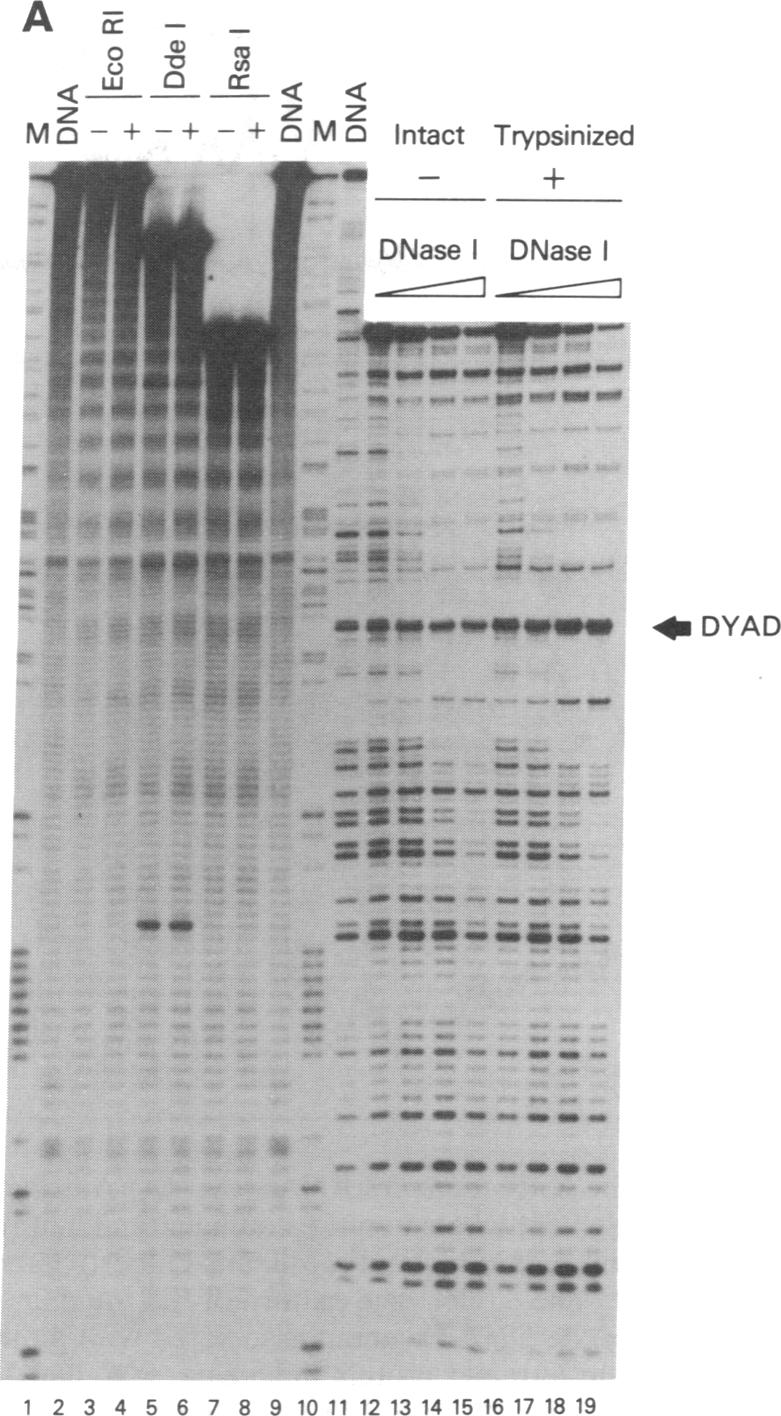
We describe the application of the hydroxyl radical footprinting technique to examine the contribution of the core histone tails and of histones H3 and H4 to the structure of DNA in the nucleosome. We first establish that, as was previously determined for a nucleosome containing a unique sequence of DNA, mixed-sequence nucleosomes contain two distinct regions of DNA structure. The central three turns of DNA in the nucleosome have a helical periodicity of approximately 10.7 base pairs per turn, while flanking regions have a periodicity of approximately 10.0 base pairs per turn. Removal of the histone tails does not change the hydroxyl radical cleavage pattern in either mixed- or unique-sequence nucleosome samples. A tetramer of histones H3 and H4, (H3/H4)2, organizes the central 120 base pairs of DNA identically to that found in the nucleosome. Moreover, "tailless" octamers and the (H3/H4)2 tetramer recognize the same nucleosome positioning signals as the intact octamer.
我们描述了羟基自由基足迹技术在研究核心组蛋白尾巴以及组蛋白H3和H4对核小体中DNA结构的贡献方面的应用。我们首先确定,正如先前针对含有独特DNA序列的核小体所确定的那样,混合序列核小体包含两个不同的DNA结构区域。核小体中DNA的中央三圈每圈具有约10.7个碱基对的螺旋周期性,而侧翼区域每圈具有约10.0个碱基对的周期性。去除组蛋白尾巴不会改变混合序列或独特序列核小体样品中的羟基自由基切割模式。组蛋白H3和H4的四聚体(H3/H4)2对中央120个碱基对的DNA的组织方式与在核小体中发现的相同。此外,“无尾”八聚体和(H3/H4)2四聚体与完整八聚体识别相同的核小体定位信号。