Doytchinova Irini A, Guan Pingping, Flower Darren R
Edward Jenner Institute for Vaccine Research, Compton, RG20 7NN, UK.
BMC Bioinformatics. 2006 Mar 13;7:131. doi: 10.1186/1471-2105-7-131.
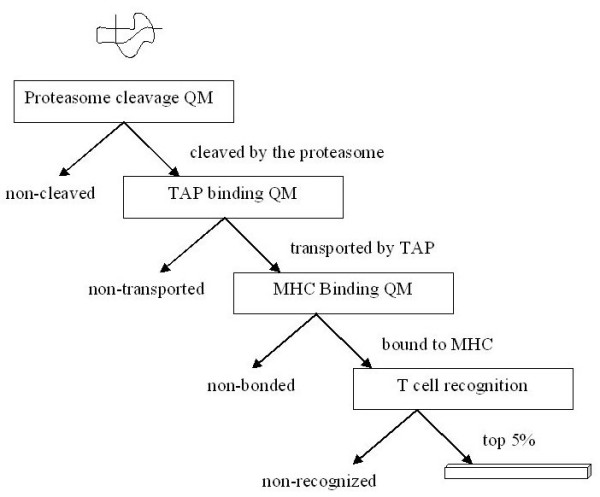
The main processing pathway for MHC class I ligands involves degradation of proteins by the proteasome, followed by transport of products by the transporter associated with antigen processing (TAP) to the endoplasmic reticulum (ER), where peptides are bound by MHC class I molecules, and then presented on the cell surface by MHCs. The whole process is modeled here using an integrated approach, which we call EpiJen. EpiJen is based on quantitative matrices, derived by the additive method, and applied successively to select epitopes. EpiJen is available free online.
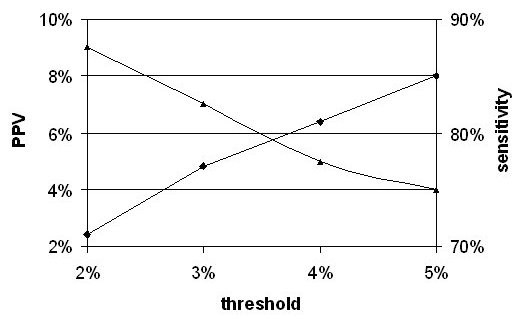
To identify epitopes, a source protein is passed through four steps: proteasome cleavage, TAP transport, MHC binding and epitope selection. At each stage, different proportions of non-epitopes are eliminated. The final set of peptides represents no more than 5% of the whole protein sequence and will contain 85% of the true epitopes, as indicated by external validation. Compared to other integrated methods (NetCTL, WAPP and SMM), EpiJen performs best, predicting 61 of the 99 HIV epitopes used in this study.
EpiJen is a reliable multi-step algorithm for T cell epitope prediction, which belongs to the next generation of in silico T cell epitope identification methods. These methods aim to reduce subsequent experimental work by improving the success rate of epitope prediction.
MHC I类配体的主要加工途径包括蛋白酶体对蛋白质的降解,随后与抗原加工相关的转运体(TAP)将产物转运至内质网(ER),在内质网中肽段与MHC I类分子结合,然后由MHC呈递至细胞表面。在此使用一种综合方法对此全过程进行建模,我们将其称为EpiJen。EpiJen基于通过加法方法推导得出的定量矩阵,并相继应用于表位选择。EpiJen可在网上免费获取。
为识别表位,将一种源蛋白经过四个步骤:蛋白酶体切割、TAP转运、MHC结合和表位选择。在每个阶段,不同比例的非表位被去除。最终的肽段集占整个蛋白质序列的比例不超过5%,并且如外部验证所示,将包含85%的真实表位。与其他综合方法(NetCTL、WAPP和SMM)相比,EpiJen表现最佳,在本研究中预测出了99个HIV表位中的61个。
EpiJen是一种可靠的用于T细胞表位预测的多步骤算法,属于下一代计算机模拟T细胞表位识别方法。这些方法旨在通过提高表位预测的成功率来减少后续的实验工作。