Labuda Milan, Trimnell Adama R, Licková Martina, Kazimírová Mária, Davies Gillian M, Lissina Olga, Hails Rosie S, Nuttall Patricia A
Institute of Zoology, Slovak Academy of Sciences, Bratislava, Slovakia.
PLoS Pathog. 2006 Apr;2(4):e27. doi: 10.1371/journal.ppat.0020027. Epub 2006 Apr 7.
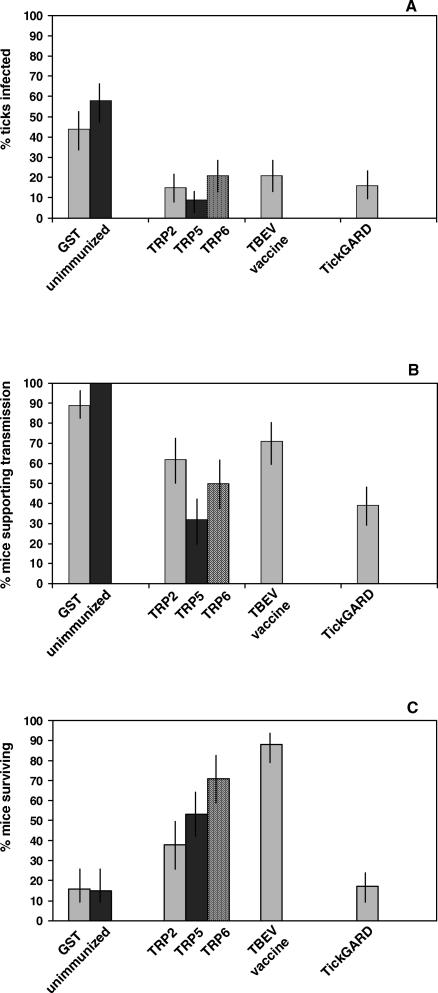
Vaccines that target blood-feeding disease vectors, such as mosquitoes and ticks, have the potential to protect against the many diseases caused by vector-borne pathogens. We tested the ability of an anti-tick vaccine derived from a tick cement protein (64TRP) of Rhipicephalus appendiculatus to protect mice against tick-borne encephalitis virus (TBEV) transmitted by infected Ixodes ricinus ticks. The vaccine has a "dual action" in immunized animals: when infested with ticks, the inflammatory and immune responses first disrupt the skin feeding site, resulting in impaired blood feeding, and then specific anti-64TRP antibodies cross-react with midgut antigenic epitopes, causing rupture of the tick midgut and death of engorged ticks. Three parameters were measured: "transmission," number of uninfected nymphal ticks that became infected when cofeeding with an infected adult female tick; "support," number of mice supporting virus transmission from the infected tick to cofeeding uninfected nymphs; and "survival," number of mice that survived infection by tick bite and subsequent challenge by intraperitoneal inoculation of a lethal dose of TBEV. We show that one dose of the 64TRP vaccine protects mice against lethal challenge by infected ticks; control animals developed a fatal viral encephalitis. The protective effect of the 64TRP vaccine was comparable to that of a single dose of a commercial TBEV vaccine, while the transmission-blocking effect of 64TRP was better than that of the antiviral vaccine in reducing the number of animals supporting virus transmission. By contrast, the commercial antitick vaccine (TickGARD) that targets only the tick's midgut showed transmission-blocking activity but was not protective. The 64TRP vaccine demonstrates the potential to control vector-borne disease by interfering with pathogen transmission, apparently by mediating a local cutaneous inflammatory immune response at the tick-feeding site.
针对吸血疾病传播媒介(如蚊子和蜱虫)的疫苗,有潜力预防由媒介传播病原体引起的多种疾病。我们测试了一种源自非洲璃眼蜱(Rhipicephalus appendiculatus)的蜱虫黏合蛋白(64TRP)的抗蜱疫苗保护小鼠免受感染的蓖麻硬蜱(Ixodes ricinus)传播的蜱传脑炎病毒(TBEV)感染的能力。该疫苗在免疫动物中具有“双重作用”:当被蜱虫叮咬时,炎症和免疫反应首先会破坏皮肤取食部位,导致取食受损,然后特异性抗64TRP抗体与中肠抗原表位发生交叉反应,导致蜱虫中肠破裂以及饱血蜱虫死亡。我们测量了三个参数:“传播”,即与感染的成年雌性蜱虫共同取食时被感染的未感染若蜱数量;“支持”,即支持病毒从感染蜱虫传播到共同取食的未感染若虫的小鼠数量;以及“存活”,即通过蜱虫叮咬感染以及随后腹腔接种致死剂量TBEV进行攻毒后存活的小鼠数量。我们发现,一剂64TRP疫苗可保护小鼠免受感染蜱虫的致死性攻毒;对照动物则患上了致命的病毒性脑炎。64TRP疫苗的保护效果与单剂量商业TBEV疫苗相当,而在减少支持病毒传播的动物数量方面,64TRP的传播阻断效果优于抗病毒疫苗。相比之下,仅针对蜱虫中肠的商业抗蜱疫苗(TickGARD)具有传播阻断活性,但没有保护作用。64TRP疫苗显示出通过干扰病原体传播来控制媒介传播疾病的潜力,显然是通过在蜱虫取食部位介导局部皮肤炎症免疫反应来实现的。