Tabor Jeffrey J, Levy Matthew, Ellington Andrew D
Center for Systems and Synthetic Biology and Institute for Cell and Molecular Biology, University of Texas at Austin, Austin, TX 78712, USA.
Nucleic Acids Res. 2006 Apr 28;34(8):2166-72. doi: 10.1093/nar/gkl176. Print 2006.
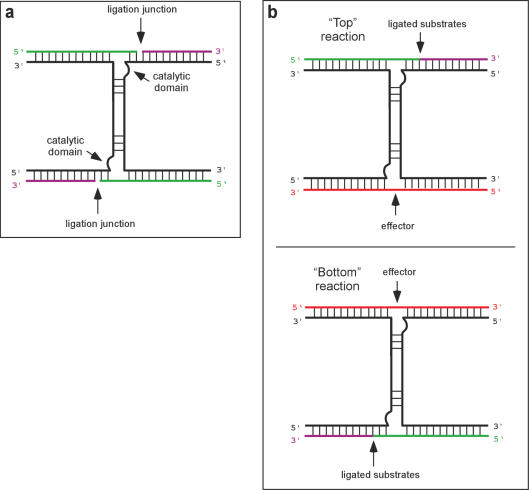
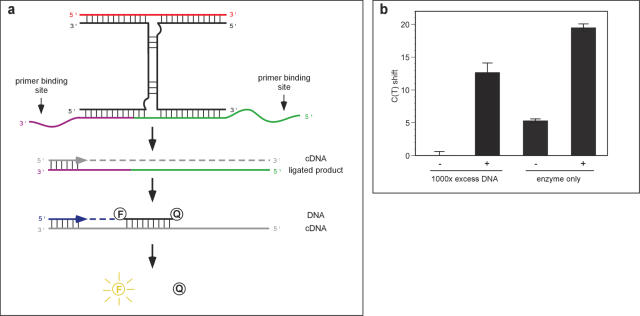
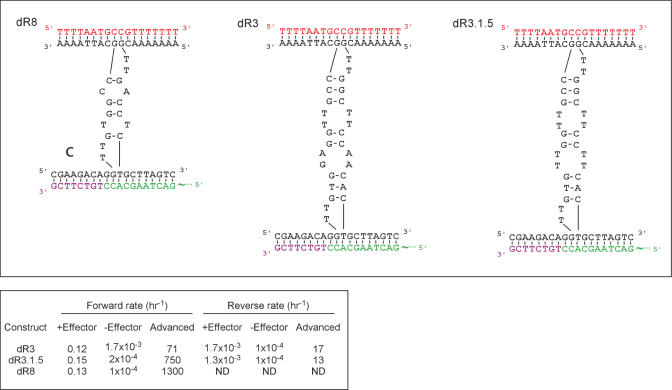
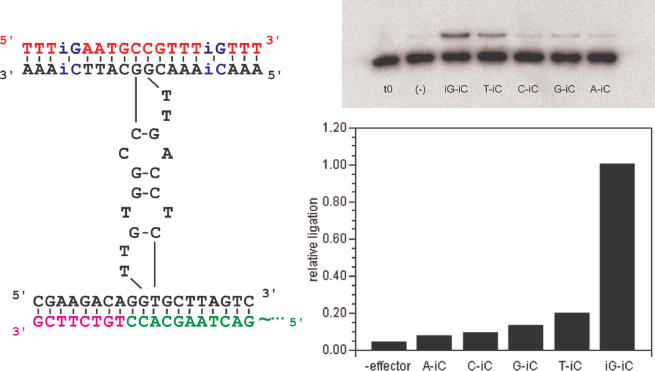
Allosteric nucleic acid ligases have been used previously to transform analyte-binding into the formation of oligonucleotide templates that can be amplified and detected. We have engineered binary deoxyribozyme ligases whose two components are brought together by bridging oligonucleotide effectors. The engineered ligases can 'read' one sequence and then 'write' (by ligation) a separate, distinct sequence, which can in turn be uniquely amplified. The binary deoxyribozymes show great specificity, can discriminate against a small number of mutations in the effector, and can read and recode DNA information with high fidelity even in the presence of excess obscuring genomic DNA. In addition, the binary deoxyribozymes can read non-natural nucleotides and write natural sequence information. The binary deoxyribozyme ligases could potentially be used in a variety of applications, including the detection of single nucleotide polymorphisms in genomic DNA or the identification of short nucleic acids such as microRNAs.
变构核酸连接酶此前已被用于将分析物结合转化为可扩增和检测的寡核苷酸模板的形成。我们构建了二元脱氧核酶连接酶,其两个组分通过桥接寡核苷酸效应物结合在一起。工程化的连接酶可以“读取”一个序列,然后“写入”(通过连接)一个单独的、不同的序列,该序列又可以被独特地扩增。二元脱氧核酶具有很高的特异性,可以区分效应物中的少量突变,即使在存在过量干扰基因组DNA的情况下,也能以高保真度读取和重新编码DNA信息。此外,二元脱氧核酶可以读取非天然核苷酸并写入天然序列信息。二元脱氧核酶连接酶可能会用于多种应用,包括检测基因组DNA中的单核苷酸多态性或鉴定短核酸,如微小RNA。