Hsu Chih-Cheng, Chen Ted, Chang Mei, Chang Yu-Kang
Center for Health Policy Research and Development, National Health Research Institutes, No.35 Keyan Road, Zhunan Town, Miaoli County, 350 Taiwan.
Am J Infect Control. 2006 May;34(4):176-81. doi: 10.1016/j.ajic.2005.11.008.
Taiwan experienced one of the most serious outbreaks of severe acute respiratory syndrome (SARS) during the 2003 epidemic. Public health nurses faced unprecedented challenges in implementing an extensive quarantine policy to prevent disease spread. Their professional confidence, however, was shattered during the SARS crisis. This paper assesses factors related to public health nurses' confidence in managing community SARS control programs.
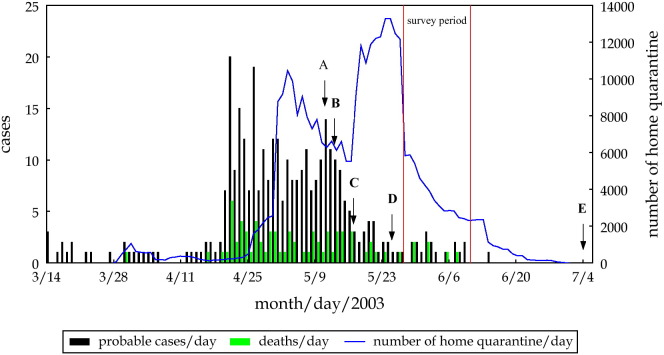
In May 2003, we sent structured questionnaires to all 361 health centers in Taiwan and asked the public health nurses responsible for epidemic control to complete. A total of 312 completed surveys were returned for a response rate of 86.4%. Descriptive methods and logistic regression were used to analyze the data.
Most public health nurses (71.9%) expressed a general lack of confidence in handling the SARS epidemic. Confidence was significantly associated with perceived epidemic severity (OR, 0.58; 95% CI: 0.35-0.99), daily epidemic updates (OR, 2.26; 95% CI: 1.28-3.98), and number of cases in the community (OR, 2.21; 95% CI: 1.13-4.31).
Nurses' individual risk perception and prompt update of epidemic information significantly affect levels of professional confidence, a key factor influencing quarantine implementation success. Strategies to promote productive interagency collaboration and advocate participatory policy making involving health workers at all levels are needed to control effectively infectious disease outbreaks.
在2003年严重急性呼吸综合征(SARS)疫情期间,台湾经历了最为严重的疫情爆发之一。公共卫生护士在实施广泛的隔离政策以防止疾病传播方面面临前所未有的挑战。然而,他们的职业信心在SARS危机期间受到了打击。本文评估了与公共卫生护士管理社区SARS防控项目信心相关的因素。
2003年5月,我们向台湾所有361个健康中心发送了结构化问卷,并要求负责疫情防控的公共卫生护士填写。共收回312份完整的调查问卷,回复率为86.4%。采用描述性方法和逻辑回归分析数据。
大多数公共卫生护士(71.9%)表示在处理SARS疫情方面普遍缺乏信心。信心与感知到的疫情严重程度(比值比[OR],0.58;95%置信区间[CI]:0.35 - 0.99)、每日疫情更新(OR,2.26;95% CI:1.28 - 3.98)以及社区病例数(OR,2.21;95% CI:1.13 - 4.31)显著相关。
护士的个人风险认知和疫情信息的及时更新显著影响职业信心水平,而职业信心是影响隔离措施实施成功的关键因素。需要采取策略促进有效的跨部门合作,并倡导各级卫生工作者参与政策制定,以有效控制传染病爆发。