Ishihara Junko, Inoue Manami, Kobayashi Minatsu, Tanaka Sachiko, Yamamoto Seiichiro, Iso Hiroyasu, Tsugane Shoichiro
Epidemiology and Prevention Division, Research Center for Cancer Prevention and Screening, National Cancer Center, Tokyo, Japan.
J Epidemiol. 2006 May;16(3):107-16. doi: 10.2188/jea.16.107.
Revision of the national nutrient database in 2000 had a strong impact on the absolute level of estimated nutrient intake in dietary assessments. However, whether it influenced the ranking of individuals by estimated intake, a more important function in epidemiologic studies, has not been investigated. Here, we investigated the effect of this revision of the nutrient database on the validity of a food frequency questionnaire (FFQ) used to estimate nutrient intake in the Japan Public Health Center-based prospective Study (JPHC Study).
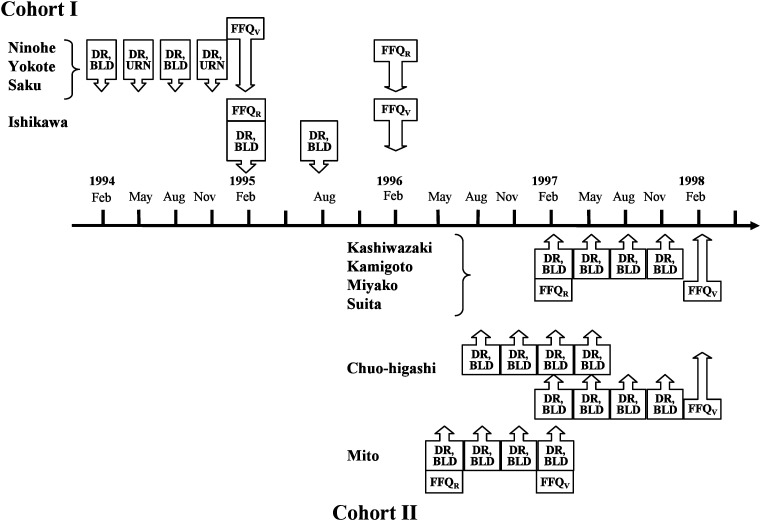
Subjects were a subsample of the JPHC Study who volunteered to participate in the validation study of the FFQ. Validity of the FFQ was evaluated by reference to the 28-day weighed dietary records as a gold standard. Nutrient intake according to the FFQ was recalculated using the revised database, and the results were compared to those using the previous database. Spearman's rank correlation coefficients (CCs) between intakes estimated by the FFQ and dietary records were computed using the revised database, and were compared to CCs computed using the previous database.
For most of the nutrients, mean intake increased or decreased significantly using the revised database. However, no notable change was seen for the CC between estimated intake according to dietary records and FFQ when the revised database was used for calculation. Differences in the point estimates of the CCs ranged from -0.14 to 0.15. Likewise, CCs between biomarkers and estimated intake according to FFQ were similar for the two databases.
Despite changes in intake levels for many nutrients, the validity of our FFQ using rank correlation by nutrient intake was not influenced by revision of the nutrient database in Japan.
2000年国家营养数据库的修订对膳食评估中估计营养素摄入量的绝对水平产生了重大影响。然而,它是否影响了根据估计摄入量对个体进行的排名(这在流行病学研究中是一个更重要的功能),尚未得到研究。在此,我们调查了营养数据库的此次修订对用于日本公共卫生中心前瞻性研究(JPHC研究)中估计营养素摄入量的食物频率问卷(FFQ)有效性的影响。
研究对象是JPHC研究中自愿参与FFQ验证研究的一个子样本。以28天称重膳食记录作为金标准来评估FFQ的有效性。使用修订后的数据库重新计算根据FFQ得出的营养素摄入量,并将结果与使用先前数据库得出的结果进行比较。使用修订后的数据库计算FFQ估计摄入量与膳食记录之间的Spearman等级相关系数(CCs),并与使用先前数据库计算的CCs进行比较。
对于大多数营养素,使用修订后的数据库时平均摄入量显著增加或减少。然而,当使用修订后的数据库进行计算时,根据膳食记录和FFQ得出的估计摄入量之间的CC没有明显变化。CCs点估计值的差异范围为-0.14至0.15。同样,两个数据库中生物标志物与根据FFQ得出的估计摄入量之间的CCs相似。
尽管许多营养素的摄入量水平发生了变化,但我们基于营养素摄入量等级相关的FFQ有效性并未受到日本营养数据库修订的影响。