Kitano Hiroaki, Oda Kanae
The Systems Biology Institute, Jingumae, Shibuya, Tokyo, Japan.
Mol Syst Biol. 2006;2:2006.0022. doi: 10.1038/msb4100039. Epub 2006 Jan 17.
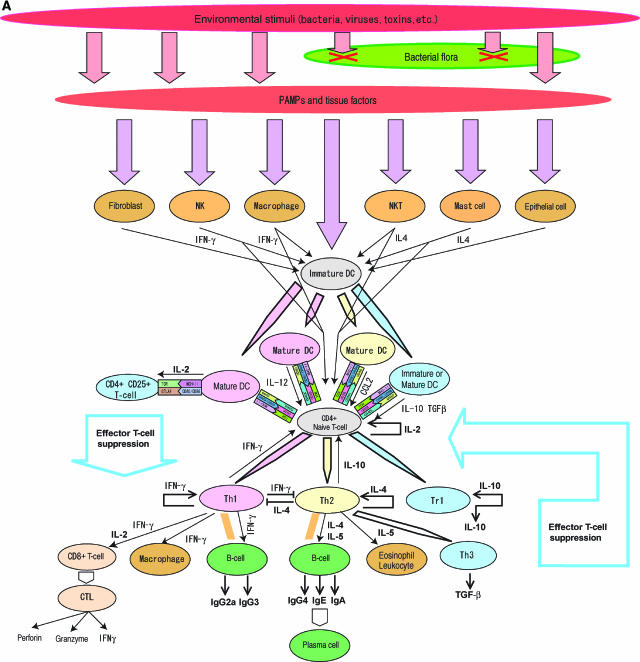
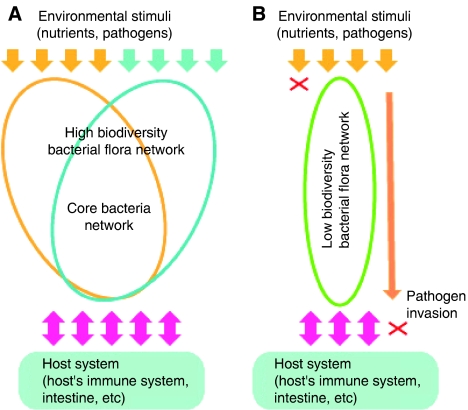
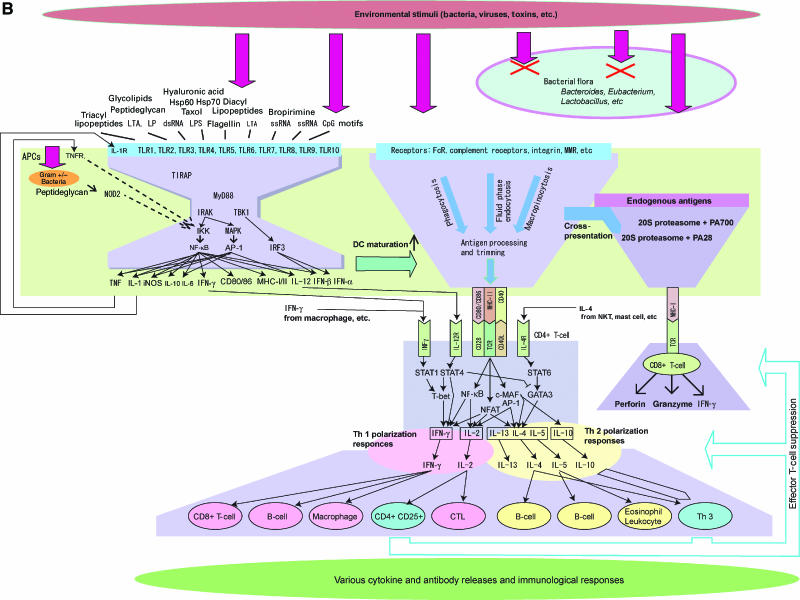
The immune system provides organisms with robustness against pathogen threats, yet it also often adversely affects the organism as in autoimmune diseases. Recently, the molecular interactions involved in the immune system have been uncovered. At the same time, the role of the bacterial flora and its interactions with the host immune system have been identified. In this article, we try to reconcile these findings to draw a consistent picture of the host defense system. Specifically, we first argue that the network of molecular interactions involved in immune functions has a bow-tie architecture that entails inherent trade-offs among robustness, fragility, resource limitation, and performance. Second, we discuss the possibility that commensal bacteria and the host immune system constitute an integrated defense system. This symbiotic association has evolved to optimize its robustness against pathogen attacks and nutrient perturbations by harboring a broad range of microorganisms. Owing to the inherent propensity of a host immune system toward hyperactivity, maintenance of bacterial flora homeostasis might be particularly important in the development of preventive strategies against immune disorders such as autoimmune diseases.
免疫系统为生物体提供抵御病原体威胁的强健性,但在自身免疫性疾病中,它也常常对生物体产生不利影响。最近,免疫系统中涉及的分子相互作用已被揭示。与此同时,细菌菌群的作用及其与宿主免疫系统的相互作用也已得到确认。在本文中,我们试图协调这些发现,以描绘出宿主防御系统的连贯图景。具体而言,我们首先认为,免疫功能中涉及的分子相互作用网络具有蝴蝶结结构,这在强健性、脆弱性、资源限制和性能之间存在内在权衡。其次,我们讨论共生细菌与宿主免疫系统构成一个综合防御系统的可能性。这种共生关系已经进化,通过容纳广泛的微生物来优化其抵御病原体攻击和营养扰动的强健性。由于宿主免疫系统具有过度活跃的固有倾向,维持细菌菌群的稳态在制定针对自身免疫性疾病等免疫紊乱的预防策略中可能尤为重要。