Rogers Christine A, Wayne Peter M, Macklin Eric A, Muilenberg Michael L, Wagner Christopher J, Epstein Paul R, Bazzaz Fakhri A
Exposure Epidemiology and Risk Program, Department of Environmental Health, Harvard School of Public Health, Landmark Center, Boston, Massachusetts 02215, USA.
Environ Health Perspect. 2006 Jun;114(6):865-9. doi: 10.1289/ehp.8549.
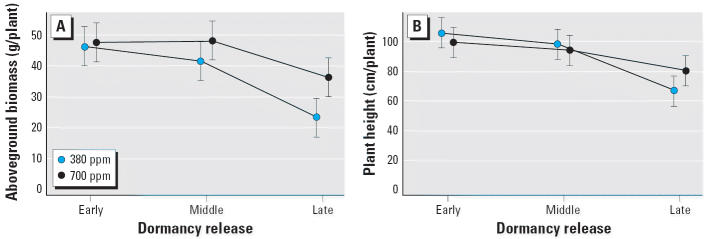
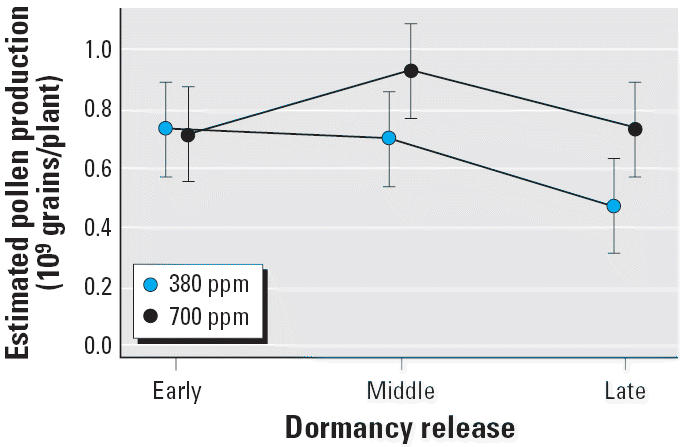
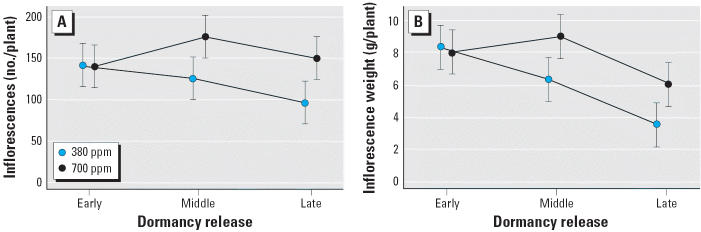
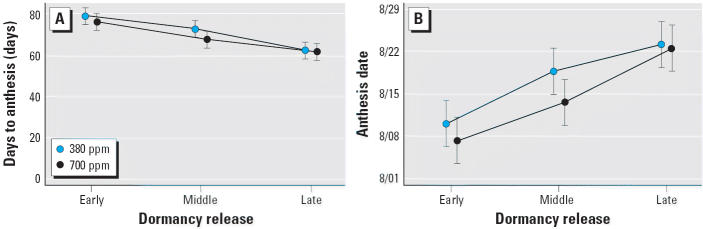
Increasing atmospheric carbon dioxide is responsible for climate changes that are having widespread effects on biological systems. One of the clearest changes is earlier onset of spring and lengthening of the growing season. We designed the present study to examine the interactive effects of timing of dormancy release of seeds with low and high atmospheric CO2 on biomass, reproduction, and phenology in ragweed plants (Ambrosia artemisiifolia L.), which produce highly allergenic pollen. We released ragweed seeds from dormancy at three 15-day intervals and grew plants in climate-controlled glass-houses at either ambient or 700-ppm CO2 concentrations, placing open-top bags over influorescences to capture pollen. Measurements of plant height and weight; inflorescence number, weight, and length; and days to anthesis and anthesis date were made on each plant, and whole-plant pollen productivity was estimated from an allometric-based model. Timing and CO2 interacted to influence pollen production. At ambient CO2 levels, the earlier cohort acquired a greater biomass, a higher average weight per inflorescence, and a larger number of influorescences; flowered earlier; and had 54.8% greater pollen production than did the latest cohort. At high CO2 levels, plants showed greater biomass and reproductive effort compared with those in ambient CO2 but only for later cohorts. In the early cohort, pollen production was similar under ambient and high CO2, but in the middle and late cohorts, high CO2 increased pollen production by 32% and 55%, respectively, compared with ambient CO2 levels. Overall, ragweed pollen production can be expected to increase significantly under predicted future climate conditions.
大气中二氧化碳含量的增加导致了气候变化,这对生物系统产生了广泛影响。最明显的变化之一是春季提前到来和生长季节延长。我们设计了本研究,以检验低、高大气二氧化碳浓度下种子休眠解除时间对豚草(Ambrosia artemisiifolia L.)生物量、繁殖和物候的交互影响,豚草会产生高致敏性花粉。我们每隔15天让豚草种子解除一次休眠,并将植株种植在气候可控的温室中,温室中的二氧化碳浓度为环境浓度或700 ppm,在花序上放置开放式袋子以收集花粉。测量每株植物的株高和重量、花序数量、重量和长度、开花天数和开花日期,并根据基于异速生长的模型估算整株植物的花粉产量。时间和二氧化碳相互作用影响花粉产量。在环境二氧化碳水平下,较早一批植株获得了更大的生物量、每个花序更高的平均重量和更多的花序数量;开花更早;花粉产量比最晚一批植株高54.8%。在高二氧化碳水平下,与环境二氧化碳条件下的植株相比,植株表现出更大的生物量和繁殖投入,但仅针对较晚一批植株。在较早一批植株中,环境二氧化碳和高二氧化碳条件下的花粉产量相似,但在中间和较晚一批植株中,与环境二氧化碳水平相比,高二氧化碳分别使花粉产量增加了32%和55%。总体而言,在预测的未来气候条件下,豚草花粉产量预计将显著增加。