Abascal Federico, Zardoya Rafael, Posada David
Departamento de Bioquímica, Genética, e Inmunología, Universidad de Vigo, 36310 Vigo, Spain.
Nucleic Acids Res. 2006 Jul 1;34(Web Server issue):W389-93. doi: 10.1093/nar/gkl044.
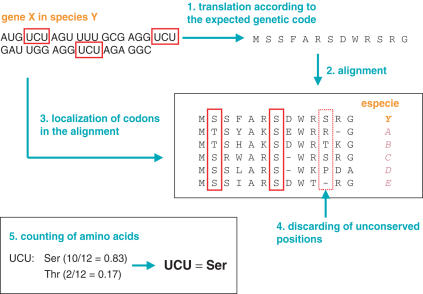
Although the majority of the organisms use the same genetic code to translate DNA, several variants have been described in a wide range of organisms, both in nuclear and organellar systems, many of them corresponding to metazoan mitochondria. These variants are usually found by comparative sequence analyses, either conducted manually or with the computer. Basically, when a particular codon in a query-species is linked to positions for which a specific amino acid is consistently found in other species, then that particular codon is expected to translate as that specific amino acid. Importantly, and despite the simplicity of this approach, there are no available tools to help predicting the genetic code of an organism. We present here GenDecoder, a web server for the characterization and prediction of mitochondrial genetic codes in animals. The analysis of automatic predictions for 681 metazoans aimed us to study some properties of the comparative method, in particular, the relationship among sequence conservation, taxonomic sampling and reliability of assignments. Overall, the method is highly precise (99%), although highly divergent organisms such as platyhelminths are more problematic. The GenDecoder web server is freely available from http://darwin.uvigo.es/software/gendecoder.html.
虽然大多数生物体使用相同的遗传密码来翻译DNA,但在广泛的生物体中,无论是在核系统还是细胞器系统中,都已描述了几种变体,其中许多与后生动物线粒体相对应。这些变体通常通过比较序列分析发现,分析方式可以是手动进行,也可以借助计算机。基本上,当查询物种中的某个特定密码子与在其他物种中始终发现特定氨基酸的位置相关联时,那么该特定密码子预计会翻译为该特定氨基酸。重要的是,尽管这种方法很简单,但目前没有可用的工具来帮助预测生物体的遗传密码。我们在此展示GenDecoder,这是一个用于表征和预测动物线粒体遗传密码的网络服务器。对681种后生动物自动预测的分析使我们研究了比较方法的一些特性,特别是序列保守性、分类抽样和分配可靠性之间的关系。总体而言,该方法非常精确(99%),尽管像扁形虫这样高度分化的生物体更具问题。GenDecoder网络服务器可从http://darwin.uvigo.es/software/gendecoder.html免费获取。