Abke Sabine, Neumeier Markus, Weigert Johanna, Wehrwein Gabriele, Eggenhofer Elke, Schäffler Andreas, Maier Kevin, Aslanidis Charalampos, Schölmerich Jürgen, Buechler Christa
Department of Internal Medicine I, University of Regensburg, D-93042 Regensburg, Germany.
Cardiovasc Diabetol. 2006 Aug 30;5:17. doi: 10.1186/1475-2840-5-17.
Systemic adiponectin is reduced in patients with cardiovascular disease (CVD) and low adiponectin may contribute to the pathogenesis of atherosclerosis. However, circulating adiponectin is elevated in type 1 diabetes (T1D) patients, who have also a higher incidence to develop CVD. Because monocytes play an important role in atherosclerosis, we analysed the influence of adiponectin on cytokine and chemokine release in monocytes from T1D patients and controls.
Systemic adiponectin was determined in the plasma and the high-molecular weight (HMW) form of adiponectin was analysed by immunoblot. Monocytes were isolated from T1D patients and controls and the adiponectin-stimulated release of interleukin-6 (IL-6), monocyte chemotactic protein-1 (MCP-1, CCL2) and interleukin-8 (IL-8, CXCL8) was analysed.
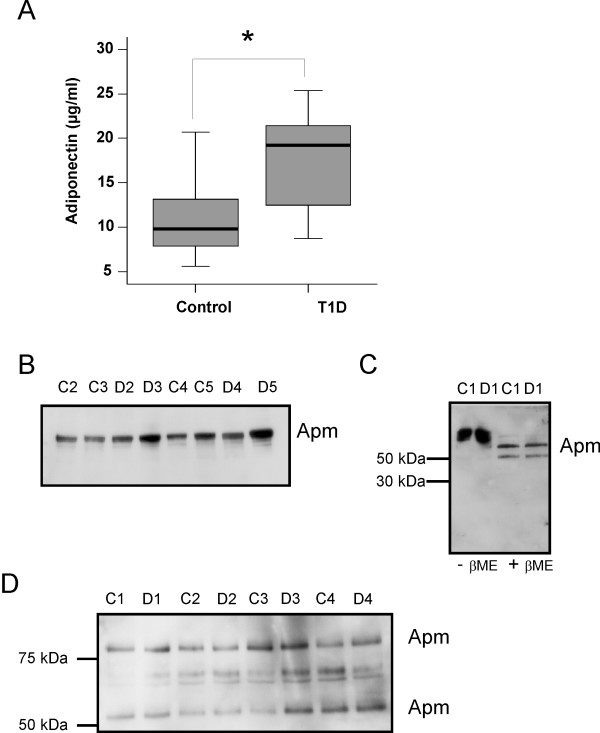
Systemic adiponectin was higher in T1D patients. Immunoblot analysis of the plasma indicate abundance of HMW adiponectin in T1D patients and controls. IL-6, CCL2 and CXCL8 secretion in response to adiponectin were found induced in monocytes from controls whereas only IL-6 was upregulated in T1D cells. The induction of IL-6 by adiponectin was abrogated by an inhibitor of the NFkappaB pathway.
These data indicate that adiponectin-mediated induction of IL-6, CCL2 and CXCL8 is disturbed in monocytes from T1D patients and therefore elevated systemic adiponectin in T1D patients may be less protective when compared to controls.
心血管疾病(CVD)患者体内的系统性脂联素水平降低,低水平的脂联素可能参与动脉粥样硬化的发病机制。然而,1型糖尿病(T1D)患者的循环脂联素水平升高,他们患CVD的几率也更高。由于单核细胞在动脉粥样硬化中起重要作用,我们分析了脂联素对T1D患者和对照组单核细胞中细胞因子和趋化因子释放的影响。
测定血浆中的系统性脂联素,并通过免疫印迹分析高分子量(HMW)形式的脂联素。从T1D患者和对照组中分离单核细胞,分析脂联素刺激后白细胞介素-6(IL-6)、单核细胞趋化蛋白-1(MCP-1,CCL2)和白细胞介素-8(IL-8,CXCL8)的释放情况。
T1D患者的系统性脂联素水平较高。血浆免疫印迹分析表明,T1D患者和对照组中均存在大量HMW脂联素。在对照组单核细胞中,脂联素可诱导IL-6、CCL2和CXCL8的分泌,而在T1D细胞中只有IL-6上调。脂联素对IL-6的诱导作用被NFκB途径抑制剂消除。
这些数据表明,T1D患者单核细胞中脂联素介导的IL-6、CCL2和CXCL8诱导作用受到干扰,因此与对照组相比,T1D患者体内升高的系统性脂联素可能保护作用较弱。