Freund T F, Gulyás A I, Acsády L, Görcs T, Tóth K
Department of Functional Neuroanatomy, Hungarian Academy of Sciences, Budapest.
Proc Natl Acad Sci U S A. 1990 Nov;87(21):8501-5. doi: 10.1073/pnas.87.21.8501.
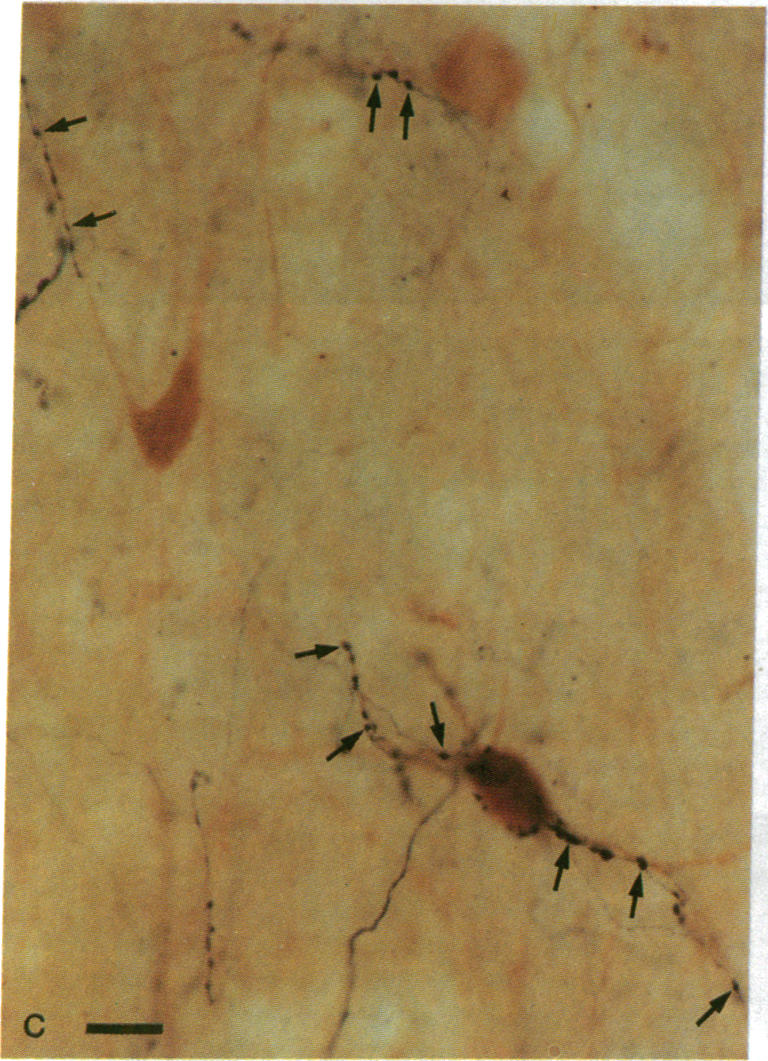
Information flow and processing in hippocampal neuronal networks is determined by a wide range of inhibitory mechanisms [e.g., feedforward or feedback, gamma-aminobutyrate (GABA) A or B receptor-mediated, perisomatic shunting, or distal dendritic inhibition], each subserving specialized functions. These forms of local inhibition are mediated by morphologically and neurochemically well-defined, mostly GABA-containing, interneurons, which control large populations of principal cells through their extensive axonal arborizations. These neurons can serve as ideal targets for subcortical pathways, such as those originating in the septum or raphe, which exercise a global control over hippocampal activity. This intriguing possibility prompted us to study whether the profound effect of the serotonergic raphe-hippocampal pathway is mediated by inhibitory interneurons or whether a direct diffuse action on the principal cells is dominant. We demonstrate that axons of this pathway form multiple synaptic contacts with hippocampal GABAergic interneurons. Interestingly, the serotonergic afferents selectively innervate the somata and dendritic trees of GABAergic neurons that contain the 28-kDa calcium-binding protein calbindin D28K, but never those that contain another calcium-binding protein, parvalbumin. These results show that the mechanism by which the serotonergic pathway may exert a powerful influence on hippocampal function involves the modulation of local inhibitory circuits. Furthermore, the selectivity in the choice of target GABAergic interneurons suggests a strong functional specialization among inhibitory circuits, as well as among the subcortical input pathways originating in the septum and raphe.
海马神经元网络中的信息流和处理过程由多种抑制机制决定[例如,前馈或反馈、γ-氨基丁酸(GABA)A或B受体介导、胞体旁分流或树突远端抑制],每种机制都具有特定的功能。这些局部抑制形式由形态和神经化学特征明确的中间神经元介导,这些中间神经元大多含有GABA,它们通过广泛的轴突分支控制大量的主细胞。这些神经元可以作为皮质下通路的理想靶点,比如起源于隔区或中缝核的通路,这些通路对海马活动进行整体控制。这种有趣的可能性促使我们研究血清素能中缝-海马通路的深远影响是由抑制性中间神经元介导的,还是对主细胞的直接扩散作用占主导地位。我们证明,该通路的轴突与海马GABA能中间神经元形成多个突触联系。有趣的是,血清素能传入纤维选择性地支配含有28 kDa钙结合蛋白钙结合蛋白D28K的GABA能神经元的胞体和树突,但从不支配含有另一种钙结合蛋白小白蛋白的神经元。这些结果表明,血清素能通路可能对海马功能产生强大影响的机制涉及局部抑制回路的调节。此外,对靶GABA能中间神经元的选择具有选择性,这表明抑制回路之间以及起源于隔区和中缝核的皮质下输入通路之间存在强大的功能特化。