Bergouignan Audrey, Schoeller Dale A, Normand Sylvie, Gauquelin-Koch Guillemette, Laville Martine, Shriver Timothy, Desage Michel, Le Maho Yvon, Ohshima Hiroshi, Gharib Claude, Blanc Stéphane
Institut Pluridisciplinaire Hubert Curien, Département d'Ecologie, Physiologie, et Ethologie, Strasbourg, France.
PLoS Clin Trials. 2006 Sep 29;1(5):e27. doi: 10.1371/journal.pctr.0010027.
Changes in the way dietary fat is metabolized can be considered causative in obesity. The role of sedentary behavior in this defect has not been determined. We hypothesized that physical inactivity partitions dietary fats toward storage and that a resistance exercise training program mitigates storage.
We used bed rest, with randomization to resistance training, as a model of physical inactivity.
The trial took place at the Space Clinic (Toulouse, France).
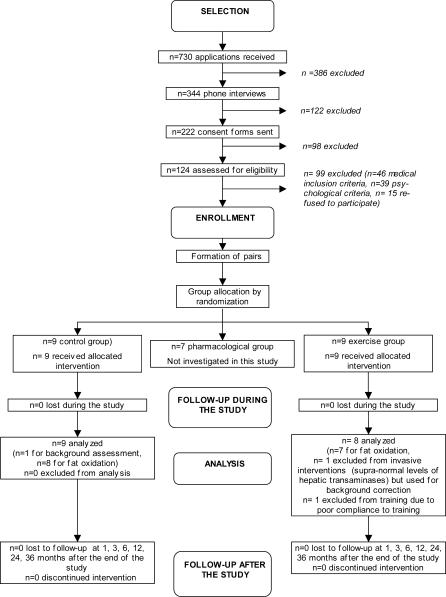
A total of 18 healthy male volunteers, of mean age +/- standard deviation 32.6 +/- 4.0 y and body mass index 23.6 +/- 0.7 kg/m(2), were enrolled.
An initial 15 d of baseline data collection were followed by 3 mo of strict bed-rest alone (control group, n = 9) or with the addition of supine resistance exercise training every 3 d (exercise group, n = 9).
Oxidation of labeled [d(31)]palmitate (the main saturated fatty acid of human diet) and [1-(13)C]oleate (the main monounsaturated fatty acid), body composition, net substrate use, and plasma hormones and metabolites were measured.
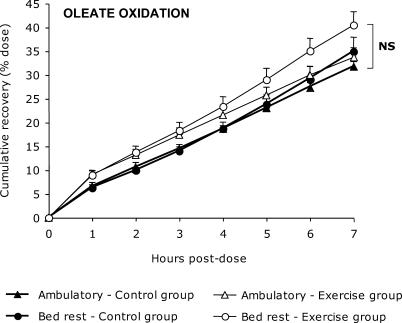
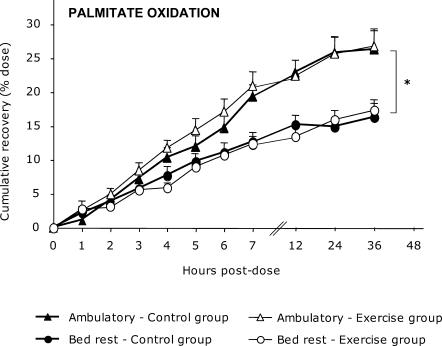
Between-group comparisons showed that exercise training did not affect oxidation of both oleate (mean difference 5.6%; 95% confidence interval [95% CI], -3.3% to 14.5%; p = 0.20) and palmitate (mean difference -0.2%; 95% CI, -4.1% to 3.6%; p = 0.89). Within-group comparisons, however, showed that inactivity changed oxidation of palmitate in the control group by -11.0% (95% CI, -19.0% to -2.9%; p = 0.01) and in the exercise group by -11.3% (95% CI, -18.4% to -4.2%; p = 0.008). In contrast, bed rest did not significantly affect oleate oxidation within groups. In the control group, the mean difference in oleate oxidation was 3.2% (95% CI, -4.2% to 10.5%; p = 0.34) and 6.8% (95% CI, -1.2% to 14.7%; p = 0.08) in the exercise group.
Independent of changes in energy balance (intake and/or output), physical inactivity decreased the oxidation of saturated but not monounsaturated dietary fat. The effect is apparently not compensated by resistance exercise training. These results suggest that Mediterranean diets should be recommended in sedentary subjects and recumbent patients.
饮食脂肪代谢方式的改变被认为是肥胖的病因。久坐行为在这种缺陷中的作用尚未确定。我们假设身体不活动会使饮食脂肪倾向于储存,而抗阻运动训练计划可减轻脂肪储存。
我们将卧床休息并随机分为抗阻训练组,作为身体不活动的模型。
试验在太空诊所(法国图卢兹)进行。
共招募了18名健康男性志愿者,平均年龄±标准差为32.6±4.0岁,体重指数为23.6±0.7kg/m²。
最初进行15天的基线数据收集,随后3个月,一组仅严格卧床休息(对照组,n = 9),另一组每3天增加一次仰卧抗阻运动训练(运动组,n = 9)。
测量标记的[d(31)]棕榈酸(人类饮食中的主要饱和脂肪酸)和[1-(13)C]油酸(主要单不饱和脂肪酸)的氧化、身体成分、净底物利用以及血浆激素和代谢产物。
组间比较显示,运动训练对油酸(平均差异5.6%;95%置信区间[95%CI],-3.3%至14.5%;p = 0.20)和棕榈酸(平均差异-0.2%;95%CI,-4.1%至3.6%;p = 0.89)的氧化均无影响。然而,组内比较显示,不活动使对照组棕榈酸氧化降低了-11.0%(95%CI,-19.0%至-2.9%;p = 0.01),运动组降低了-11.3%(95%CI,-18.4%至-4.2%;p = 0.008)。相比之下,卧床休息对组内油酸氧化无显著影响。对照组油酸氧化的平均差异为3.2%(95%CI,-4.2%至10.5%;p = 0.34),运动组为6.8%(95%CI,-1.2%至14.7%;p = 0.08)。
与能量平衡(摄入和/或输出)的变化无关,身体不活动会降低饱和饮食脂肪的氧化,但不会降低单不饱和饮食脂肪的氧化。抗阻运动训练显然无法补偿这种影响。这些结果表明,应向久坐的人和卧床患者推荐地中海饮食。