Miller F W, Waite K A, Biswas T, Plotz P H
Arthritis and Rheumatism Branch, National Institute of Arthritis and Musculoskeletal and Skin Diseases, National Institutes of Health, Bethesda, MD 20892.
Proc Natl Acad Sci U S A. 1990 Dec;87(24):9933-7. doi: 10.1073/pnas.87.24.9933.
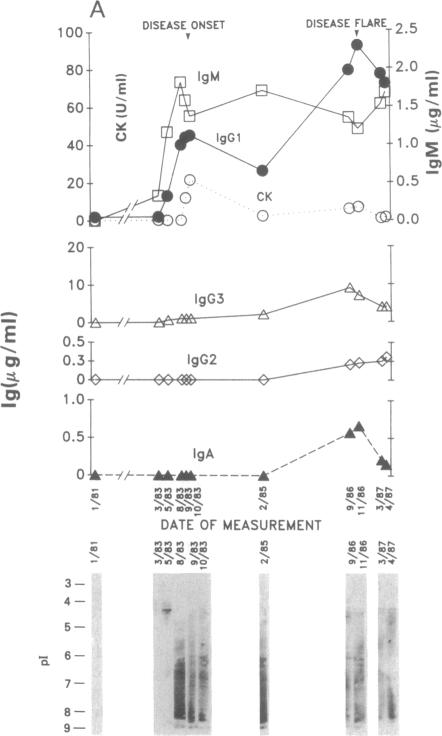
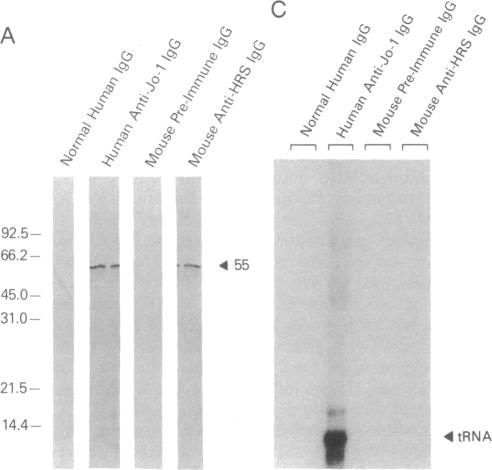
Patients with systemic autoimmune diseases make specific autoantibodies that are directed against self structures. According to one view, these autoantibodies arise as a result of an immune response to foreign antigens such as infectious agents that share, by molecular mimicry, common structures with host proteins. An alternative view is that the target autoantigen itself initiates, selects, and sustains autoantibody synthesis. We show here that anti-Jo-1 autoantibodies directed against histidyl-tRNA synthetase in the human autoimmune muscle disease polymyositis undergo, in addition to spectrotype broadening and class switching, the sine qua non of an immune response to the target antigen--affinity maturation to that antigen. We demonstrate further that these autoantibodies, unlike anti-synthetase antibodies induced in mice immunized with heterologous antigen, bind only nonlinear epitopes on the native human synthetase that remain exposed when the enzyme is complexed to tRNA(His). These data suggest that the native target autoantigen itself has played a direct role in selecting and sustaining the autoantibody response and sharply restrict the time and the way in which a molecular mimic might act to provoke autoantibodies.
患有全身性自身免疫性疾病的患者会产生针对自身结构的特异性自身抗体。一种观点认为,这些自身抗体是由于对诸如感染因子等外来抗原产生免疫反应而产生的,这些感染因子通过分子模拟与宿主蛋白具有共同结构。另一种观点是,靶自身抗原本身启动、选择并维持自身抗体的合成。我们在此表明,在人类自身免疫性肌肉疾病多肌炎中,针对组氨酰 - tRNA合成酶的抗Jo - 1自身抗体,除了光谱型拓宽和类别转换外,还经历了对靶抗原免疫反应的关键要素——对该抗原的亲和力成熟。我们进一步证明,与用异源抗原免疫的小鼠中诱导产生的抗合成酶抗体不同,这些自身抗体仅结合天然人合成酶上的非线性表位,当该酶与tRNA(His)复合时这些表位仍暴露在外。这些数据表明,天然靶自身抗原本身在选择和维持自身抗体反应中发挥了直接作用,并严格限制了分子模拟引发自身抗体的时间和方式。