Bent Stephen, Padula Amy, Moore Dan, Patterson Michael, Mehling Wolf
Osher Center for Integrative Medicine, University of California, San Francisco, CA 94121, USA.
Am J Med. 2006 Dec;119(12):1005-12. doi: 10.1016/j.amjmed.2006.02.026.
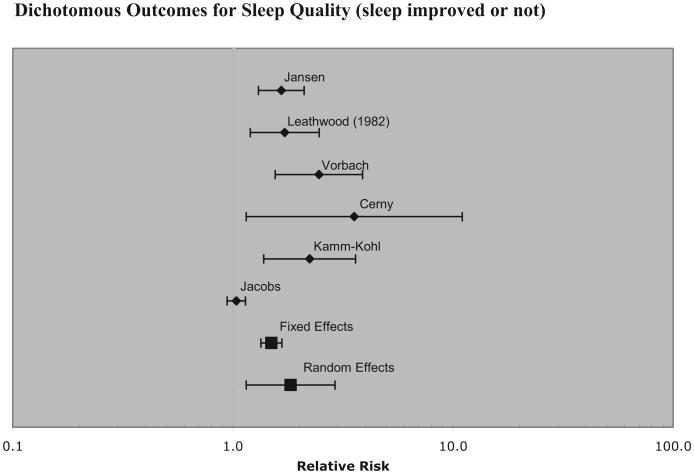
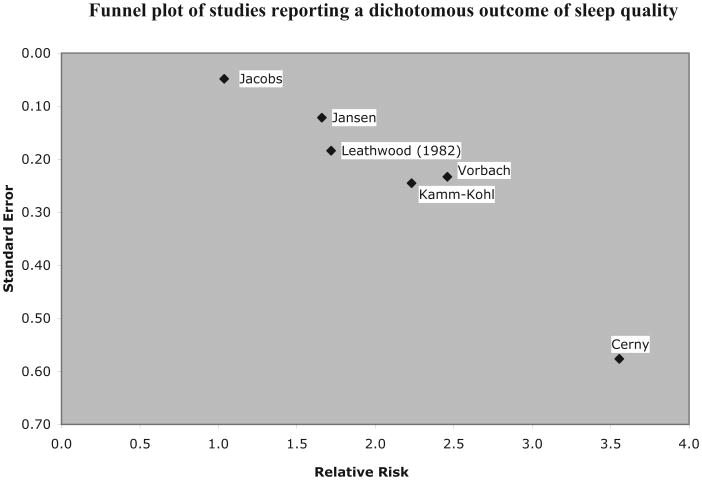
Insomnia affects approximately one-third of the adult population and contributes to increased rates of absenteeism, health care use, and social disability. Extracts of the roots of valerian (Valeriana officinalis) are widely used for inducing sleep and improving sleep quality. A systematic review of randomized, placebo-controlled trials of valerian for improving sleep quality is presented. An extensive literature search identified 16 eligible studies examining a total of 1093 patients. Most studies had significant methodologic problems, and the valerian doses, preparations, and length of treatment varied considerably. A dichotomous outcome of sleep quality (improved or not) was reported by 6 studies and showed a statistically significant benefit (relative risk of improved sleep = 1.8, 95% confidence interval, 1.2-2.9), but there was evidence of publication bias in this summary measure. The available evidence suggests that valerian might improve sleep quality without producing side effects. Future studies should assess a range of doses of standardized preparations of valerian and include standard measures of sleep quality and safety.
失眠影响着约三分之一的成年人口,并导致旷工率、医疗保健使用率和社会残疾率上升。缬草(Valeriana officinalis)根提取物被广泛用于诱导睡眠和改善睡眠质量。本文对缬草改善睡眠质量的随机、安慰剂对照试验进行了系统评价。广泛的文献检索确定了16项符合条件的研究,共涉及1093名患者。大多数研究存在重大方法学问题,缬草的剂量、制剂和治疗时长差异很大。6项研究报告了睡眠质量的二分结果(改善或未改善),显示出统计学上的显著益处(睡眠改善的相对风险=1.8,95%置信区间,1.2 - 2.9),但该汇总指标存在发表偏倚的证据。现有证据表明,缬草可能改善睡眠质量且无副作用。未来的研究应评估一系列标准化缬草制剂的剂量,并纳入睡眠质量和安全性的标准测量方法。