• 文献检索
  • 文档翻译
  • 深度研究
  • 学术资讯
  • Suppr Zotero 插件Zotero 插件
  • 邀请有礼
  • 套餐&价格
  • 历史记录
应用&插件
Suppr Zotero 插件Zotero 插件浏览器插件Mac 客户端Windows 客户端微信小程序
定价
高级版会员购买积分包购买API积分包
服务
文献检索文档翻译深度研究API 文档MCP 服务
关于我们
关于 Suppr公司介绍联系我们用户协议隐私条款
关注我们

Suppr 超能文献

核心技术专利:CN118964589B侵权必究
粤ICP备2023148730 号-1Suppr @ 2026

文献检索

告别复杂PubMed语法,用中文像聊天一样搜索,搜遍4000万医学文献。AI智能推荐,让科研检索更轻松。

立即免费搜索

文件翻译

保留排版,准确专业,支持PDF/Word/PPT等文件格式,支持 12+语言互译。

免费翻译文档

深度研究

AI帮你快速写综述,25分钟生成高质量综述,智能提取关键信息,辅助科研写作。

立即免费体验

一项基于人群的印度南部人类免疫缺陷病毒研究揭示了与基于哨点监测估计值的重大差异。

A population-based study of human immunodeficiency virus in south India reveals major differences from sentinel surveillance-based estimates.

作者信息

Dandona Lalit, Lakshmi Vemu, Sudha Talasila, Kumar G Anil, Dandona Rakhi

机构信息

Health Studies Area, Centre for Human Development, Administrative Staff College of India, Hyderabad, India.

出版信息

BMC Med. 2006 Dec 13;4:31. doi: 10.1186/1741-7015-4-31.

DOI:10.1186/1741-7015-4-31
PMID:17166257
原文链接:https://pmc.ncbi.nlm.nih.gov/articles/PMC1764025/
Abstract

BACKGROUND

The human immunodeficiency virus (HIV) burden among adults in India is estimated officially by direct extrapolation of annual sentinel surveillance data from public-sector antenatal and sexually transmitted infection (STI) clinics and some high-risk groups. The validity of these extrapolations has not been systematically examined with a large sample population-based study.

METHODS

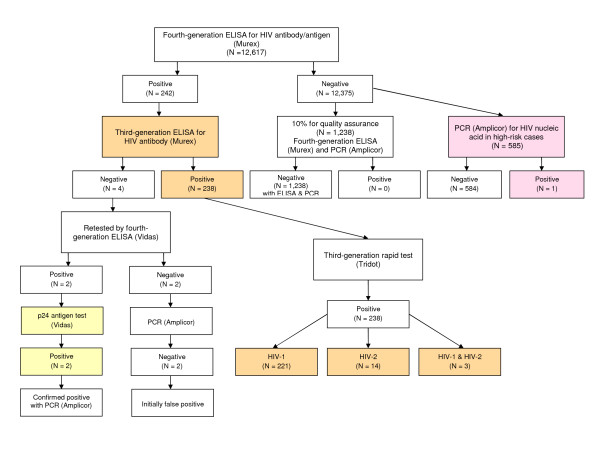
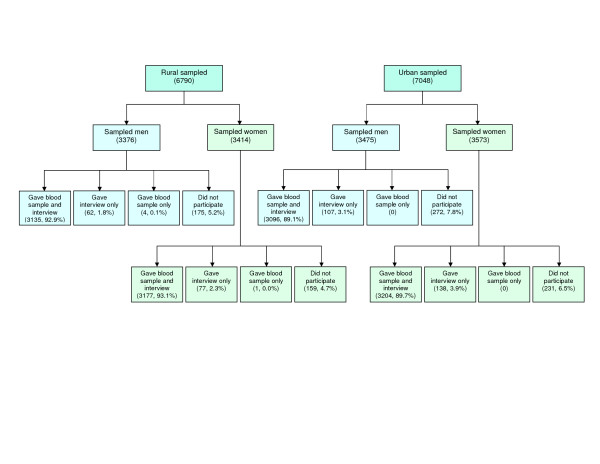
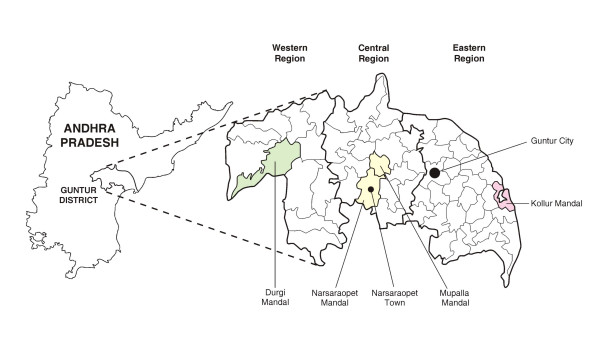
We sampled 13838 people, 15-49 years old, from 66 rural and urban clusters using a stratified random method to represent adults in Guntur district in the south Indian state of Andhra Pradesh. We interviewed the sampled participants and obtained dried blood spots from them, and tested blood for HIV antibody, antigen and nucleic acid. We calculated the number of people with HIV in Guntur district based on these data, compared it with the estimate using the sentinel surveillance data and method, and analysed health services use data to understand the differences.

RESULTS

In total, 12617 people (91.2% of the sampled group) gave a blood sample. Adjusted HIV prevalence was 1.72% (95% confidence interval 1.35-2.09%); men 1.74% (1.27-2.21%), women 1.70% (1.36-2.04%); rural 1.64% (1.10-2.18%), urban 1.89% (1.39-2.39%). HIV prevalence was 2.58% and 1.20% in people in the lower and upper halves of a standard of living index (SLI). Of women who had become pregnant during the past 2 years, 21.1% had used antenatal care in large public-sector hospitals participating in sentinel surveillance. There was an over-representation of the lowest SLI quartile (44.7%) in this group, and 3.61% HIV prevalence versus 1.08% in the remaining pregnant women. HIV prevalence was higher in that group even when women were matched for the same SLI half (lower half 4.39%, upper 2.63%) than in the latter (lower 1.06%, upper 1.05%), due to referral of HIV-positive/suspected women by private practitioners to public hospitals. The sentinel surveillance method (HIV prevalence: antenatal clinic 3%, STI clinic 22.8%, female sex workers 12.8%) led to an estimate of 112635 (4.38%) people with HIV, 15-49 years old, in Guntur district, which was 2.5 times the 45942 (1.79%) estimate based on our population-based study.

CONCLUSION

The official method in India leads to a gross overestimation of the HIV burden in this district due to addition of substantial extra HIV estimates from STI clinics, the common practice of referral of HIV-positive/suspected people to public hospitals, and a preferential use of public hospitals by people in lower socioeconomic strata. India may be overestimating its HIV burden with the currently used official estimation method.

摘要

背景

印度官方通过直接外推公共部门产前和性传播感染(STI)诊所以及一些高危人群的年度哨点监测数据,来估计成年人中的人类免疫缺陷病毒(HIV)负担。这些外推的有效性尚未通过基于大样本人群的研究进行系统检验。

方法

我们采用分层随机方法,从印度南部安得拉邦贡图尔区的66个城乡集群中抽取了13838名15至49岁的人,以代表该地区的成年人。我们对抽样参与者进行了访谈,并采集了他们的干血斑,检测血液中的HIV抗体、抗原和核酸。我们根据这些数据计算了贡图尔区的HIV感染者人数,将其与使用哨点监测数据和方法得出的估计值进行比较,并分析卫生服务使用数据以了解差异。

结果

共有12617人(占抽样组的91.2%)提供了血样。校正后的HIV流行率为1.72%(95%置信区间1.35 - 2.09%);男性为1.74%(1.27 - 2.21%),女性为1.70%(1.36 - 2.04%);农村为1.64%(1.10 - 2.18%),城市为1.89%(1.39 - 2.39%)。生活水平指数(SLI)下半部分人群的HIV流行率为2.58%,上半部分人群为1.20%。在过去两年中怀孕的妇女中,21.1%在参与哨点监测的大型公共部门医院接受了产前护理。该组中SLI最低四分位数人群的占比过高(44.7%),HIV流行率为3.61%,而其余孕妇的流行率为1.08%。即使将妇女按相同的SLI半部分进行匹配(下半部分4.39%,上半部分2.63%),该组的HIV流行率仍高于后者(下半部分1.06%,上半部分1.05%),这是由于私人执业医生将HIV阳性/疑似妇女转诊至公立医院所致。哨点监测方法(HIV流行率:产前诊所3%,性传播感染诊所22.8%,女性性工作者12.8%)得出贡图尔区15至49岁的HIV感染者估计人数为112635人(4.38%),这是基于我们的人群研究得出的估计值45942人(1.79%)的2.5倍。

结论

由于性传播感染诊所大幅增加了额外的HIV估计数、HIV阳性/疑似患者转诊至公立医院的普遍做法以及社会经济地位较低阶层的人群优先使用公立医院,印度的官方方法导致该地区HIV负担被严重高估。印度目前使用的官方估计方法可能高估了其HIV负担。
https://cdn.ncbi.nlm.nih.gov/pmc/blobs/ceee/1764025/c29e57a6ffb1/1741-7015-4-31-3.jpg
https://cdn.ncbi.nlm.nih.gov/pmc/blobs/ceee/1764025/f41ba40a50c3/1741-7015-4-31-1.jpg
https://cdn.ncbi.nlm.nih.gov/pmc/blobs/ceee/1764025/6cbeaf1d4651/1741-7015-4-31-2.jpg
https://cdn.ncbi.nlm.nih.gov/pmc/blobs/ceee/1764025/c29e57a6ffb1/1741-7015-4-31-3.jpg
https://cdn.ncbi.nlm.nih.gov/pmc/blobs/ceee/1764025/f41ba40a50c3/1741-7015-4-31-1.jpg
https://cdn.ncbi.nlm.nih.gov/pmc/blobs/ceee/1764025/6cbeaf1d4651/1741-7015-4-31-2.jpg
https://cdn.ncbi.nlm.nih.gov/pmc/blobs/ceee/1764025/c29e57a6ffb1/1741-7015-4-31-3.jpg

相似文献

1
A population-based study of human immunodeficiency virus in south India reveals major differences from sentinel surveillance-based estimates.一项基于人群的印度南部人类免疫缺陷病毒研究揭示了与基于哨点监测估计值的重大差异。
BMC Med. 2006 Dec 13;4:31. doi: 10.1186/1741-7015-4-31.
2
Is the HIV burden in India being overestimated?印度的艾滋病毒负担是否被高估了?
BMC Public Health. 2006 Dec 20;6:308. doi: 10.1186/1471-2458-6-308.
3
Studying dynamics of the HIV epidemic: population-based data compared with sentinel surveillance in Zambia.研究赞比亚艾滋病病毒流行动态:基于人群的数据与哨点监测的比较。
AIDS. 1998 Jul 9;12(10):1227-34. doi: 10.1097/00002030-199810000-00015.
4
Sentinel surveillance for HIV-1 infection: how representative are blood donors, outpatients with fever, anaemia, or sexually transmitted diseases, and antenatal clinic attenders in Mwanza Region, Tanzania?对HIV-1感染的哨点监测:坦桑尼亚姆万扎地区的献血者、发烧、贫血或患有性传播疾病的门诊患者以及产前检查者具有多大代表性?
AIDS. 1993 Apr;7(4):567-72.
5
Risk factors associated with HIV in a population-based study in Andhra Pradesh state of India.在印度安得拉邦进行的一项基于人群的研究中与艾滋病毒相关的风险因素。
Int J Epidemiol. 2008 Dec;37(6):1274-86. doi: 10.1093/ije/dyn161. Epub 2008 Aug 13.
6
Population and antenatal-based HIV prevalence estimates in a high contracepting female population in rural South Africa.南非农村高避孕率女性人群中基于人口和产前检查的艾滋病毒流行率估计
BMC Public Health. 2007 Jul 18;7:160. doi: 10.1186/1471-2458-7-160.
7
HIV testing among adults in a high prevalence district in India.印度高流行区成年人中的艾滋病毒检测。
Natl Med J India. 2009 Nov-Dec;22(6):289-93.
8
Sentinel surveillance and cross sectional survey on HIV infection prevalence: a comparative study.艾滋病病毒感染率的哨点监测与横断面调查:一项对比研究。
East Afr Med J. 1996 May;73(5):298-302.
9
Multilevel Analysis of the Predictors of HIV Prevalence among Pregnant Women Enrolled in Annual HIV Sentinel Surveillance in Four States in Southern India.印度南部四个邦参加年度艾滋病毒哨点监测的孕妇中艾滋病毒流行率预测因素的多水平分析
PLoS One. 2015 Jul 6;10(7):e0131629. doi: 10.1371/journal.pone.0131629. eCollection 2015.
10
Prevalence and determinants of HIV and sexually transmitted infections in a general population-based sample in Mysore district, Karnataka state, southern India.印度南部卡纳塔克邦迈索尔区一个基于普通人群样本的艾滋病毒和性传播感染的患病率及决定因素
AIDS. 2008 Dec;22 Suppl 5:S117-25. doi: 10.1097/01.aids.0000343770.92949.0b.

引用本文的文献

1
Strengthening India's Response to HIV/AIDS Epidemic Through Strategic Planning, Innovative Financing, and Mathematical Modeling: Key Achievements over the Last 3 Decades.通过战略规划、创新融资和数学建模加强印度对艾滋病毒/艾滋病疫情的应对:过去三十年的关键成就
J Indian Inst Sci. 2022;102(2):791-809. doi: 10.1007/s41745-022-00331-y. Epub 2022 Sep 7.
2
Stability of Human Immunodeficiency Virus Serological Markers in Samples Collected as HemaSpot and Whatman 903 Dried Blood Spots.HemaSpot 和 Whatman 903 干血斑采集样本中人类免疫缺陷病毒血清学标志物的稳定性。
J Clin Microbiol. 2018 Sep 25;56(10). doi: 10.1128/JCM.00933-18. Print 2018 Oct.
3

本文引用的文献

1
National population based HIV prevalence surveys in sub-Saharan Africa: results and implications for HIV and AIDS estimates.撒哈拉以南非洲基于全国人口的艾滋病毒流行率调查:结果及对艾滋病毒和艾滋病估计数的影响
Sex Transm Infect. 2006 Jun;82 Suppl 3(Suppl 3):iii64-70. doi: 10.1136/sti.2006.019901.
2
Demography and sex work characteristics of female sex workers in India.印度女性性工作者的人口统计学特征及性工作特点
BMC Int Health Hum Rights. 2006 Apr 14;6:5. doi: 10.1186/1472-698X-6-5.
3
How much attention is needed towards men who sell sex to men for HIV prevention in India?
Analysis of Viral Diversity in Relation to the Recency of HIV-1C Infection in Botswana.
博茨瓦纳与HIV-1C感染近期情况相关的病毒多样性分析。
PLoS One. 2016 Aug 23;11(8):e0160649. doi: 10.1371/journal.pone.0160649. eCollection 2016.
4
Sero-Epidemiological and Behavioural Survey of HIV, HBV and HCV amongst Indian Armed Forces Trainees.印度武装部队学员中艾滋病毒、乙肝病毒和丙肝病毒的血清流行病学及行为调查。
Med J Armed Forces India. 2010 Jan;66(1):50-4. doi: 10.1016/S0377-1237(10)80093-0. Epub 2011 Jul 21.
5
Seroprevalence of human immunodeficiency virus in pregnant women: A hospital based study from North Delhi.孕妇中人类免疫缺陷病毒的血清流行率:一项来自北德里的基于医院的研究。
Indian J Sex Transm Dis AIDS. 2015 Jul-Dec;36(2):217-8. doi: 10.4103/0253-7184.167192.
6
Monitoring HIV Epidemic in Pregnant Women: Are the Current Measures Enough?监测孕妇中的艾滋病毒流行情况:当前措施是否足够?
J Sex Transm Dis. 2015;2015:194831. doi: 10.1155/2015/194831. Epub 2015 Jan 19.
7
Population and dyadic-based seroincidence of herpes simplex virus-2 and syphilis in southern India.印度南部单纯疱疹病毒2型和梅毒基于人群及配对的血清学发病率
Sex Transm Infect. 2015 Aug;91(5):375-82. doi: 10.1136/sextrans-2014-051708. Epub 2015 Jan 20.
8
A digital network approach to infer sex behavior in emerging HIV epidemics.一种用于推断新出现的艾滋病毒疫情中性行为的数字网络方法。
PLoS One. 2014 Jul 3;9(7):e101416. doi: 10.1371/journal.pone.0101416. eCollection 2014.
9
Factors associated with attrition, mortality, and loss to follow up after antiretroviral therapy initiation: data from an HIV cohort study in India.抗逆转录病毒治疗启动后与流失、死亡和失访相关的因素:来自印度一项 HIV 队列研究的数据。
Glob Health Action. 2013 Sep 12;6:21682. doi: 10.3402/gha.v6i0.21682.
10
HIV incidence from the first population-based cohort study in India.印度首次基于人群的队列研究中的 HIV 发病率。
BMC Infect Dis. 2013 Jul 17;13:327. doi: 10.1186/1471-2334-13-327.
在印度,对于向男性提供性服务的男性群体,在预防艾滋病毒方面需要给予多少关注?
BMC Public Health. 2006 Feb 15;6:31. doi: 10.1186/1471-2458-6-31.
4
Cost and efficiency of public sector sexually transmitted infection clinics in Andhra Pradesh, India.印度安得拉邦公共部门性传播感染诊所的成本与效率
BMC Health Serv Res. 2005 Nov 5;5:69. doi: 10.1186/1472-6963-5-69.
5
High risk of HIV in non-brothel based female sex workers in India.印度非妓院女性性工作者感染艾滋病毒的风险很高。
BMC Public Health. 2005 Aug 20;5:87. doi: 10.1186/1471-2458-5-87.
6
Association between medical injections and HIV infection in a community-based study in India.印度一项基于社区的研究中医疗注射与艾滋病毒感染之间的关联。
AIDS. 2005 Aug 12;19(12):1334-6. doi: 10.1097/01.aids.0000180111.34185.88.
7
Community prevalence of antibodies to human immunodeficiency virus in rural and urban Vellore, Tamil Nadu.印度泰米尔纳德邦韦洛尔城乡地区人类免疫缺陷病毒抗体的社区流行情况。
Natl Med J India. 2005 Jan-Feb;18(1):15-7.
8
Application of laboratory methods for estimation of HIV-1 incidence.用于估计HIV-1发病率的实验室方法的应用。
Indian J Med Res. 2005 Apr;121(4):510-8.
9
Sex behaviour of men who have sex with men and risk of HIV in Andhra Pradesh, India.印度安得拉邦男男性行为者的性行为与感染艾滋病毒的风险
AIDS. 2005 Mar 24;19(6):611-9. doi: 10.1097/01.aids.0000163938.01188.e4.
10
Enhancing the evidence base for HIV/AIDS control in India.加强印度艾滋病毒/艾滋病防治的证据基础。
Natl Med J India. 2004 May-Jun;17(3):160-6.