Sacco Isabel de Camargo Neves, Takahasi Henrique Yuji, Suda Eneida Yuri, Battistella Linamara Rizzo, Kavamoto Cristianne Akie, Lopes José Augusto Fernandes, Vasconcelos Jeane Cintra Peixoto de
Department of Physical Therapy, Speech and Occupational Therapy, School of Medicine, Universidade de São Paulo, Rua Cipotânia 51, Cidade Universitária São Paulo (SP), CEP 05360-000, Brazil.
Sao Paulo Med J. 2006 Sep 7;124(5):245-52. doi: 10.1590/s1516-31802006000500002.
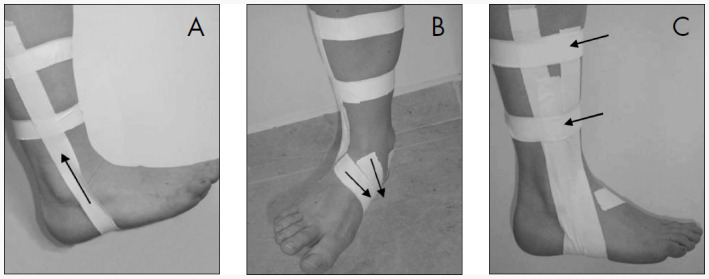
In basketball, the most common injuries are ankle sprains. For this reason, players frequently use external ankle devices or taping as prophylactic and rehabilitation measures. The purpose of this study was to evaluate ground reaction force (GRF) responses in basketball players while performing typical cutting maneuvers with and without ankle bracing and ankle taping.
Comparative study with experimental design of single-group repeated measurements, at Medical Rehabilitation Division, Hospital das Clínicas, Faculdade de Medicina, Universidade de São Paulo.
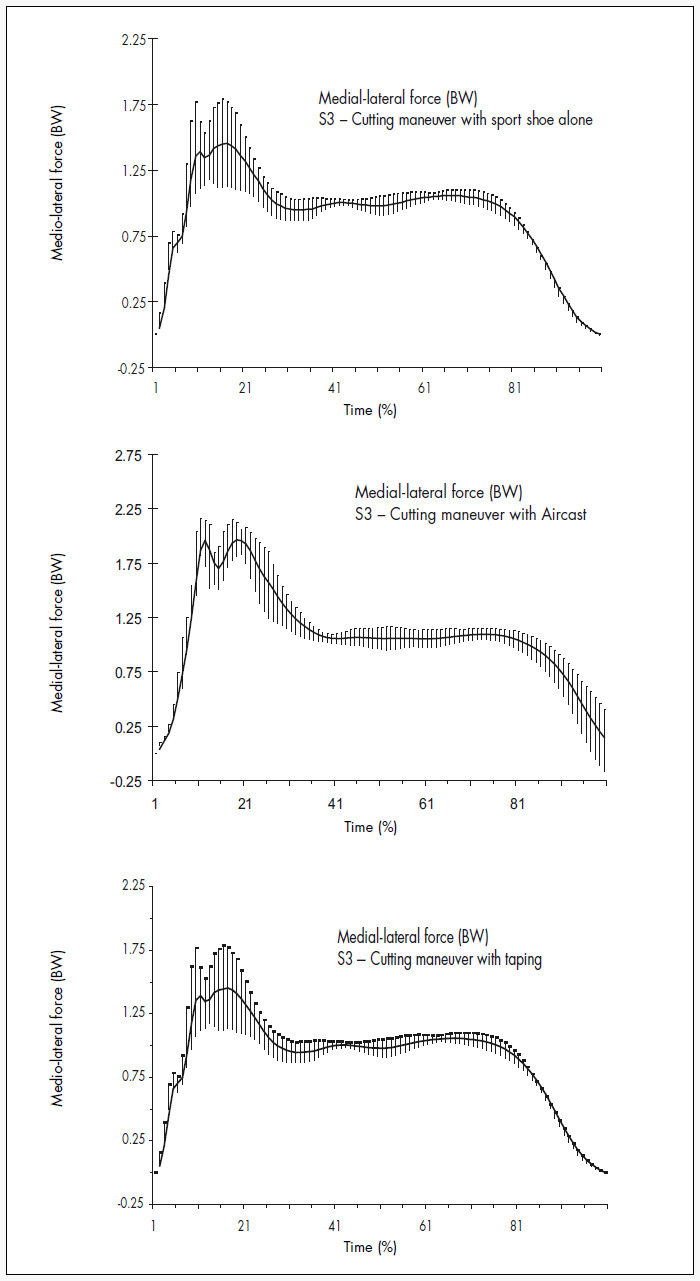
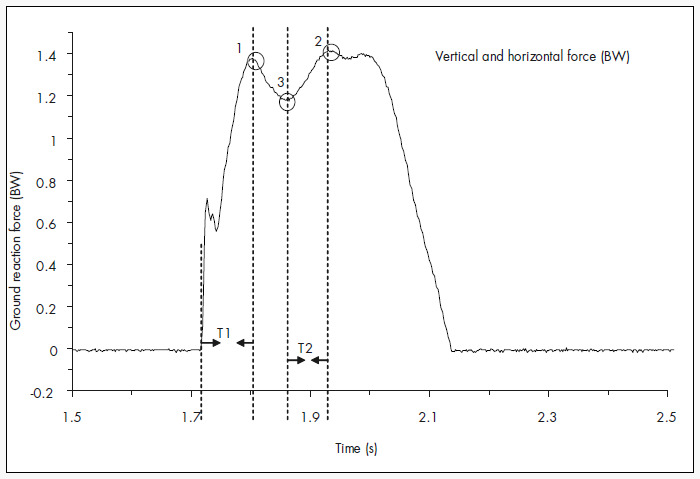
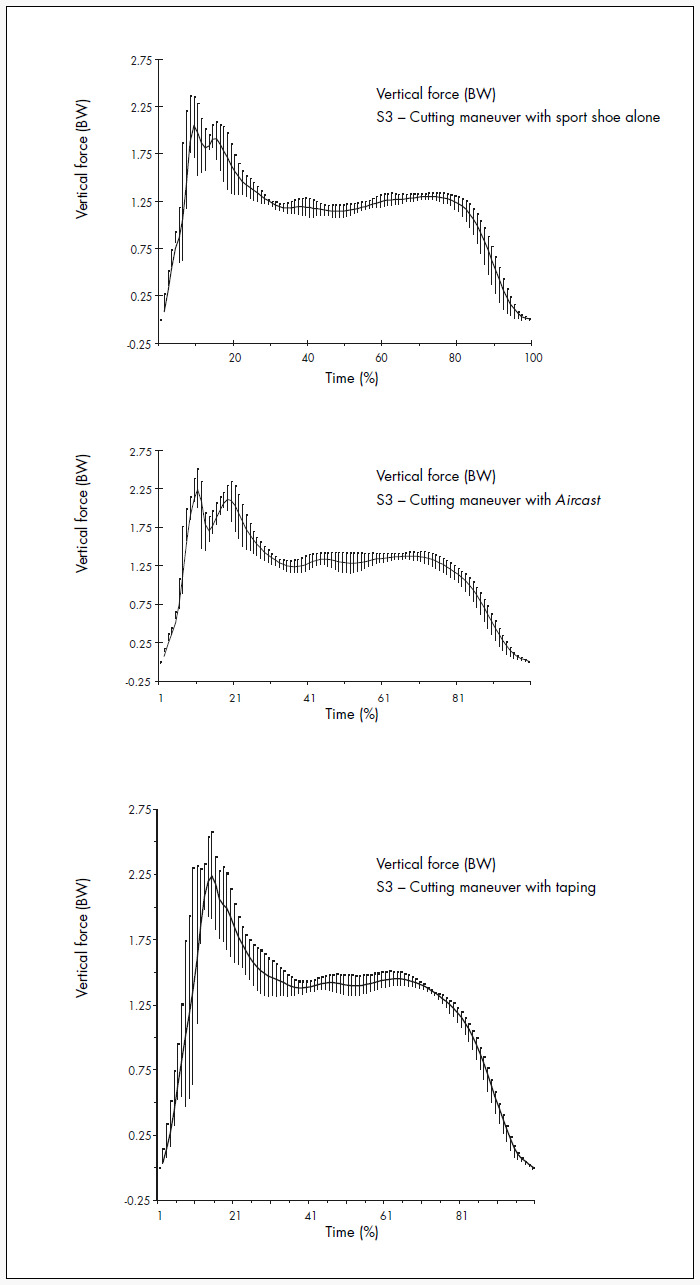
Vertical (Fy) and medial-lateral (Fz) GRF measurements were made under three conditions (taping, Aircast-type orthosis and basketball shoes alone), with analysis of peak forces at foot contact (Fymax1, Fzmax1, Fymax2 and Fzmax2), growth gradient (peak/time) (GG Fymax1, GG Fzmax1, GG Fymax2 and GG Fzmax2) and impulse after foot contact.
Bracing significantly reduced Fymax2 and GG Fymax2. GG Fzmax1 was significantly higher for the sport shoe condition than for the taping condition. Taping increased Fy in relation to the sport shoe at foot contact, but over a longer time interval, without increasing excessive ankle loading. Fz reached a peak in less time, which might generate greater inversion/eversion loading on a player's foot. The Aircast exerted better shock-absorbing effect than did the other two conditions, since it generated less vertical force over longer time intervals and smaller medial-lateral forces in relation to taping.
Ankle bracing and ankle taping action mechanisms are still unclear and therefore should be carefully prescribed. More studies are needed to clarify taping and bracing effects on sporting activities.
在篮球运动中,最常见的损伤是脚踝扭伤。因此,运动员经常使用脚踝外部装置或绷带作为预防和康复措施。本研究的目的是评估篮球运动员在进行典型切入动作时,佩戴和不佩戴脚踝支撑装置及绷带情况下的地面反作用力(GRF)反应。
在圣保罗大学医学院临床医院医学康复科进行的单组重复测量实验设计的比较研究。
在三种条件下(绷带、Aircast型矫形器和仅穿篮球鞋)进行垂直(Fy)和内侧-外侧(Fz)GRF测量,分析足部接触时的峰值力(Fymax1、Fzmax1、Fymax2和Fzmax2)、增长梯度(峰值/时间)(GG Fymax1、GG Fzmax1、GG Fymax2和GG Fzmax2)以及足部接触后的冲量。
支撑显著降低了Fymax2和GG Fymax2。运动鞋条件下的GG Fzmax1显著高于绷带条件。与运动鞋相比,绷带在足部接触时增加了Fy,但作用时间更长,且不会增加脚踝的过度负荷。Fz在更短的时间内达到峰值,这可能会给运动员的脚部带来更大的内翻/外翻负荷。与其他两种条件相比,Aircast的减震效果更好,因为它在更长的时间间隔内产生的垂直力更小,与绷带相比,内侧-外侧力也更小。
脚踝支撑装置和绷带的作用机制仍不清楚,因此应谨慎使用。需要更多的研究来阐明绷带和支撑装置对体育活动的影响。