Tai-Seale Ming, Bramson Rachel, Bao Xiaoming
Department of Health Policy and Management, School of Rural Public Health, Texas A&M Health Science Center, College Station, Texas 77843-1266, USA.
J Gen Intern Med. 2007 Mar;22(3):297-302. doi: 10.1007/s11606-006-0086-z.
A clearly stated clinical decision can induce a cognitive closure in patients and is an important investment in the end of patient-physician communications. Little is known about how often explicit decisions are made in primary care visits.
To use an innovative videotape analysis approach to assess physicians' propensity to state decisions explicitly, and to examine the factors influencing decision patterns.
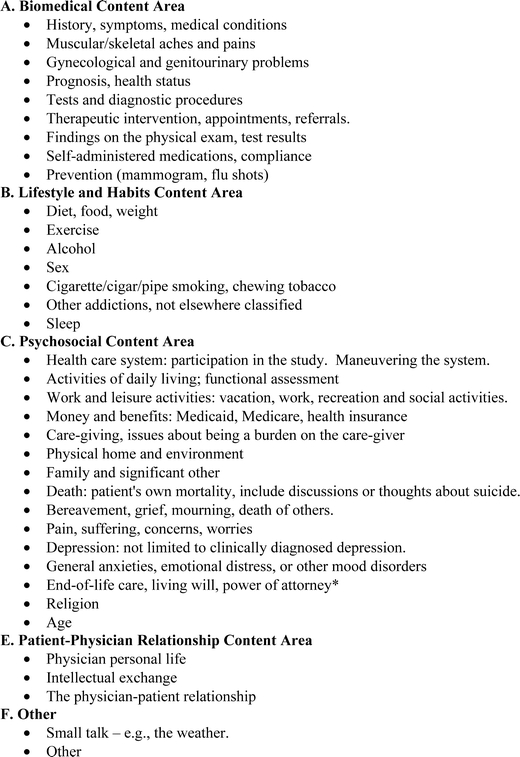
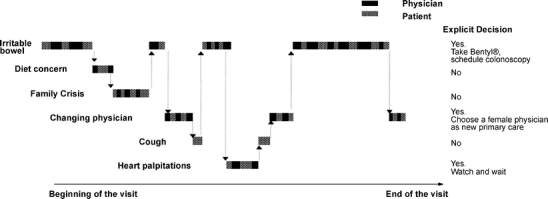
We coded topics discussed in 395 videotapes of primary care visits, noting the number of instances and the length of discussions on each topic, and how discussions ended. A regression analysis tested the relationship between explicit decisions and visit factors such as the nature of topics under discussion, instances of discussion, the amount of time the patient spoke, and competing demands from other topics.
About 77% of topics ended with explicit decisions. Patients spoke for an average of 58 seconds total per topic. Patients spoke more during topics that ended with an explicit decision, (67 seconds), compared with 36 seconds otherwise. The number of instances of a topic was associated with higher odds of having an explicit decision (OR = 1.73, p < 0.01). Increases in the number of topics discussed in visits (OR = 0.95, p < .05), and topics on lifestyle and habits (OR = 0.60, p < .01) were associated with lower odds of explicit decisions.
Although discussions often ended with explicit decisions, there were variations related to the content and dynamics of interactions. We recommend strengthening patients' voice and developing clinical tools, e.g., an "exit prescription," to improving decision making.
明确陈述的临床决策能够促使患者形成认知闭合,是医患沟通结束阶段的一项重要投入。对于在初级保健就诊中明确决策的频率知之甚少。
采用创新的录像带分析方法,评估医生明确陈述决策的倾向,并探究影响决策模式的因素。
我们对395份初级保健就诊录像带中讨论的主题进行编码,记录每个主题的讨论实例数量、讨论时长以及讨论的结束方式。回归分析检验了明确决策与就诊因素之间的关系,这些因素包括正在讨论的主题性质、讨论实例、患者发言时间以及来自其他主题的竞争需求。
约77%的主题以明确决策结束。每个主题患者平均总发言时间为58秒。与未以明确决策结束的主题(36秒)相比,以明确决策结束的主题患者发言更多(67秒)。主题的讨论实例数量与做出明确决策的较高几率相关(比值比=1.73,p<0.01)。就诊中讨论的主题数量增加(比值比=0.95,p<0.05)以及生活方式和习惯主题(比值比=0.60,p<0.01)与做出明确决策的较低几率相关。
尽管讨论通常以明确决策结束,但仍存在与互动内容和动态变化相关的差异。我们建议增强患者的话语权,并开发临床工具,如“出院处方”,以改善决策制定。