García-Pérez Javier, Boldo Elena, Ramis Rebeca, Pollán Marina, Pérez-Gómez Beatriz, Aragonés Nuria, López-Abente Gonzalo
Cancer and Environmental Epidemiology Area, National Centre for Epidemiology, Carlos III Institute of Health, C/Sinesio Delgado, 6, 28029 Madrid, Spain.
BMC Public Health. 2007 Mar 21;7:40. doi: 10.1186/1471-2458-7-40.
Toxic substances released into the environment (to both air and water) by many types of industries might be related with the occurrence of some malignant tumours and other diseases. The publication of the EPER (European Pollutant Emission Register) Spanish data allows to investigate the presence of geographical mortality patterns related to industrial pollution. The aim of this paper is to describe industrial air and water pollution in Spain in 2001, broken down by activity group and specific pollutant, and to plot maps depicting emissions of carcinogenic substances.
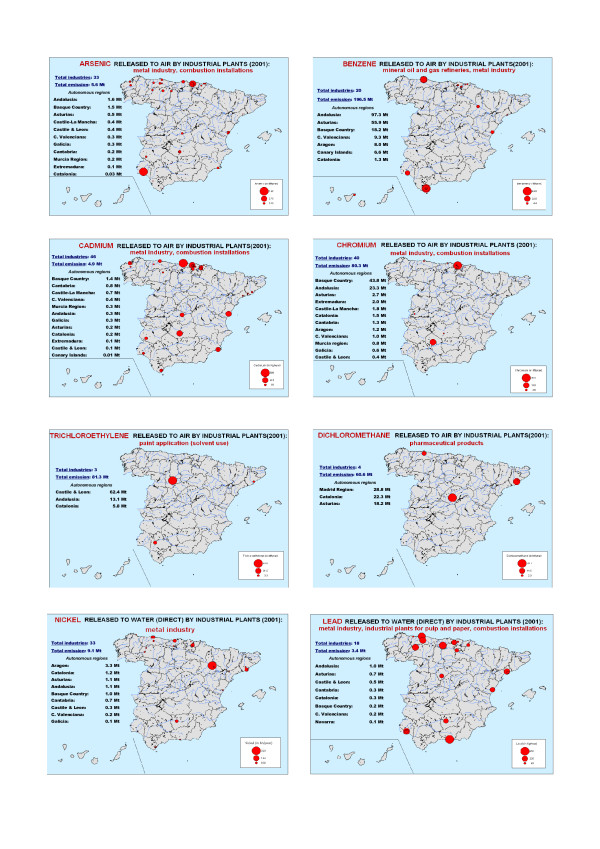
All information on industrial pollution discharge in 2001 was drawn from EPER-Spain public records provided by the European Commission server. We described the distribution of the number of industries and amounts discharged for each pollutant, as well as emission by pollutant group and the industrial activities associated with each pollutant. Maps of Spain were drawn up, with UTM coordinates being used to plot pollutant foci, and circles with an area proportional to the emission to depict pollution emission values.
The EPER-Spain contained information on 1,437 industrial installations. The industrial plants that discharge pollutant substances into air and water above the pollutant-specific EPER threshold were mainly situated in the Autonomous Regions of Aragon, Andalusia and Catalonia and in Catalonia, the Basque Country and Andalusia respectively. Pollution released in 2001 into air approached 158 million Mt. Emissions into water were over 8 million Mt.
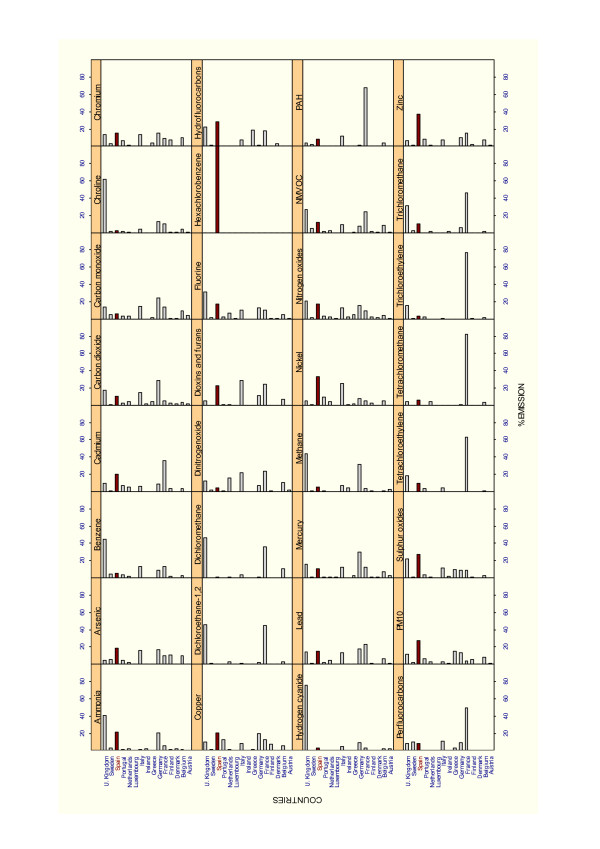
A few single industrial plants are responsible for the highest percentage of emissions, thus rendering monitoring of their possible health impact on the surrounding population that much simpler. Among European countries Spain is the leading polluter in almost one third of all EPER-registered pollutant substances released into the air and ranks among the top three leading polluters in two-thirds of all such substances. Information obtained through publication of EPER data means that the possible consequences of reported pollutant foci on the health of neighbouring populations can now be studied.
许多类型的工业向环境(空气和水)中排放的有毒物质可能与某些恶性肿瘤和其他疾病的发生有关。欧洲污染物排放登记册(EPER)西班牙数据的公布使得能够调查与工业污染相关的地理死亡模式。本文的目的是描述2001年西班牙的工业空气和水污染情况,按活动组和特定污染物进行分类,并绘制描绘致癌物质排放的地图。
2001年所有工业污染排放信息均取自欧盟委员会服务器提供的EPER - 西班牙公共记录。我们描述了各污染物行业数量和排放量的分布情况,以及按污染物组别的排放情况和与每种污染物相关的工业活动。绘制了西班牙地图,使用通用横轴墨卡托(UTM)坐标来绘制污染物源点,并使用面积与排放量成比例的圆圈来描绘污染排放值。
EPER - 西班牙包含1437个工业设施的信息。向空气和水中排放污染物超过特定EPER阈值的工业工厂主要分别位于阿拉贡、安达卢西亚和加泰罗尼亚自治区,以及加泰罗尼亚、巴斯克地区和安达卢西亚。2001年向空气中排放的污染物接近1.58亿吨。向水中排放的污染物超过800万吨。
少数单个工业工厂的排放量占比最高,因此对其可能对周边人群健康产生的影响进行监测要简单得多。在欧洲国家中,西班牙在排放到空气中的所有EPER登记污染物中,几乎三分之一的物质排放量位居首位,在所有此类物质中,三分之二的物质排放量位列前三。通过公布EPER数据获得的信息意味着现在可以研究报告的污染物源点对周边人群健康可能产生的后果。