Laue Michael, Niederwöhrmeier Bärbel, Bannert Norbert
Centre for Biological Safety 4, Robert Koch Institute, Nordufer 20, D-13353 Berlin, Germany.
J Microbiol Methods. 2007 Jul;70(1):45-54. doi: 10.1016/j.mimet.2007.03.006. Epub 2007 Mar 30.
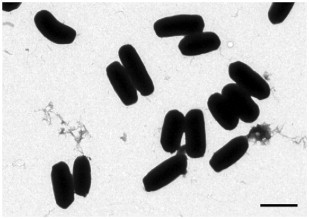
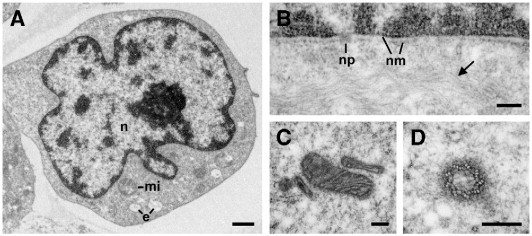
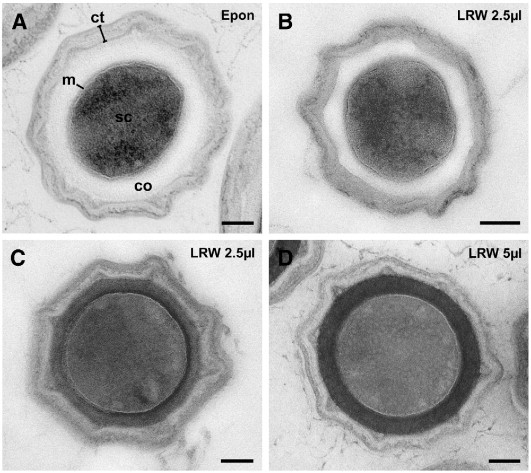
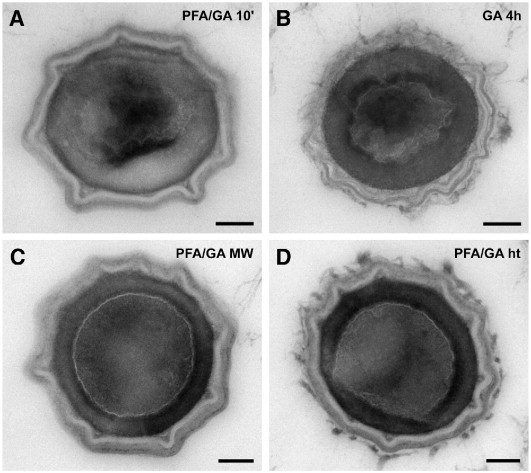
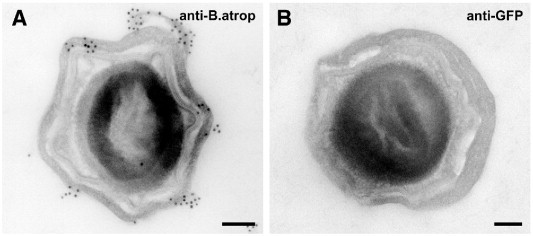
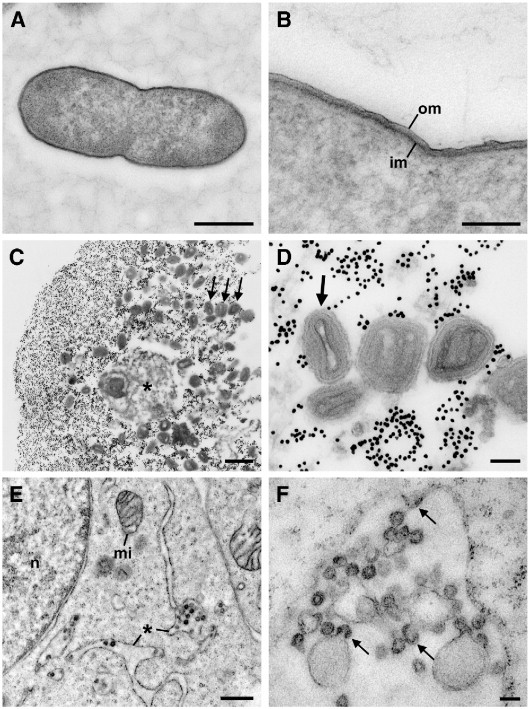
Emerging infectious diseases such as SARS and the bioterror attacks with anthrax spores that occurred after September 11th, 2001 have highlighted the need to be better prepared for the detection and management of infectious pathogens that threaten public health. Negative staining electron microscopy is one method used to screen environmental and clinical samples for relevant infectious pathogens. Unfortunately, bacterial endospores, like those of Bacillus anthracis, are difficult to identify using this method because of their density that prevents imaging of structural details. Thin section electron microscopy would be an alternative method but this usually requires a few days for preparation and diagnosis. In the present paper we describe the development of a rapid thin section protocol, using mainly Bacillus subtilis spores as a model, which allows an unequivocal diagnosis of endospores within 2 h. The protocol involves chemical fixation assisted by heat or microwaves, rapid dehydration, embedding in the low-viscosity resin LR White and chemically enhanced polymerization. Structural preservation of spores is comparable to preservation after standard Epon embedding. Immunolabeling experiments using B. atrophaeus spores and a specific antibody suggest that the protocol preserves significant antigenicity for on-section immunocytochemistry and therefore offers the possibility for the strain typing of spores using specific antibodies. Further experiments with vegetative bacteria, viruses and cell cultures indicate that the rapid thin section protocol not only preserves spores but also other biological structures. Because of its universality and speed the described protocol complements negative staining electron microscopy as a front line method for the morphology-based diagnosis of pathogens in environmental and clinical samples.
诸如严重急性呼吸综合征(SARS)等新出现的传染病以及2001年9月11日之后发生的炭疽芽孢生物恐怖袭击事件凸显了对威胁公共卫生的传染性病原体的检测和管理做好更充分准备的必要性。负染色电子显微镜检查是用于筛查环境和临床样本中相关传染性病原体的一种方法。不幸的是,像炭疽芽孢杆菌的芽孢那样的细菌芽孢,由于其密度会妨碍结构细节成像,所以难以用这种方法识别。超薄切片电子显微镜检查将是一种替代方法,但这通常需要几天时间来制备和诊断。在本文中,我们描述了一种快速超薄切片方案的开发,主要以枯草芽孢杆菌芽孢为模型,该方案能在2小时内明确诊断芽孢。该方案包括加热或微波辅助的化学固定、快速脱水、包埋于低粘度树脂LR White以及化学增强聚合。芽孢的结构保存与标准环氧树脂包埋后的保存效果相当。使用萎缩芽孢杆菌芽孢和特异性抗体进行的免疫标记实验表明,该方案为切片免疫细胞化学保留了显著的抗原性,因此提供了使用特异性抗体对芽孢进行菌株分型的可能性。对营养细菌、病毒和细胞培养物进行的进一步实验表明,快速超薄切片方案不仅能保存芽孢,还能保存其他生物结构。由于其通用性和速度,所描述的方案可作为负染色电子显微镜检查的补充,作为对环境和临床样本中病原体进行基于形态学诊断的一线方法。