Ozbay Yilmaz, Akbulut Mehmet, Balin Mehmet, Kayancicek Hidayet, Baydas Adil, Korkmaz Hasan
Department of Cardiology, School of Medicine, Firat University, 23200 Elaziğ, Turkey.
Mediators Inflamm. 2007;2007:89649. doi: 10.1155/2007/89649. Epub 2006 Dec 27.
BACKGROUND/AIM: Coronary artery ectasia (CAE) was thought of as a variant of atherosclerosis. C-reactive protein (CRP) which is among the most sensitive markers of systemic inflammation, and elevation of systemic and local levels of this inflammatory marker which has been associated with an increased risk for cardiovascular disease in the obstructive coronary artery disease (O-CAD) are well known, but little was known in CAE. The anti-inflammatory effects of statins and the effect of angiotensin-converting enzyme (ACE) inhibitors on endothelial dysfunction are well established in atherosclerosis. The aim of the present study was to investigate CRP level and its response to statin and ACE inhibitor treatment in CAE.
We measured serum hs-CRP level in 40 CAE (26 males, mean age: 56.32 +/- 9 years) and 41 O-CAD (34 males, mean age: 57.19 +/- 10 years) patients referred for elective coronary angiography at baseline and after 3-month statin and ACE inhibitor treatment.
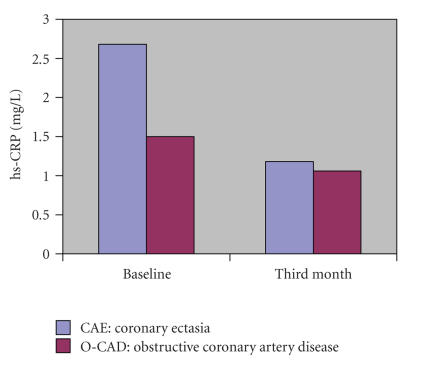
Plasma hs-CRP levels were significantly higher in CAE group than O-CAD group at baseline (2.68 +/- 66 mg/L versus 1, 64 +/- 64, resp., P < .0001). Plasma hs-CRP levels significantly decreased from baseline 3 months later in the CE (from 2.68 +/- 0.66 mg/L to 1.2 +/- 0.53 mg/L, P < .0001) as well as in the O-CAD group (from 1.64 +/- 0.64 mg/L to 1.01 +/- 0.56 mg/L, P < .001).
We think that hs-CRP measurement may be a good prognostic value in CAE patients as in stenotic ones. Further placebo-controlled studies are needed to evaluate the clinical significance of this decrease in hs-CRP.
背景/目的:冠状动脉扩张(CAE)曾被认为是动脉粥样硬化的一种变体。C反应蛋白(CRP)是全身炎症最敏感的标志物之一,在阻塞性冠状动脉疾病(O-CAD)中,这种炎症标志物的全身和局部水平升高与心血管疾病风险增加相关,这是众所周知的,但在CAE中却知之甚少。他汀类药物的抗炎作用以及血管紧张素转换酶(ACE)抑制剂对内皮功能障碍的作用在动脉粥样硬化中已得到充分证实。本研究的目的是调查CAE患者中CRP水平及其对他汀类药物和ACE抑制剂治疗的反应。
我们测量了40例CAE患者(26例男性,平均年龄:56.32±9岁)和41例O-CAD患者(34例男性,平均年龄:57.19±10岁)在基线时以及接受3个月他汀类药物和ACE抑制剂治疗后的血清高敏CRP(hs-CRP)水平。
在基线时,CAE组的血浆hs-CRP水平显著高于O-CAD组(分别为2.68±0.66mg/L和1.64±0.64mg/L,P<.0001)。3个月后,CAE组(从2.68±0.66mg/L降至1.2±0.53mg/L,P<.0001)以及O-CAD组(从1.64±0.64mg/L降至1.01±0.56mg/L,P<.001)的血浆hs-CRP水平均较基线时显著降低。
我们认为,与狭窄性病变患者一样,hs-CRP检测对CAE患者可能具有良好的预后价值。需要进一步进行安慰剂对照研究以评估hs-CRP水平降低的临床意义。