Carneiro Ilona A, Drakeley Chris J, Owusu-Agyei Seth, Mmbando Bruno, Chandramohan Daniel
Department of Infectious & Tropical Diseases, London School of Hygiene & Tropical Medicine, Keppel Street, London, UK.
Malar J. 2007 May 22;6:67. doi: 10.1186/1475-2875-6-67.
Anaemic status is determined by haemoglobin using the HemoCue system or haematocrit measurements, and a threefold conversion is commonly used to equate the two measures (haemoglobin = haematocrit/3). The validity of this conversion in malaria endemic settings was assessed.
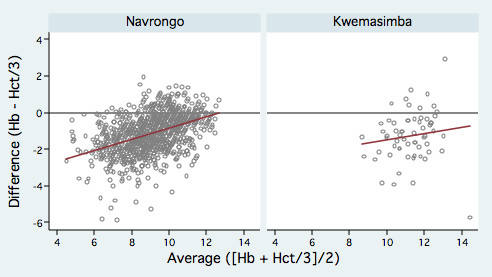
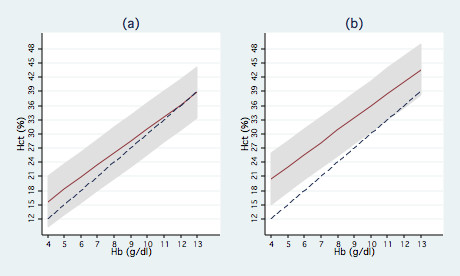
Concurrent measures of haemoglobin and centrifuged haematocrit in children aged 6-59 months were compared by modelling the difference between the two measures against their average. A random effects linear regression of the difference of the measures on their average was used to describe the line of best agreement and 95% limits of agreement for these two measures over a range of values after adjusting for statistically significant covariates.
There was a consistent bias between the two measures, with haemoglobin less than haematocrit/3 in 87% (899/1,030) of observations. This difference was non-uniform, decreasing with the average measure, i.e. less difference at higher haemoglobin and haematocrit values. In these studies, use of haematocrit would have underestimated the prevalence of anaemia by misclassifying 10% (89/920) of individuals with haemoglobin < 11 g/dl, 66% (252/380) of individuals with haemoglobin < 8 g/dl and 100% (23/23) of individuals with haemoglobin < 5 g/dl. The mean difference between the measures was greater in males than females, increased with age between 6-59 months, and was greater in the wet than dry season suggesting that the relationship between haemoglobin and haematocrit may be modified by exposure to malaria.
The regression model indicated that the standard threefold conversion from haematocrit to haemoglobin underestimates the prevalence of haemoglobin < 11 g/dl in children under five years of age in malaria endemic settings. This bias was more acute for more severe anaemia defined by haemoglobin < 8 g/dl and haemoglobin < 5 g/dl. This has important implications for the comparability of studies using these different measures. Direct determination of haemoglobin should be the measurement of choice for assessing anaemia outcomes in malaria intervention trials and surveys.
贫血状态通过使用HemoCue系统测定血红蛋白或测量血细胞比容来确定,通常采用三倍换算来使这两种测量方法等效(血红蛋白 = 血细胞比容/3)。评估了这种换算在疟疾流行地区的有效性。
通过对6至59个月儿童的血红蛋白和离心后的血细胞比容进行同步测量,将两种测量值之间的差异与其平均值进行建模比较。在调整具有统计学意义的协变量后,使用测量值差异对其平均值的随机效应线性回归来描述这两种测量方法在一系列值范围内的最佳拟合线和95%一致性界限。
两种测量方法之间存在一致的偏差,在87%(899/1030)的观察结果中,血红蛋白低于血细胞比容/3。这种差异并不均匀,随着平均值的增加而减小,即在较高的血红蛋白和血细胞比容值时差异较小。在这些研究中,使用血细胞比容会低估贫血患病率,因为会将10%(89/920)血红蛋白<11 g/dl的个体、66%(252/380)血红蛋白<8 g/dl的个体和100%(23/23)血红蛋白<5 g/dl的个体误分类。男性的测量值平均差异大于女性,在6至59个月之间随年龄增加,且雨季大于旱季,这表明血红蛋白与血细胞比容之间的关系可能会因接触疟疾而改变。
回归模型表明,在疟疾流行地区,从血细胞比容到血红蛋白的标准三倍换算低估了五岁以下儿童血红蛋白<11 g/dl的患病率。对于由血红蛋白<8 g/dl和血红蛋白<5 g/dl定义的更严重贫血,这种偏差更为明显。这对使用这些不同测量方法的研究的可比性具有重要意义。在疟疾干预试验和调查中,直接测定血红蛋白应是评估贫血结果的首选测量方法。