Srivatsan Malathi
Department of Biological Sciences, Arkansas State University, Jonesboro, AR 72401, USA.
Bioinformation. 2006 Dec 6;1(8):281-4. doi: 10.6026/97320630001281.
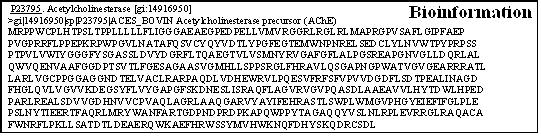
The enzyme acetylcholinesterase (AChE) which belongs to the family of alpha/beta hydrolases is well known for hydrolyzing the neurotransmitter acetylcholine (ACh). In addition to its catalytic function, AChE appears to play a significant non-catalytic role in development, regeneration and modulation of properties of neurons. However the mechanisms underlying these important actions of AChE are unknown. It prompted the analysis of the sequence of fetal bovine serum AChE to seek clue(s) for the mechanisms of AChE non-catalytic actions. The searches for motifs, finger prints and domains demonstrated the presence of a highly conserved carboxylesterase type B signature in AChE from slime molds to human. Interestingly, the presence of finger prints for a metabotropic glutamate receptor, gap junction protein connexin, a calcium binding motif, several phosphorylation sites, and a motif similar to nicotinic acetylcholine receptor were also found in the sequence of AChE suggesting a role for AChE in cell signalling. The similarity search using gapped BLAST retrieved previously known similar proteins, namely neurotactin, neuroligin and thyroglobulin. When aligned neurotactin, neuroligin and bovine AChE showed the presence of three stretches of consensus, one of which is carboxylesterase B signature. The identity of the other two are not known. Amino acids in these stretches in AChE may be involved in possible growth factor like action and awaits experimental verification. Thus sequence analysis can be very useful for biologists while searching for a possible mechanism of action of a protein. Further, these results underscore the significance of performing both local and global searches to identify possible functional domains as well as consensus sequence.
属于α/β水解酶家族的乙酰胆碱酯酶(AChE)因能水解神经递质乙酰胆碱(ACh)而广为人知。除了其催化功能外,AChE在神经元的发育、再生和特性调节中似乎还发挥着重要的非催化作用。然而,AChE这些重要作用的潜在机制尚不清楚。这促使人们对胎牛血清AChE的序列进行分析,以寻找AChE非催化作用机制的线索。对基序、指纹和结构域的搜索表明,从黏菌到人类的AChE中都存在高度保守的B型羧酸酯酶特征。有趣的是,在AChE序列中还发现了代谢型谷氨酸受体、间隙连接蛋白连接蛋白、钙结合基序、几个磷酸化位点以及与烟碱型乙酰胆碱受体相似的基序的指纹,这表明AChE在细胞信号传导中发挥作用。使用带空位的BLAST进行的相似性搜索检索到了先前已知的相似蛋白质,即神经触蛋白、神经连接蛋白和甲状腺球蛋白。当对神经触蛋白、神经连接蛋白和牛AChE进行比对时,发现存在三段共有序列,其中一段是羧酸酯酶B特征。另外两段的身份尚不清楚。AChE中这些序列中的氨基酸可能参与了类似生长因子的作用,有待实验验证。因此,序列分析对于生物学家寻找蛋白质可能的作用机制非常有用。此外,这些结果强调了进行局部和全局搜索以识别可能的功能结构域以及共有序列的重要性。