Neuman Robert B, Bloom Heather L, Shukrullah Irfan, Darrow Lyndsey A, Kleinbaum David, Jones Dean P, Dudley Samuel C
Division of Cardiology, Department of Medicine, Emory University School of Medicine, Atlanta, GA, USA.
Clin Chem. 2007 Sep;53(9):1652-7. doi: 10.1373/clinchem.2006.083923. Epub 2007 Jun 28.
Atrial fibrillation (AF) has been associated with myocardial oxidative stress, and antioxidant agents have demonstrated antiarrhythmic benefit in humans. We compared serum markers of oxidation and associated inflammation in individuals with or without AF.
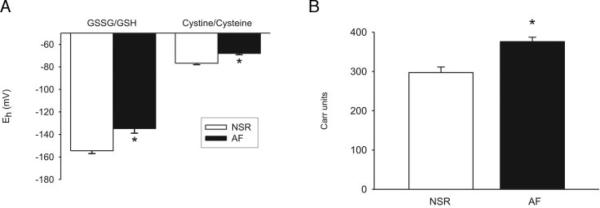
Serum markers of oxidative stress and inflammation were compared in a cross-sectional, case-control design study of 40 male individuals, with or without persistent or permanent AF, who were matched for age, sex, diabetes, and smoking status, known confounding variables for the measurement of oxidative stress. We used derivatives of reactive oxidative metabolites (DROMs) and ratios of oxidized to reduced glutathione (E(h) GSH) and cysteine (E(h) CySH) to quantify oxidative stress. We also measured inflammatory markers, including high-sensitivity C-reactive protein, interleukins 1beta and 6, and tumor necrosis factor alpha.
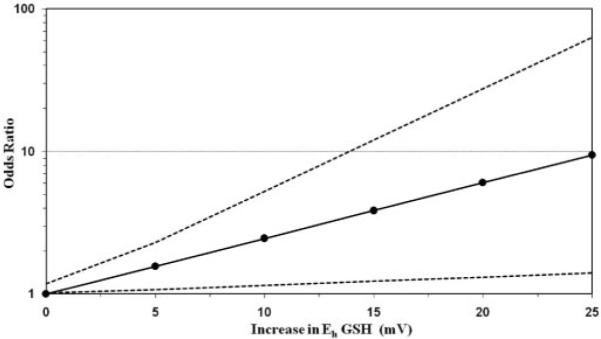
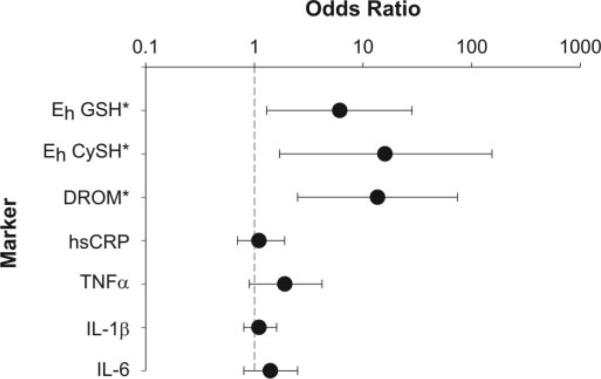
Univariate, conditional logistical regression analysis showed that oxidative stress but not inflammatory markers were statistically associated with AF (P <0.05). The increase in the odds ratios for AF for E(h) GSH, E(h) CySH, and DROMs were 6.1 (95% CI, 1.3-28.3; P = 0.02), 13.6 (95% CI, 2.5-74.1; P = 0.01), and 15.9 (95% CI, 1.7-153.9; P = 0.02), respectively. There was a stronger correlation between E(h) GSH and E(h) CySH (r = 0.66) than between E(h) GSH and DROMs (r = 0.41). In multivariate analysis corrected for statins and other AF risk factors differing between the groups, the association of AF and oxidative stress remained significant.
These data suggest that oxidative stress markers may have predictive value in AF management.
心房颤动(AF)与心肌氧化应激有关,抗氧化剂已在人体中显示出抗心律失常的益处。我们比较了有或没有AF的个体的氧化血清标志物及相关炎症。
在一项横断面病例对照设计研究中,比较了40名男性个体(有或没有持续性或永久性AF)的氧化应激和炎症血清标志物,这些个体在年龄、性别、糖尿病和吸烟状况方面相匹配,而这些是已知的氧化应激测量的混杂变量。我们使用活性氧化代谢产物衍生物(DROMs)以及氧化型谷胱甘肽与还原型谷胱甘肽(E(h)GSH)和半胱氨酸(E(h)CySH)的比率来量化氧化应激。我们还测量了炎症标志物,包括高敏C反应蛋白、白细胞介素1β和6以及肿瘤坏死因子α。
单因素条件逻辑回归分析表明,氧化应激而非炎症标志物与AF在统计学上相关(P<0.05)。E(h)GSH、E(h)CySH和DROMs的AF比值比增加分别为6.1(95%CI,1.3 - 28.3;P = 0.02)、13.6(95%CI,2.5 - 74.1;P = 0.01)和15.9(95%CI,1.7 - 153.9;P = 0.02)。E(h)GSH与E(h)CySH之间的相关性(r = 0.66)比E(h)GSH与DROMs之间的相关性(r = 0.41)更强。在针对他汀类药物和其他两组间不同的AF危险因素进行校正的多因素分析中,AF与氧化应激的关联仍然显著。
这些数据表明氧化应激标志物可能在AF管理中具有预测价值。