Straub Stephen V, Nelson Mark T
Department of Pharmacology, University of Vermont, Burlington, VT 05405, USA.
Trends Cardiovasc Med. 2007 Aug;17(6):183-90. doi: 10.1016/j.tcm.2007.05.001.
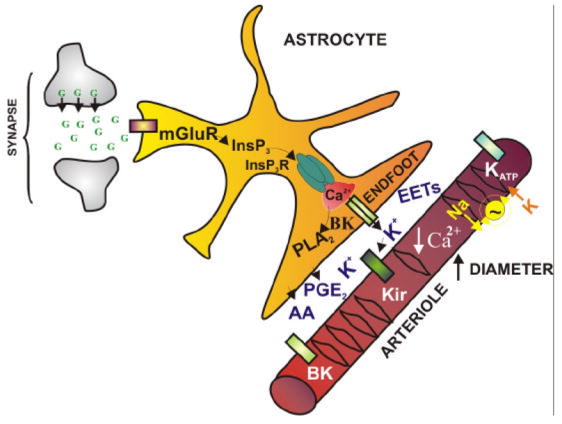
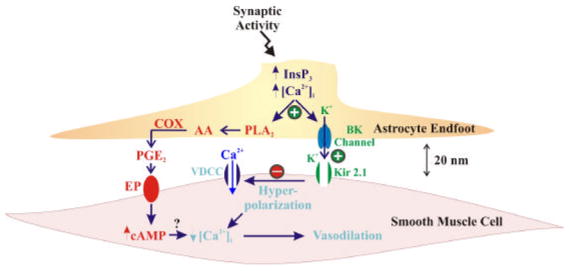
In the brain, increased neuronal synaptic activity is accompanied by an increase in local cerebral blood flow that serves to satisfy neuronal metabolic demands. This linkage between neuronal activity and local blood flow has been appreciated for more than 100 years. Although this process has been exploited clinically in the form of functional imaging techniques to map brain function, the mechanisms by which increased synaptic activity is communicated to the cerebral microcirculation to generate a vasodilatory response are poorly understood. Recent studies, however, have illuminated a central role for astrocytic calcium (Ca(2+)) signals as mediators of this process of neurovascular coupling. This review highlights recent evidence implicating astrocytes in the regulation of intracerebral arteriolar diameter, with particular emphasis on the putative signaling molecules and pathways proposed to exert changes on arteriolar physiology.
在大脑中,神经元突触活动的增加伴随着局部脑血流量的增加,这有助于满足神经元的代谢需求。这种神经元活动与局部血流之间的联系已被认识超过100年。尽管这一过程已在临床上以功能成像技术的形式被用于绘制脑功能图,但突触活动增加是如何传递到脑微循环以产生血管舒张反应的机制却知之甚少。然而,最近的研究揭示了星形胶质细胞钙(Ca(2+))信号作为神经血管耦合这一过程的介质所起的核心作用。本综述重点介绍了近期有关星形胶质细胞参与调节脑内小动脉直径的证据,特别强调了推测的信号分子和途径,这些信号分子和途径被认为会对小动脉生理学产生影响。