Volkers Anita C, Westert Gert P, Schellevis Francois G
NIVEL (Netherlands Institute for Health Services Research), Utrecht, The Netherlands.
BMC Public Health. 2007 Aug 8;7:196. doi: 10.1186/1471-2458-7-196.
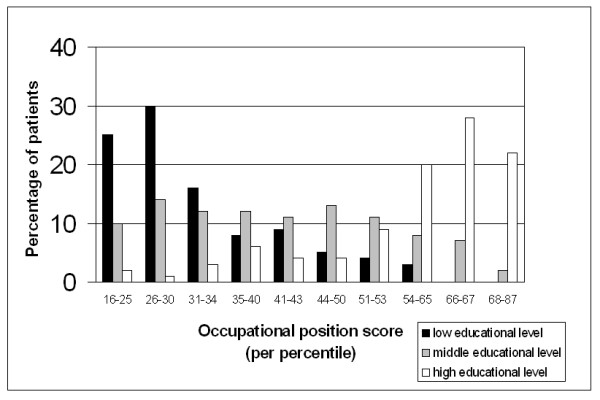
Socio-economic disparities in health status are frequently reported in research. By comparison with education and income, occupational status has been less extensively studied in relation to health status or the occurrence of specific chronic diseases. The aim of this study was to investigate health disparities in the working population based on occupational position and how they were modified by education.
Our data were derived from the National Survey of General Practice that comprised 104 practices in the Netherlands. 136,189 working people aged 25-64 participated in the study. Occupational position was assessed by the International Socio-Economic Index of occupational position (ISEI). Health outcomes were self-perceived health status and physician-diagnosed diseases. Odds ratios were estimated using multivariate logistic regression analysis.
The lowest occupational position was observed to be associated with poor health in men (OR = 1.6, 95% CI 1,5 to 1.7) and women (OR = 1.3, 95% CI 1.2 to 1.4). The risk of poor health gradually decreased in relation to higher occupational positions. People with the lowest occupational positions were more likely to suffer from depression, diabetes, ischaemic heart disease, arthritis, muscle pain, neck and back pain and tension headache, in comparison to people with the highest occupational position (OR 1.2 to 1.6). A lower educational level induced an additional risk of poor health and disease. We found that gender modified the effects on poor health when both occupational position and education were combined in the analysis.
A low occupational position was consistently associated working people with poor health and physician-diagnosed morbidity. However a low educational level was not. Occupational position and education had a combined effect on self-perceived health, which supports the recent call to improve the conceptual framework of health disparities.
研究中经常报道健康状况方面的社会经济差异。与教育和收入相比,职业地位与健康状况或特定慢性病发生之间的研究较少。本研究的目的是基于职业地位调查劳动人口中的健康差异,以及教育如何对这些差异产生影响。
我们的数据来自荷兰全国综合医疗调查,该调查涵盖了104家医疗机构。136189名年龄在25 - 64岁的劳动者参与了这项研究。职业地位通过国际职业社会经济指数(ISEI)进行评估。健康结果包括自我感知的健康状况和医生诊断的疾病。使用多变量逻辑回归分析估计比值比。
在男性(OR = 1.6,95% CI 1.5至1.7)和女性(OR = 1.3,95% CI 1.2至1.4)中,最低职业地位与健康状况不佳相关。随着职业地位升高,健康状况不佳的风险逐渐降低。与最高职业地位的人相比,最低职业地位的人更易患抑郁症、糖尿病、缺血性心脏病、关节炎、肌肉疼痛、颈背痛和紧张性头痛(OR 1.2至1.6)。较低的教育水平会带来额外的健康状况不佳和患病风险。我们发现,在分析中将职业地位和教育结合起来时,性别会改变对健康状况不佳的影响。
低职业地位一直与劳动者健康状况不佳和医生诊断的发病率相关。然而,低教育水平并非如此。职业地位和教育对自我感知的健康有综合影响,这支持了最近改善健康差异概念框架的呼吁。