Tae Hongseok, Kong Eun-Bae, Park Kiejung
Information Technology Institute, SmallSoft Co., Ltd., Jang-Dong 59-5, Yusung-Gu, Daejeon 305-343, South Korea.
BMC Bioinformatics. 2007 Sep 3;8:327. doi: 10.1186/1471-2105-8-327.
Polyketides are secondary metabolites of microorganisms with diverse biological activities, including pharmacological functions such as antibiotic, antitumor and agrochemical properties. Polyketides are synthesized by serialized reactions of a set of enzymes called polyketide synthase(PKS)s, which coordinate the elongation of carbon skeletons by the stepwise condensation of short carbon precursors. Due to their importance as drugs, the volume of data on polyketides is rapidly increasing and creating a need for computational analysis methods for efficient polyketide research. Moreover, the increasing use of genetic engineering to research new kinds of polyketides requires genome wide analysis.
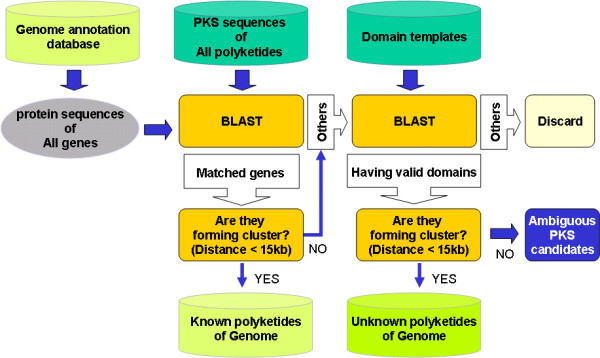
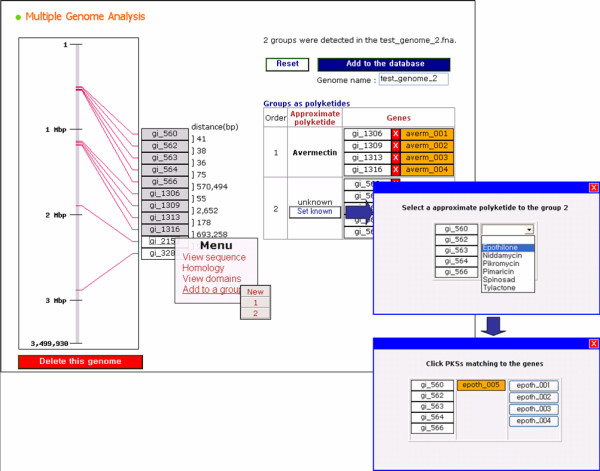
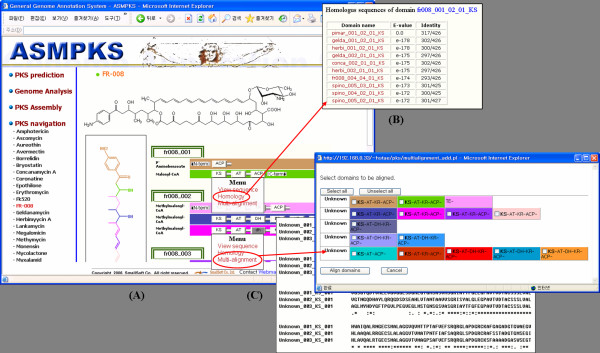
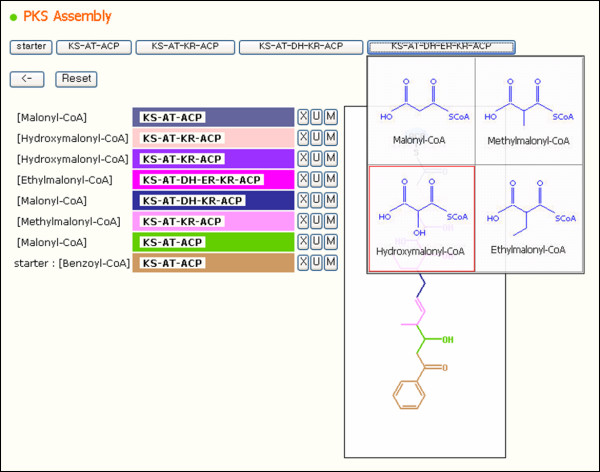
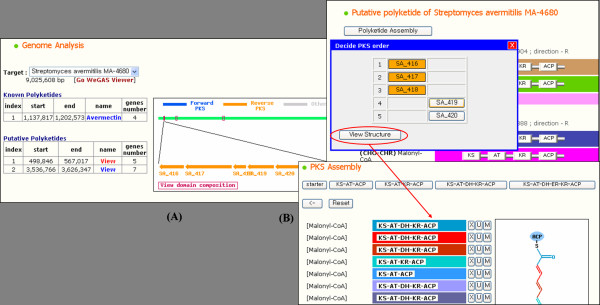
We describe a system named ASMPKS (Analysis System for Modular Polyketide Synthesis) for computational analysis of PKSs against genome sequences. It also provides overall management of information on modular PKS, including polyketide database construction, new PKS assembly, and chain visualization. ASMPKS operates on a web interface to construct the database and to analyze PKSs, allowing polyketide researchers to add their data to this database and to use it easily. In addition, the ASMPKS can predict functional modules for a protein sequence submitted by users, estimate the chemical composition of a polyketide synthesized from the modules, and display the carbon chain structure on the web interface.
ASMPKS has powerful computation features to aid modular PKS research. As various factors, such as starter units and post-processing, are related to polyketide biosynthesis, ASMPKS will be improved through further development for study of the factors.
聚酮化合物是微生物的次级代谢产物,具有多种生物活性,包括抗生素、抗肿瘤和农用化学品等药理功能。聚酮化合物由一组称为聚酮合酶(PKS)的酶通过一系列反应合成,这些酶通过短碳前体的逐步缩合来协调碳骨架的延伸。由于它们作为药物的重要性,聚酮化合物的数据量正在迅速增加,因此需要计算分析方法来进行高效的聚酮化合物研究。此外,越来越多地使用基因工程来研究新型聚酮化合物需要进行全基因组分析。
我们描述了一个名为ASMPKS(模块化聚酮化合物合成分析系统)的系统,用于针对基因组序列对聚酮合酶进行计算分析。它还提供了关于模块化聚酮合酶信息的全面管理,包括聚酮化合物数据库构建、新的聚酮合酶组装和链可视化。ASMPKS通过网络界面运行以构建数据库并分析聚酮合酶,使聚酮化合物研究人员能够将他们的数据添加到该数据库并轻松使用它。此外,ASMPKS可以预测用户提交的蛋白质序列的功能模块,估计由这些模块合成的聚酮化合物的化学成分,并在网络界面上显示碳链结构。
ASMPKS具有强大的计算功能,有助于模块化聚酮合酶的研究。由于起始单元和后处理等各种因素与聚酮化合物的生物合成有关,ASMPKS将通过进一步开发来研究这些因素而得到改进。