Zheng Pinpin, Guo Fengxia, Chen Yue, Fu Yingying, Ye Tingting, Fu Hua
School of Public Health, Fudan University, Shanghai, People's Republic of China.
J Epidemiol. 2007 Sep;17(5):147-55. doi: 10.2188/jea.17.147.
New training programs need to be developed to help Chinese smokers achieve quitting. The objective of this study was to assess the effectiveness of a group smoking cessation intervention based on social cognitive theory among Chinese smokers.
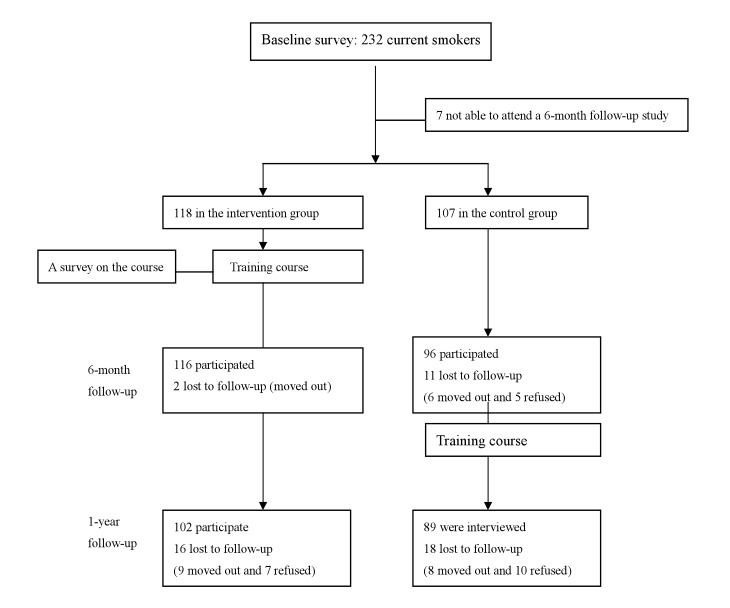
A total of 225 smokers were eligible for the study and were randomly assigned to an intervention group (n=118) and a control group (n=107). The intervention group received the course soon after a baseline survey, whereas the control group received routine training in the first 6 months, and then took the same course. Effectiveness was evaluated at 6-month and 1-year follow-up from baseline.
After 6 months, 40.5% (47/116) in the intervention group and 5.0% (5/101) in the control group quit smoking (absolute risk reduction: 35.5% [95% confidence interval (CI): 24.2-46.8%]). The 6-month continuous abstinence rate was 28.4% (33/116) in the intervention group and 3.0% (3/101) in the control group (absolute risk reduction 25.4% [95% CI: 15.6-35.2%]). At 1-year follow-up, the proportion of quitting and the 6-month abstinence rate in the intervention group were 35.8% and 22.0%, respectively. The factors associated with smoking cessation during the 6 month period were intervention (adjusted odds ratio [OR]=6.42 [95% CI: 2.46-13.28]), as well as anticipation of quitting (adjusted OR=1.46 [95% CI: 1.12-1.91]) and skill self-efficacy score in the baseline (adjusted OR=1.04 [95% CI: 1.01-1.07]). The same intervention was conducted in the control group after the 6-month study, in which a similar intervention effect was observed.
A smoking cessation intervention based on social cognitive theory among Chinese smokers is highly effective.
需要开发新的培训项目来帮助中国吸烟者戒烟。本研究的目的是评估基于社会认知理论的团体戒烟干预对中国吸烟者的有效性。
共有225名吸烟者符合研究条件,被随机分为干预组(n = 118)和对照组(n = 107)。干预组在基线调查后不久接受课程,而对照组在前6个月接受常规培训,然后参加相同的课程。从基线开始在6个月和1年随访时评估有效性。
6个月后,干预组40.5%(47/116)的吸烟者戒烟,对照组为5.0%(5/101)(绝对风险降低:35.5%[95%置信区间(CI):24.2 - 46.8%])。干预组6个月持续戒烟率为28.4%(33/116),对照组为3.0%(3/101)(绝对风险降低25.4%[95%CI:15.6 - 35.2%])。在1年随访时,干预组的戒烟比例和6个月戒烟率分别为35.8%和22.0%。6个月期间与戒烟相关的因素是干预(调整后的优势比[OR]=6.42[95%CI:2.46 - 13.28]),以及戒烟预期(调整后的OR = 1.46[95%CI:1.12 - 1.91])和基线时的技能自我效能得分(调整后的OR = 1.04[95%CI:1.01 - 1.07])。6个月研究结束后,对照组进行了相同的干预,观察到了类似的干预效果。
基于社会认知理论的戒烟干预对中国吸烟者非常有效。